Dinero Now Live & Verified on Portals: A Guide to Two-Token Liquid Restaking
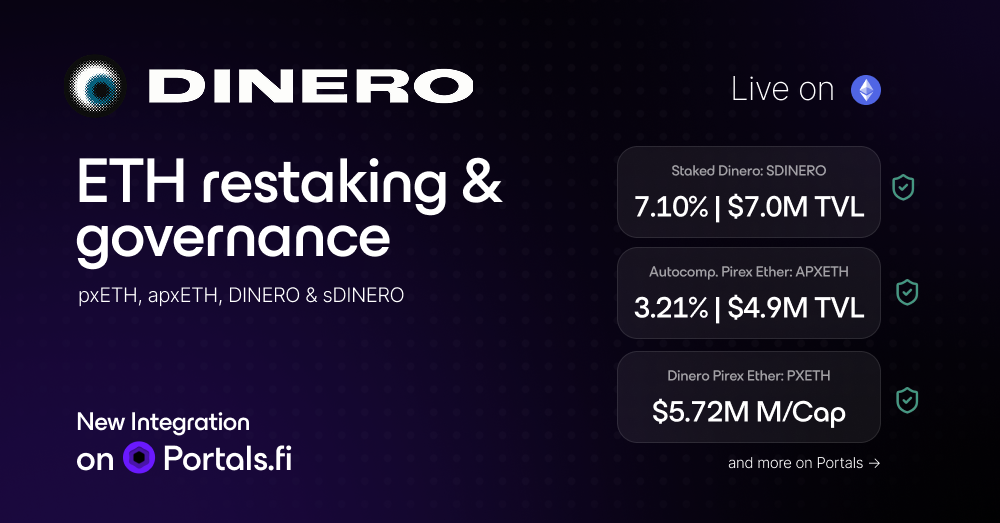
Positions from the Dinero ecosystem are live on the Portals Explorer, where users can browse them alongside opportunities from across DeFi.
This article reflects the status of the integration described as of the publication date. Supported positions and protocols can be removed from public access, deprecated, or otherwise changed at any time after this article is posted. Portals does not undertake to update this article when that happens. The current status of any position can be checked on the Portals Explorer.
This article walks through what Dinero is, how its core products work, and where it fits in the broader DeFi landscape.
What Dinero is
Dinero is the successor to Redacted Cartel, repositioned as a suite of products centred on Ethereum yield infrastructure.
The team frames the protocol as a yield base-plate: a foundational layer that scales staking, execution-layer, and restaking yield for users and other protocols.
The core product set today includes pxETH and apxETH, a two-token liquid staking and restaking pair, plus an in-development collateral-backed stablecoin (pxUSD) and a permissionless transaction relayer that pays gas on behalf of users.
How pxETH and apxETH work
Liquid staking and restaking are among the largest categories in DeFi. Users want exposure to ETH staking yield without locking the capital outright, and they want a tradable token they can use elsewhere. Most designs combine those two needs into a single token. Dinero splits them.
pxETH is the liquidity-side token. It is minted 1:1 against ETH deposited into the protocol and is intended to be used freely across DeFi: as collateral, as a trading asset, as a building block in other strategies. The yield produced by the underlying staking infrastructure does not accrue to pxETH directly.
apxETH is the yield-side token. It is an ERC-4626 vault that accepts pxETH and issues apxETH share tokens that grow in value as the vault auto-compounds the yield stream. The stream includes consensus rewards, execution-layer MEV and tips, and EigenCloud restaking yield, which is built directly into the protocol architecture.
The two-token split has a useful side effect for the rest of DeFi. Because the yield is concentrated in apxETH, integrations that need a stable, non-rebasing peg can use pxETH cleanly without having to model accruing yield. apxETH then carries the yield in a single, well-defined wrapper.
Other parts of the Dinero stack
Beyond the LRT pair, Dinero is building two other primitives that share the same base.
pxUSD is a collateral-backed stablecoin that uses Dinero-issued yield-bearing assets as backing. The intent is to turn the staking yield from apxETH into something that, when the user borrows against it, partially offsets or fully repays the loan over time.
The relayer is a permissionless service that lets users transact without holding ETH for gas. The relayer pays the gas on the user's behalf, removing one of the standard onboarding frictions in Ethereum DeFi.
What problems does Dinero solve?
Liquid staking and restaking are solved problems in the broad sense. There are dozens of LSTs and LRTs across Ethereum. What Dinero is doing differently sits at the design level rather than the user level.
Splitting the liquid token from the yield token is intended to make pxETH more useful as a money lego. A non-rebasing, yield-free liquid token is easier to integrate into AMMs, money markets, and structured products without complicating accounting on the integrating side. apxETH then preserves all of the yield in a single, ERC-4626-shaped wrapper that is also easy to compose with.
Notable features
A few things stand out about Dinero relative to other LRT suites:
- Two-token LRT design. Cleanly separates liquidity and yield, which makes downstream integrations simpler.
- ERC-4626 yield vault. apxETH conforms to the standard tokenised vault interface, so any protocol that supports 4626 vaults can support apxETH with minimal additional work.
- Permissionless relayer. Removes the requirement to hold ETH for gas before interacting with the protocol.
- Continuity from Redacted. The team carries forward governance and tokenomics infrastructure built up over the prior cycle.
Risks worth understanding
Dinero's products inherit the standard risk surface of Ethereum DeFi. Smart contract risk applies at the protocol level.
Liquid staking tokens carry the underlying validator risk of the Ethereum staking infrastructure, plus any specific operator or slashing exposure introduced by the protocol's staking design.
apxETH, as an ERC-4626 vault, has the additional wrapper-layer risk that comes with any vaulted yield product. Because apxETH's yield stream includes EigenCloud restaking, holders carry the additional slashing surface of any AVSs the protocol opts into.
pxUSD, when launched, will carry the additional risk surface of a collateral-backed stablecoin, including peg risk and collateral liquidation dynamics.
None of this is unique to Dinero. It is the standard risk surface of liquid staking, restaking, and stablecoin issuance in DeFi.
Where Dinero fits in DeFi
Dinero occupies a specific position in the Ethereum yield stack. It is not trying to be the largest LRT by deposits, nor is it competing on validator economics. It is building infrastructure that other protocols can plug into: a clean liquid token, a clean yield-bearing wrapper, a stablecoin that closes the loop on borrowing against staked ETH, and a relayer that smooths out the user-experience friction at the edges.
For a Portals user browsing the Explorer, Dinero adds a two-token split that most LST and LRT suites do not offer: a liquid building block on one side, an auto-compounding restaking wrapper on the other.
Dinero via Portals.fi
Portals.fi is a DeFi aggregation platform that surfaces curated yield positions across major protocols through a unified interface.
Users exploring Dinero can find supported positions on the Portals Explorer alongside opportunities from other protocols, accessible from a single access point.
For more information about how Portals.fi works, visit portals.fi.
This article is for informational purposes only and does not constitute financial advice. DeFi protocols carry inherent risks including smart contract vulnerabilities, validator and slashing risk, vault-layer risk, stablecoin peg risk, and variable yield. Information in this article is current as of the publication date and may not reflect later changes to the protocol or its products. Always conduct your own research before interacting with any protocol. For our full disclaimer, please visit here.
Portals.fi Blog Newsletter
Join the newsletter to receive the latest updates in your inbox.