Royco Dawn Now Live on Portals: A Guide to Perpetual Risk Tranching
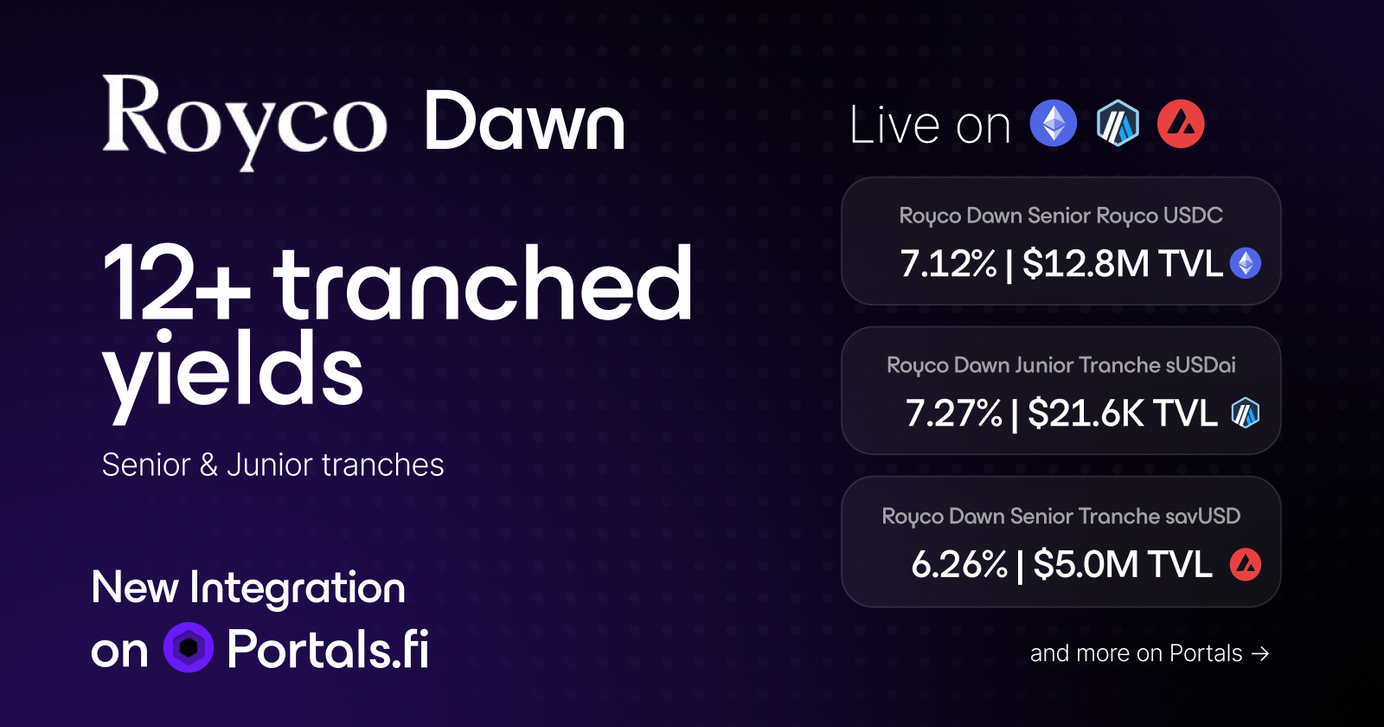
Royco Dawn is now supported on Portals. Positions from the Royco Dawn ecosystem on both Avalanche and Arbitrum are live on the Portals Explorer, where users can browse them alongside opportunities from across DeFi.
This article reflects the status of the integration described as of the publication date. Supported positions and protocols can be removed from public access, deprecated, or otherwise changed at any time after this article is posted.
Portals does not undertake to update this article when that happens. The current status of any position can be checked on the Portals Explorer.
This article walks through what Royco Dawn is, how risk tranching works in DeFi, and where the protocol fits in the broader landscape.
What Royco Dawn is
Royco Dawn is the second-generation product from the team behind Royco, a protocol that has been one of the more interesting designs in the on-chain incentives and liquidity-formation space.
The original Royco built a marketplace for incentivised actions, a system where parties offering rewards and parties willing to perform on-chain actions could negotiate directly. Royco Dawn extends that work into a different domain: structured risk distribution.
At its core, Royco Dawn is a perpetual risk-tranching protocol. It takes yield opportunities, both on-chain and off-chain, and splits them into senior and junior tranches with different risk and return profiles. Users choose which tranche fits their preference and hold the corresponding token.
How risk tranching works
Risk tranching is a long-established structure in traditional finance, used for everything from mortgage-backed securities to corporate debt CDOs.
The basic idea is straightforward: take a pool of assets that produce a stream of returns, and split that pool into layers with different priority claims on the returns and different exposure to losses.
Royco Dawn applies this structure to DeFi yield opportunities. A given yield source (a lending market, a structured product, an off-chain strategy, or any composable yield primitive) is wrapped into a Dawn vault.
Deposits into the vault are split between two tranches:
Senior tranche: The senior position is the lower-risk side. Senior depositors are protected from a market-defined drawdown percentage in the underlying investment by the junior tranche, which serves as first-loss capital. In exchange, Seniors pay a portion of their yield to Juniors as a risk premium.
Junior tranche: The junior position is the higher-risk, higher-return side. Junior depositors receive a portion of the senior tranche's yield in addition to their own, which produces a leveraged return profile. They also absorb the first losses if the underlying yield source draws down.
The "perpetual" part of the name refers to the structure being open-ended rather than time-locked. Traditional tranched products typically have fixed maturities; Royco Dawn does not.
Positions have no expiry, though junior liquidity is conditional: when junior capital is needed to cover senior exposure, it stays locked, and exits are only available when there is excess junior capital above the coverage requirement.
What problems does Royco Dawn solve?
Most DeFi yield products force a single risk profile on every depositor. Lending markets pay one rate to everyone; AMM pools distribute fees and emissions evenly across LPs; vault strategies expose all depositors to the same drawdown profile. Users with different risk tolerances either accept the same product or skip it.
Risk tranching unbundles that one-size-fits-all structure. Two users can deposit into the same underlying yield source and end up with very different exposure profiles depending on which tranche they hold.
A risk-averse depositor can take the senior position and accept a lower headline yield in exchange for downside protection. A user with a higher tolerance can take the junior position and pick up the leveraged exposure.
This creates a way to attract a wider range of capital to the same underlying yield source for protocols on the supply side. The same lending market or structured product can be packaged in two different shapes for two different audiences.
Notable features
A few things distinguish Royco Dawn from the broader DeFi yield landscape:
- Perpetual structure: Open-ended entry and exit, rather than fixed-maturity tranches like most TradFi structured products.
- Underlying-agnostic design: The protocol can wrap on-chain or off-chain yield opportunities into the tranching structure.
- Two-tranche split: Senior and junior positions give users a choice of risk profile rather than forcing a single exposure.
- Multi-chain availability: Royco Dawn is live on multiple ecosystems, including Avalanche and Arbitrum.
- Continuity from Royco V1: The team brings forward the design and infrastructure work from the original Royco incentivised-action market.
Risks worth understanding
Risk tranching changes the shape of risk; it does not remove it. Smart contract risk applies at the protocol level.
The senior tranche's downside protection depends on the junior tranche having enough capital to absorb losses; in extreme drawdown scenarios, senior depositors can still take a loss once the junior buffer is exhausted.
Junior tranche depositors carry the full first-loss exposure, which means returns can be sharply negative if the underlying yield source draws down.
Underlying-source risk applies as well: whatever yield opportunity the Dawn vault is wrapping carries its own smart contract, counterparty, or market risk, which flows through to both tranches.
None of this is unique to Royco Dawn. It is the standard risk surface of any tranched yield product, on chain or off chain.
Where Royco Dawn fits in DeFi
Structured products have been one of the slower-developing categories in DeFi. Most of the early structured products on chain were time-locked options vaults, which had a narrow user base and an even narrower set of underlying yield sources to work with.
Risk tranching is a more general primitive: it can wrap any yield opportunity, and it can do so without the time-lock constraint.
For a Portals user browsing the Explorer, Royco Dawn adds a category of yield that hasn't been broadly available on chain: senior and junior exposure to underlying DeFi yield sources, with the risk profile chosen at the position level rather than baked into the protocol.
Royco Dawn via Portals.fi
Portals.fi is a DeFi aggregation platform that surfaces curated yield positions across major protocols through a unified interface.
Users exploring Royco Dawn can find supported positions on Avalanche and Arbitrum on the Portals Explorer alongside opportunities from other protocols, accessible from a single access point.
For more information about how Portals.fi works
This article is for informational purposes only and does not constitute financial advice. DeFi protocols carry inherent risks including smart contract vulnerabilities, tranche-structure risk, underlying-source risk, drawdown and liquidation dynamics, and variable yield.
Information in this article is current as of the publication date and may not reflect later changes to the protocol or its products. Always conduct your own research before interacting with any protocol.
For our full disclaimer, please visit here.
Portals.fi Blog Newsletter
Join the newsletter to receive the latest updates in your inbox.