Arcadia Finance: DeFi Drop Podcast Recap
What Is Arcadia Finance?
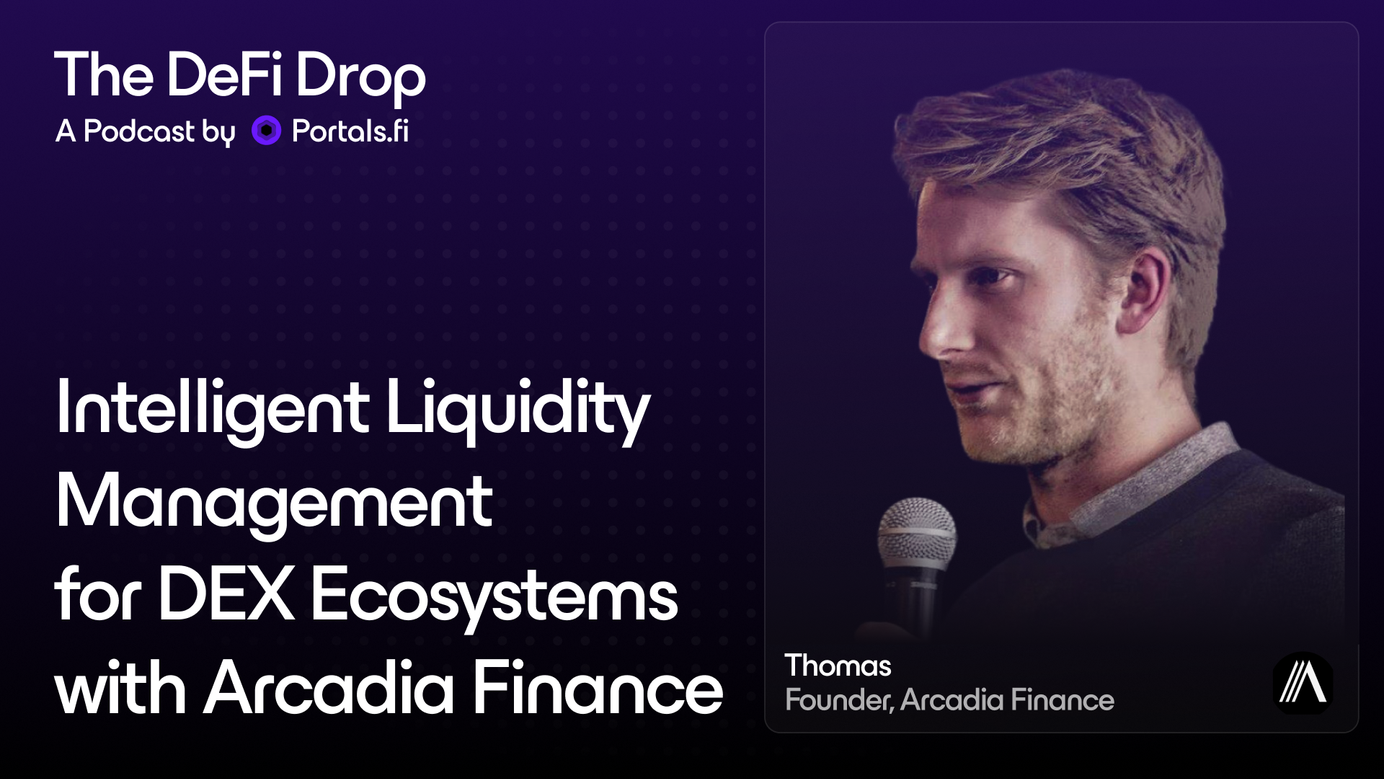
In this episode of the DeFi Drop, Edward Ward sits down with Thomas, founder of Arcadia Finance. The main topics discussed were intelligent liquidity management, leveraged LP positions, and what it takes to build DeFi infrastructure that actually solves real problems.
Arcadia is a liquidity management protocol live on Base, Optimism, and Unichain. It lets users earn yield on AMM liquidity positions with built-in leverage, automated rebalancing, and one-click access to sophisticated strategies.
The conversation covers everything from Thomas’s early days running MEV strategies with flash loans to Arcadia’s on-chain account architecture.
Furthermore, the realities of impermanent loss hedging, a candid discussion of a $3 million security incident, and a prediction for where DeFi TVL is heading by mid-2026.
From MEV Strategies to Building Infrastructure
Thomas’s journey into DeFi started as a trader initially, around 2016 . By 2020, he and his co-founder were building arbitrage strategies on DEX, including triangular arbitrage across liquidity pools. Also, early NFT arbitrage using protocols like NFTX and OpenSea in a single atomic transaction.
Flash loans were central to their approach, allowing them to execute complex multi-million dollar strategies without needing significant upfront capital.
The experience revealed DeFi’s core advantage: atomicity. Complex transactions either succeed entirely or fail entirely, with no settlement risk in between.
That concept is impossible in traditional finance, where settlement latency would eliminate the edge these strategies rely on. But the experience also exposed serious friction. Every new strategy required deploying a custom smart contract, which cost $100 to $300 in gas during 2021.
Minting a single liquidity position required up to 12 separate transactions: approvals, swaps to balance token ratios, more approvals, the actual mint, and then staking. Borrowing against a diversified portfolio was equally painful because lending markets valued assets individually rather than collectively.
Those three pain points became the foundation for Arcadia. Thomas and his co-founder realised these frustrations were universal among DeFi power users, and that smart contracts were expressive enough to solve them properly.
How the DeFi Account Works
At its core, Arcadia is an on-chain account for DeFi. It functions as a smart contract wallet that can batch complex transactions, automate position management, and enable borrowing against a collectively valued portfolio.
Think of it as a virtual machine on top of the EVM, purpose-built for managing DeFi positions.
Arcadia offers two account types. Spot accounts work with any standard token (ERC-20, ERC-721, ERC-1155) and let users batch transactions through what Arcadia calls "flash actions."
Users can withdraw from their account, pull assets from their wallet, execute any series of swaps, mints, or interactions through a separate trampoline contract, and deposit the results back, all in one transaction.
Margin accounts add leverage and borrowing. They work with whitelisted assets governed by a risk framework that sets initial margins, maintenance margins, and caps per asset.
Users can borrow from lending pools, execute complex strategies, and repay, with a health check enforced at the end of every transaction. If any action would leave the account in an unhealthy state, the entire transaction reverts as if nothing happened.
Liquidation and Risk Management
When a margin account's collateral value drops too close to its debt, a liquidation process begins. Any user can trigger liquidation on an unhealthy account, which starts a Dutch auction.
MEV bots monitor for these opportunities, calculate the value they can extract, and bid when the auction price becomes profitable for them.
Arcadia uses atomicity here as well. Instead of requiring bidders to pay first and receive assets second, the protocol hands over the distressed assets first.
The liquidator can then decompose the positions, sell the underlying tokens, repay the debt, and pocket any profit, all within a single atomic transaction. This design makes liquidations more efficient because bidders do not need to hold large capital reserves upfront.
Tackling Impermanent Loss
Impermanent loss remains the biggest deterrent for most would-be liquidity providers. Arcadia addresses it with two approaches that Thomas described as "true delta neutral" and "pseudo delta neutral."
He noted that both are technically delta neutral in the traditional finance sense. The difference comes down to gamma neutrality.
True delta neutral strategies involve providing liquidity in two pegged tokens, for example wrapped ETH and a liquid staking derivative like stETH.
Because both assets track the same underlying price, the position stays balanced regardless of how much ETH moves. Yield comes from trading fees and staking rewards, with minimal directional exposure.
Pseudo delta neutral strategies involve volatile pairs like ETH/USDC. A user deposits one unit of USDC from their wallet, borrows one unit of wrapped ETH from Arcadia's lending pool, and creates an LP position.
At the starting price, the position is delta neutral. However, as the price moves, the 50/50 balance shifts and the position is no longer perfectly hedged. This requires periodic rebalancing to maintain the neutral exposure.
Automated Rebalancing
Rebalancing is handled by dedicated smart contracts with bounded permissions. The rebalancer contract contains immutable logic that defines exactly how a position can be modified. It can take a liquidity position, adjust the underlying token amounts, and mint a new position. It cannot do anything else.
Users set constraints on when rebalancing can be triggered. Options include percentage-based thresholds (rebalance when a certain percentage out of range), cooldown periods, and volatility or oracle-driven triggers.
Within those user-defined limits, Arcadia's backend logic determines the optimal moment to execute. Only the account owner can grant rebalancing permissions, and those permissions are scoped strictly to the rebalancer contract.
The cost of rebalancing falls on the user, either directly through gas fees or indirectly through the protocol's service fee. Thomas was candid about this: "We will not front the cost."
Chains, Uniswap V4, and the AAA Token
Arcadia is live on Base, Optimism, and Unichain. Thomas noted that Unichain currently handles around 75% of all Uniswap V4 volume, which is significant for a relatively new chain.
However, he was measured in his assessment: while the team is optimistic about V4's hook architecture, the expected wave of innovation has not fully materialised yet.
Arcadia does not build hooks itself but can manage liquidity positions that use hooks, as long as they are not too exotic. The protocol aims to be both DEX-agnostic and hook-agnostic where possible.
The AAA governance token uses a staking model with built-in flexibility. The base token is a standard ERC-20, while the staked version can distribute emissions from multiple sources including protocol revenue.
The architecture deliberately separates the token from the staking layer so Arcadia can evolve toward more complex models (like vote-escrow systems) without requiring a token migration.
Roadmap: Foundry, Vaults, and Aerodrome V3
Arcadia Foundry launched in early 2026 as the institutional arm of the protocol. It uses the same underlying smart contracts but with strategies tailored for protocols managing their own liquidity or L1 chains looking to deepen on-chain liquidity.
Clients already include projects like Akenomagroup, RUN, and Summer Finance, with objectives focused on capital preservation and liquidity depth rather than yield maximisation.
A vault layer is in development. Vaults will sit on top of Arcadia accounts and be managed by curators who make all the strategic decisions: which pools, which rebalancing strategies, which ranges.
Users simply choose how much to deposit. This addresses the reality that most users do not want to configure thousands of parameters; they want passive exposure to actively managed strategies.
Aerodrome V3 represents a significant new opportunity. Arcadia plans to build an autopilot for both liquidity management and voting management of Aero emissions. This will leverage the protocol's data and on-chain expertise to help users optimise their positions in Aerodrome's predictive markets system.
On-chain options hedging for LP positions remains on the roadmap but is not yet viable for retail users. Current on-chain options premiums would consume all the yield, making the economics unworkable.
Thomas noted that proof-of-concept work has been done, and large power users can be helped to set up hedged positions manually across separate protocols.
Security: Lessons from a $3 Million Exploit
Thomas spoke openly about a security incident in 2025 where an attacker exploited one of Arcadia's periphery automation contracts, resulting in roughly $3 million in losses. The core protocol was not breached, but the impacted automation was widely used.
The attack was a sophisticated two-stage operation.
The attacker first triggered a decoy transaction that activated Arcadia's circuit breaker. During the mandatory cooldown period (designed to prevent permanent lockup of user funds), the attacker executed the real exploit while the circuit breaker could not be re-triggered.
The lesson: multiple layers of defence can inadvertently create vulnerabilities when one layer's safeguard disables another.
Arcadia has since redesigned its security architecture around a core principle: assume every smart contract can contain a bug, and ensure no single bug can result in a total wipeout.
The new circuit breaker design allows risk-increasing actions to be paused immediately without cooldowns, while risk-reducing actions (which protect user fund access) retain cooldown periods.
Account assets are isolated rather than pooled, and cross-account reentrancy guards add further compartmentalisation.
AI, the Lindy Effect, and the Future of DeFi Security
Thomas offered an interesting perspective on AI's impact on DeFi security. AI tools have effectively reset the Lindy effect for smart contract safety.
Code that survived years of human review is now being examined by AI models that can find vulnerabilities in "boring old libraries" that no human bothered to audit thoroughly.
The short-term result is a painful period of increased exploits across the industry. The long-term result, Thomas argued, is that protocols surviving this era of AI-powered scrutiny will be demonstrably safer than anything that came before.
Every year that passes post-AI adds more safety assurance than the equivalent period of human-only review.
Will Active LP Management Go Mainstream?
When asked whether a Coinbase user with a passive yield mindset could be converted into an active LP manager, Thomas was refreshingly direct: "No, I don't think so."
Active strategies require decisions across thousands of parameters, and most users simply want to know expected yield, risk level, and whether a source is healthy.
This is precisely why Arcadia is building the vault layer. Power users and institutions will continue using Arcadia's granular tooling directly. Everyone else will access the same strategies passively through curator-managed vaults.
The protocol serves both audiences without pretending they have the same needs.
TVL Prediction: A Bearish First
Every DeFi Drop guest is asked to predict the total DeFi TVL (per DeFi Llama) for 21 June 2026. With TVL sitting at $84 billion at the time of recording, Thomas predicted $80 billion, making him the first guest in the show's history to forecast a decline.
His reasoning: the fallout from the Kelp DAO situation remains unresolved, and once affected users can withdraw locked funds, net outflows will temporarily drag TVL down. His longer view, however, is optimistic: "From there it's up only."
Listen to the Full Episode
This recap covers the highlights, but the full conversation goes deeper into Arcadia's smart contract architecture, the mechanics of on-chain liquidation auctions, and Thomas's unfiltered take on the state of DeFi security in 2026.
Listen to the full DeFi Drop episode wherever you get your podcasts.
About Portals.fi
Portals.fi is a DeFi aggregation platform that lets users swap tokens, discover yields, and manage positions across 20+ blockchains from a single interface.
Whether you are executing a simple swap or routing a complex multi-chain transaction, Portals searches across hundreds of protocols to find the optimal route. Visit portals.fi to get started.
This article is a summary of a podcast conversation and is for informational purposes only. It does not constitute financial advice.
DeFi protocols carry inherent risks, including smart contract vulnerabilities, impermanent loss, and liquidation risk. Always conduct your own research before interacting with any protocol. For our full disclaimer, please visit disclaimer.
Portals.fi Blog Newsletter
Join the newsletter to receive the latest updates in your inbox.