DeFi TVL September 2026 Week 1: Tectonic Exploit
The DeFi TVL September 2026 week 1 snapshot opens with TVL at $86.9B, down 0.9% over seven days. Bitcoin gained 2.9%, Ethereum advanced 1.1%, and the Fear & Greed Index held in Greed at 74.
The defining security event was a price-manipulation exploit against Tectonic on Cronos. The network halted and restored a pre-exploit state after an attacker allegedly borrowed about $75M against artificially inflated TONIC collateral.
Institutional and regulatory developments also accelerated. Twenty-one financial institutions committed to a joint stablecoin venture, the G20 supported clearer digital-asset pathways, Ethena launched a consumer payments app, and South Korea published a phased tokenized-securities roadmap.
On the yield front, this edition highlights five positions on Portals Explorer. The selection spans Ethereum lending and real-world asset strategies alongside two tokenized-stock opportunities from the Portals and Base campaign.
Market Pulse
- Total Market Cap: $2.77T (+2.2% 24h)
- DeFi TVL: $86.9B (-0.9% 7d)
- BTC Price: $79,772 (+2.9% 7d)
- ETH Price: $2,454 (+1.1% 7d)
- Gas (ETH): 0.079 Gwei
- Sentiment: Greed (74)
The DeFi TVL September 2026 week 1 data shows a divergence between crypto prices and onchain liquidity. Bitcoin and Ethereum remained positive over seven days, while DeFi TVL fell 0.9% over the same period.
The Total market cap is at $2.77T, up 2.2% over the latest 24-hour period. That shorter market-cap window is not directly comparable with the seven-day TVL and asset changes, so it is best read as a late-session momentum indicator.
Ethereum gas was 0.079 Gwei at the snapshot time. These low costs support mainnet deposits, withdrawals, and portfolio rebalancing, especially for strategies that require several contract interactions.
Greed at 74 indicates strong risk appetite despite the weekly TVL contraction. The combination calls for selectivity where yield depends on thin collateral, leverage, or temporary incentives.
Top Yields on Portals Explorer
This week, we highlight five live opportunities on Portals Explorer. The selection combines three Ethereum lending and real-world asset positions with two Base vaults that generate yield on Coinbase Tokenized Stocks.
1. NVDA SuperVault (Base)
The NVDA SuperVault on Base is offering a 30.44% APY with $128.41K in TVL. This Superform vault gives users onchain exposure to NVIDIA-linked assets through Coinbase Tokenized Stocks on Base.
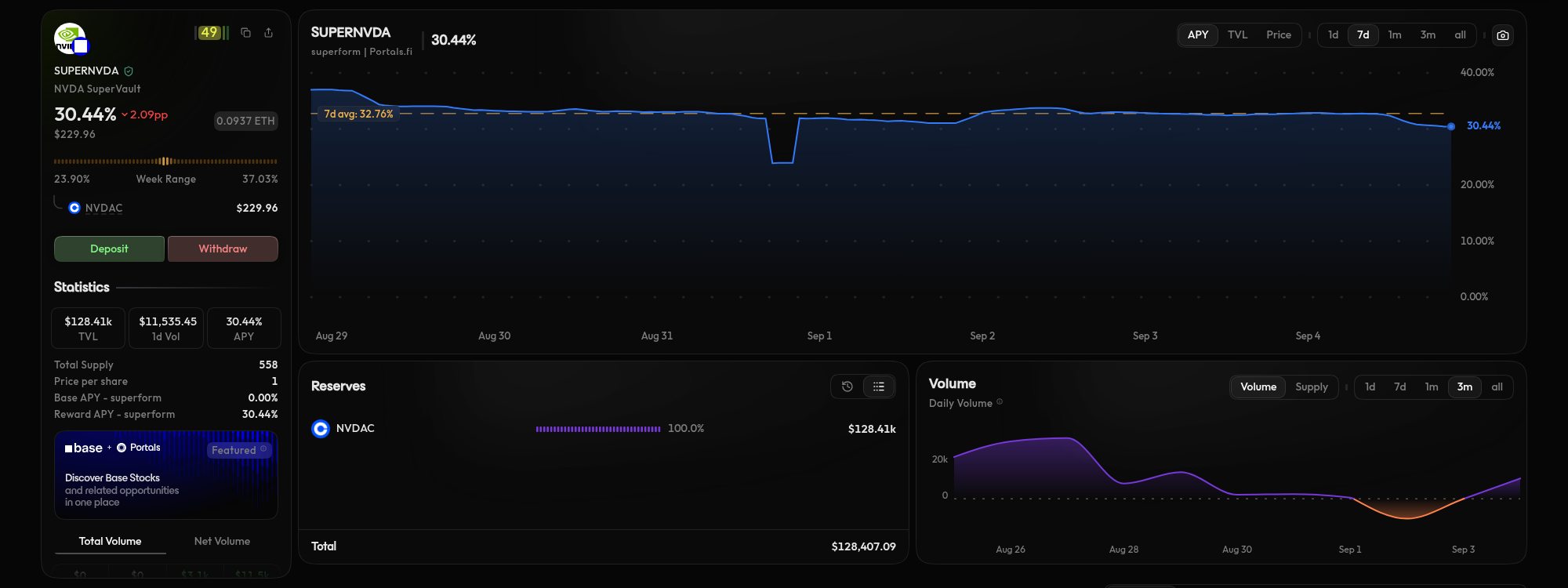
The position combines equity exposure with onchain yield generation in a single vault. It currently holds NVDAC as its reserve asset, while the return consists 30.44% reward APY.
Depositors face smart-contract risk, strategy risk from the vault's evolving onchain allocation, reward-rate instability, and market risk tied to NVIDIA-linked price exposure.
2. TAU AAPLc Carry Vault (Base)
The TAU AAPLc Carry Vault on Base is offering a 10.00% APY with $9.67K in TVL. This IPOR Fusion vault provides an evergreen carry strategy for Coinbase's Apple-linked token.
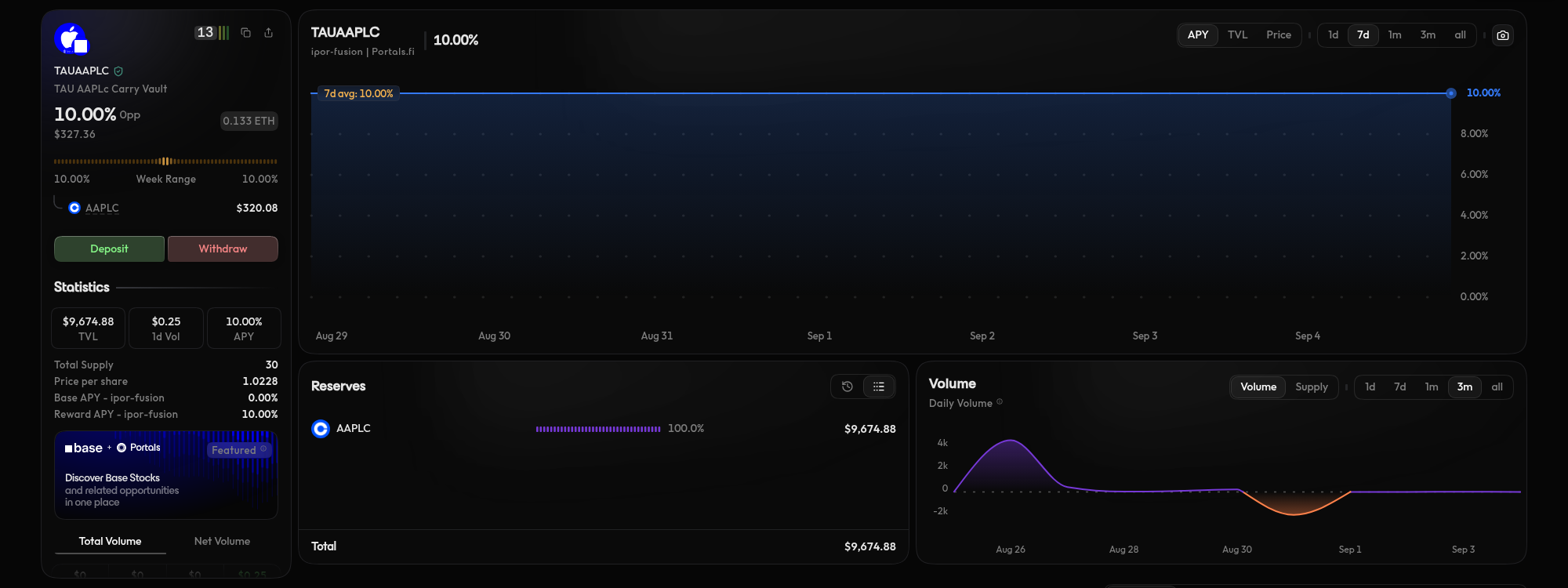
The vault holds AAPLC as its reserve asset and allows users to generate yield while retaining tokenized Apple exposure. The APY has remained at 10.00% across the seven-day average and range.
Depositors face smart-contract and strategy risk, Apple-linked market risk, and elevated liquidity risk due to the vault's relatively small size.
3. Morpho USDT / wstETH (Ethereum)
The Morpho USDT / wstETH market on Ethereum is offering a 4.80% APY with $24.06M in TVL. This isolated lending market allows users to supply USDT against wrapped staked Ether collateral.
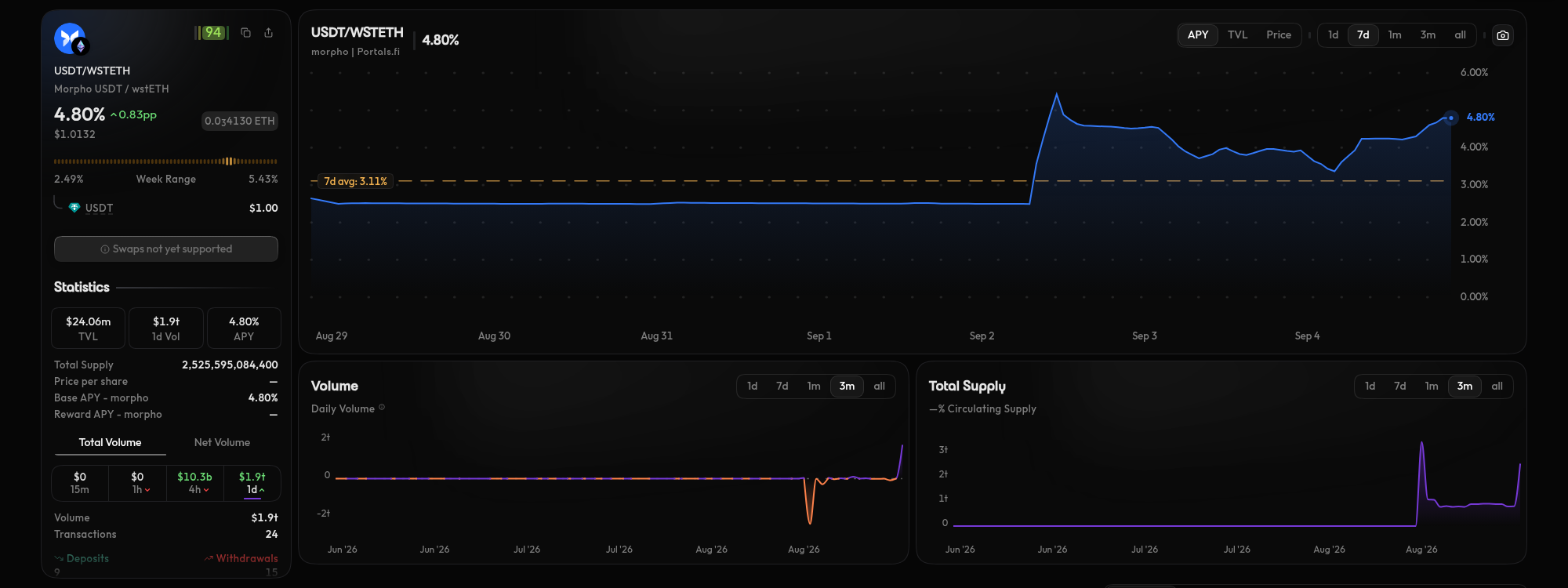
The position combines stablecoin lending demand with liquid staking collateral. Its rate can change as borrowing utilization and market liquidity move.
Depositors face Morpho smart-contract and oracle risk, USDT issuer and depeg risk, wstETH staking and liquidity risk, and possible withdrawal constraints during periods of high utilization.
4. Superstate Crypto Carry Fund (Ethereum)
The Superstate Crypto Carry Fund on Ethereum is offering a 6.58% APY with $67.55M in TVL. Also known as USCC, the position packages crypto carry strategies in a tokenized real-world asset structure.
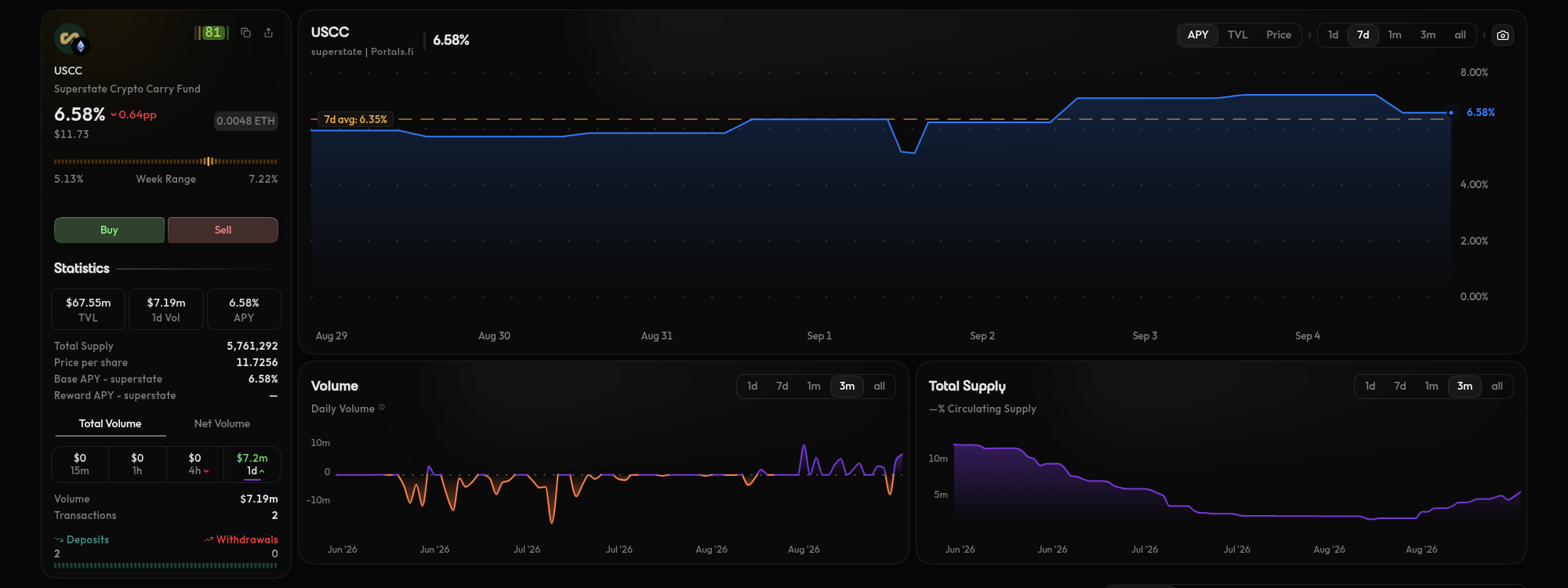
Its yield source differs from standard borrower-paid lending interest. The return depends on the fund's underlying carry trades, counterparties, and operating structure.
Investors should assess custody, counterparty, strategy, redemption, liquidity, leverage, and smart-contract risks. The displayed APY can change as the underlying strategy evolves.
5. Morpho USDC / PT-reUSD-10DEC2026 (Ethereum)
The Morpho USDC / PT-reUSD-10DEC2026 market on Ethereum is offering a 6.24% APY with $93.05M in TVL. This isolated market supplies USDC against a Pendle principal token linked to reUSD and maturing on 10 December 2026.
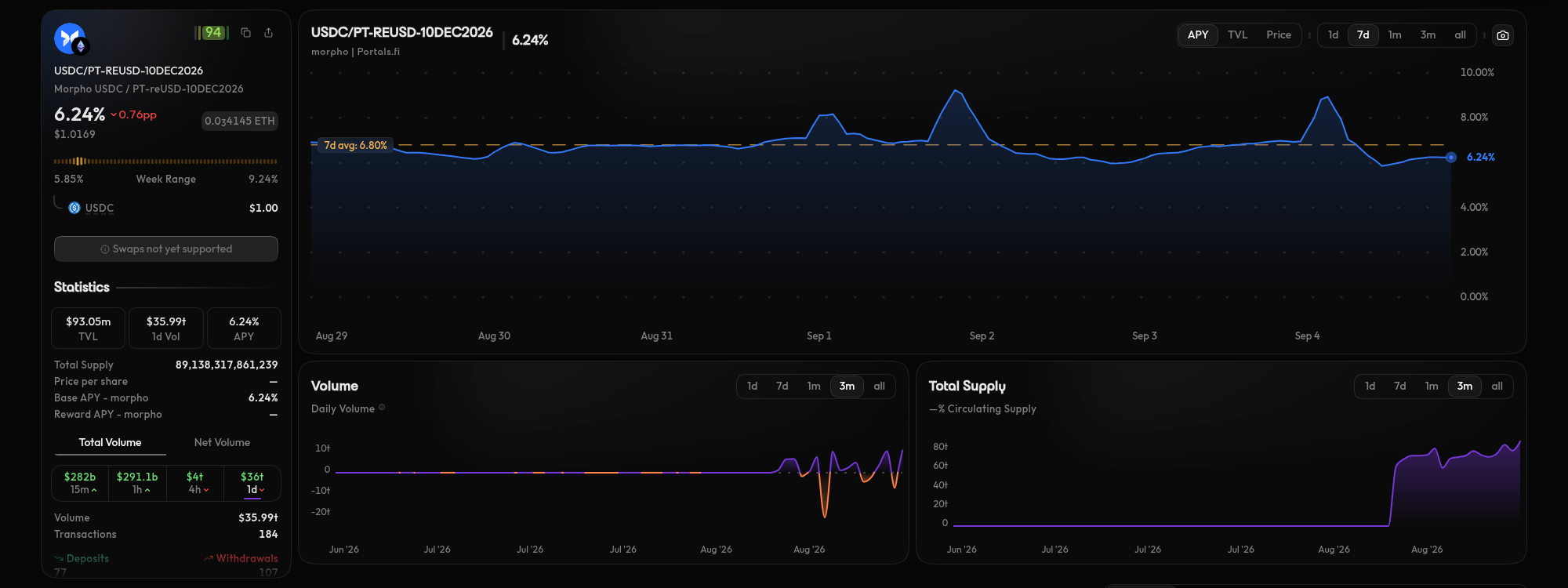
The maturity structure creates a different risk and return profile from a standard spot-collateral market. Pricing can shift as the principal token approaches maturity and implied yields change.
Depositors face Morpho and oracle risk, USDC and reUSD depeg risk, maturity-basis risk, collateral liquidity risk, and liquidation exposure created by leveraged borrowers.
Explore Tokenized Stocks on Base
Track, manage, and optimize your DeFi portfolio across major networks with Portals Explorer. Zap into the stocks and DeFi opportunities they power in one place.

Discover Base Tokenized Stocks on Portals
DeFi News
Tectonic Exploit Triggers Cronos Halt and Rollback
Cronos announced an exploit against Tectonic and halted the network on 30 August. An attacker allegedly pushed the thinly traded TONIC collateral price roughly 100 times higher before borrowing an estimated $75M against the artificial value.
Validators restored the chain to a pre-exploit state and resumed block production at 23:49 UTC. The rollback discarded nearly two hours of transactions, while roughly $6.29M that had already moved to Ethereum remained outside its reach.
Twenty-One Institutions Plan a Shared Dollar Stablecoin
A group of 21 financial institutions committed to establishing a stablecoin company in the second half of 2026. The official announcement names participants including Bank of America, Citi, Goldman Sachs, Fidelity Investments, UBS, and Deutsche Bank.
The proposed dollar token targets a first-half 2027 launch for payments and digital-asset settlement, subject to closing conditions. Payments Dive independently reported the planned company formation and launch timetable.
If the venture launches, DeFi could gain another regulated source of settlement liquidity. The immediate development is an institutional commitment, not a live token or deployable onchain supply.
G20 Finance Leaders Support Clearer Digital-Asset Pathways
G20 finance ministers and central-bank governors committed to advancing regulatory and supervisory frameworks that support sound digital-asset innovation. The G20 Chair's Statement also anticipated Financial Stability Board work on the cross-border implications and data challenges of global stablecoin arrangements.
The statement does not create a binding global rulebook. It signals continued coordination around stablecoin oversight, financial stability, and cross-border payments.
For DeFi users and protocols, the practical impact will depend on how individual jurisdictions implement the shared policy direction. Licensing, reserve standards, and data obligations remain key areas to monitor.
Ethena Launches a Self-Custodial Payments App on Avalanche
Ethena Pay launched on iOS on 3 September with USDe savings rewards, fiat on-ramps, transfers, a virtual IBAN, and card spending. Avalanche provides the app's settlement layer.
The product is initially available in roughly 50 jurisdictions. The advertised rate of up to 6% is tiered and capped, while cashback and availability also depend on account and jurisdictional conditions.
The product extends USDe from DeFi collateral and trading into consumer payments. Users still face USDe, AVAX, smart-contract, provider, reward-program, and jurisdictional risks.
South Korea Sets a Tokenized-Securities Roadmap
South Korea's Financial Services Commission published a three-phase plan on 4 September. The first phase begins when the amended Electronic Registration Act recognizes security tokens as digitized securities on 4 February 2027.
Later phases would expand tokenization to all publicly offered securities and eventually connect onchain settlement to stablecoins. The final phase has no fixed date and depends on phase-one results, technology adoption, and future stablecoin legislation.
This plan differs from a commercial tokenized-stock launch because it addresses national securities infrastructure, licensing, investor protections, and settlement policy.
Chain Performance Analysis
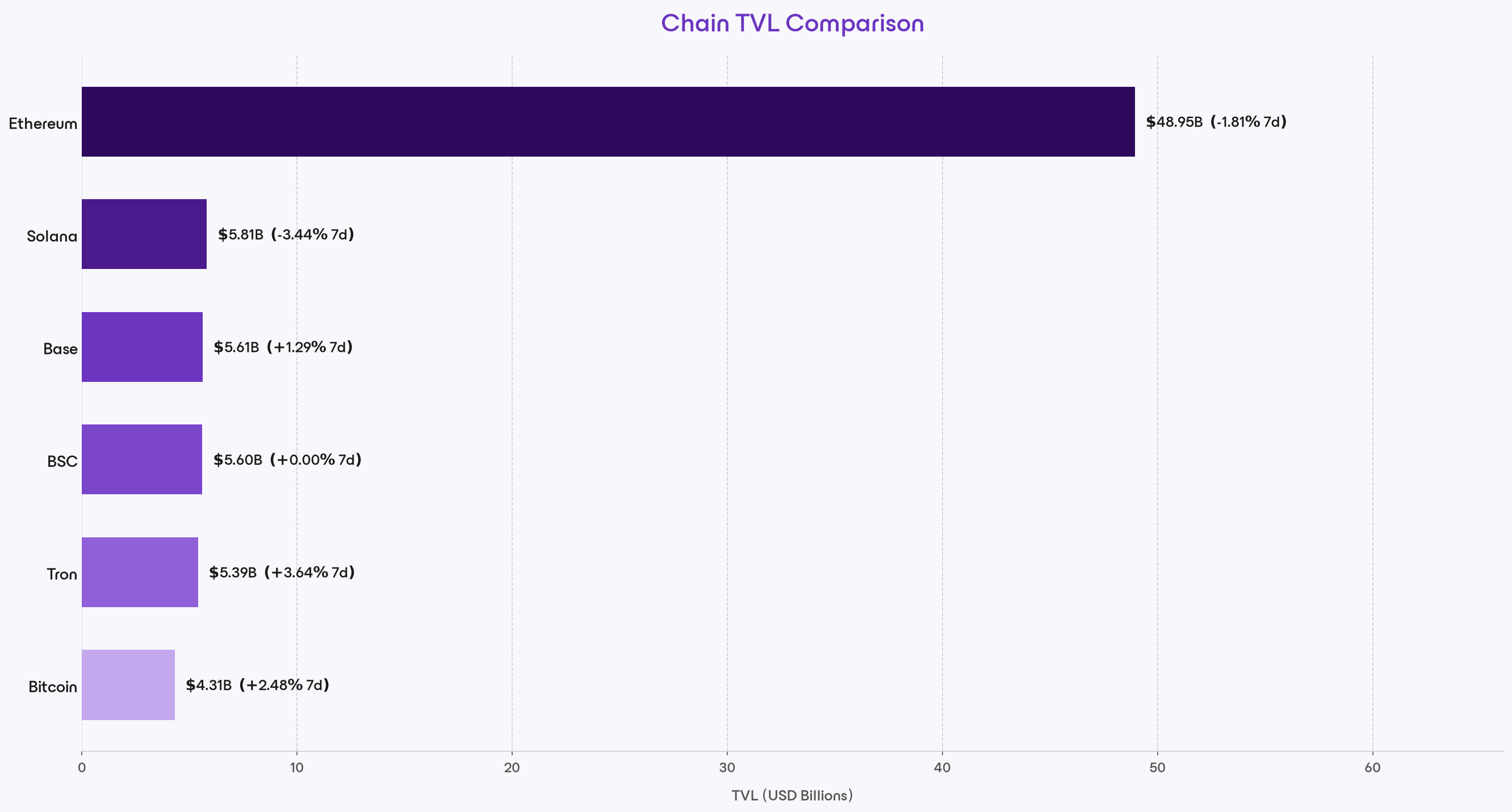
Ethereum held $48.95B in DeFi TVL, equal to 56.3% of the cross-chain total, after a 1.81% weekly decline. Its continued dominance anchors liquidity routing, staking collateral, and institutional onchain activity.
Solana remained the second-largest chain at $5.806B despite a 3.44% decline. Base gained 1.29% to reach $5.608B and narrowly moved ahead of BSC at $5.604B, which was essentially flat over seven days.
Tron led the positive weekly movers at 3.64%, reaching $5.392B. Bitcoin's DeFi ecosystem added 2.48% to reach $4.312B.
Top DeFi Protocols
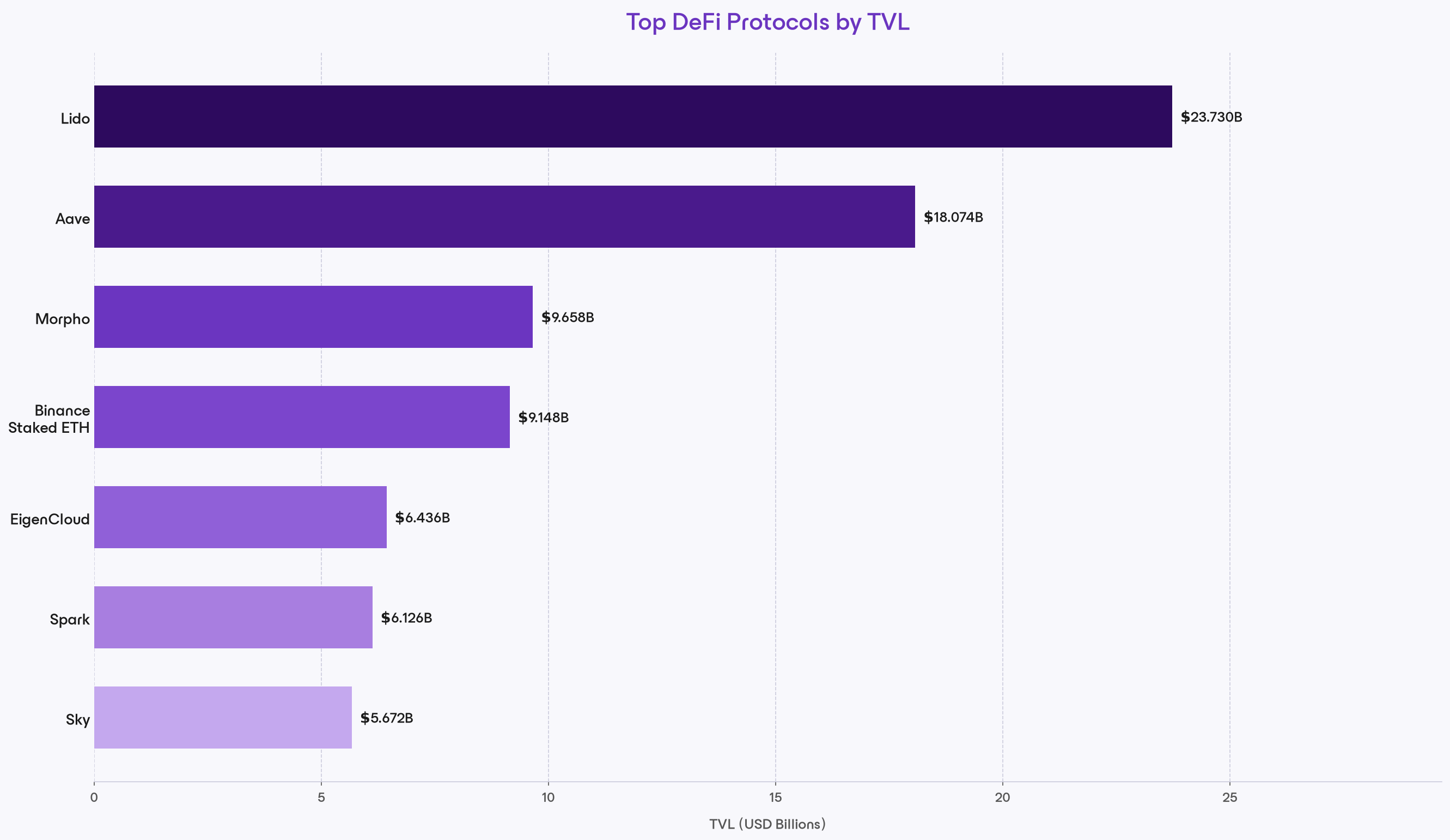
Lido remained the largest DeFi protocol at $23.730B after a 1.97% weekly decline. Its stETH liquid staking token continues to function as foundational collateral across lending, restaking, and yield strategies.
Aave ranked second at $18.074B, down 1.37%, while Morpho held $9.658B after a 0.18% gain. Morpho was the only top-seven parent protocol with a positive weekly change in the final snapshot.
Binance Staked ETH fell 2.12% to $9.148B, EigenCloud declined 3.27% to $6.436B, and Sky slipped 3.19% to $5.672B. Spark showed the sharpest live seven-day decline at 21.24%, finishing at $6.126B.
Looking Ahead
Tectonic Puts Collateral Controls Under Scrutiny
Lending teams will likely review collateral caps, thin-market exposure, and the relationship between oracle prices and executable liquidity. An accurate spot price does not make a thin asset safe collateral when borrowing capacity exceeds realistic exit liquidity.
The Cronos rollback will also keep validator coordination and finality expectations in focus. Users should monitor Tectonic's final loss accounting and Cronos's post-incident report before interacting again.
Stablecoins Move Toward Institutional and Consumer Distribution
The 21-institution venture and Ethena Pay approach stablecoin adoption from opposite directions. One targets regulated settlement, while the other packages self-custodial USDe savings and spending for consumers.
The next milestones are the consortium's formal incorporation and Ethena Pay's expansion beyond its initial markets. Actual onchain supply, transaction volume, and user retention will matter more than launch announcements.
Regulation Turns Toward Market Infrastructure
The G20 statement and South Korea's roadmap both focus on supervision, settlement rails, and cross-border interoperability. This shift could clarify how regulated stablecoins and tokenized securities interact with public blockchains.
Implementation details will determine whether these plans expand open DeFi liquidity or remain inside permissioned systems. Licensing standards, stablecoin legislation, and investor-protection rules remain the central variables.
Read last week's edition: DeFi TVL August 2026 Week 4: Coinbase Stocks on Base & Term Finance Hack
About portals.fi: Portals is the DeFi Super App. A one-click gateway to the entire onchain economy. Powered by real-time data and seamless execution, Portals connects traders to over 20 million assets, thousands of protocols, and every major blockchain.
Disclaimer: The content of this newsletter is for informational purposes only. It is not investment advice. Please do your own research and consult with a qualified financial advisor before making any investment decisions. DeFi investments carry significant risks, and past performance does not guarantee future results. More details here.
Portals.fi Blog Newsletter
Join the newsletter to receive the latest updates in your inbox.