DeFi Weekly October 2026 Week 2: Aave V4 Tokenized Stocks
The DeFi Weekly October 2026 week 2 snapshot closes with TVL at $91.45B, down 3.90% over seven days. Bitcoin fell 2.2%, Ethereum fell 6.99%, and the Fear & Greed Index registered 59, or Greed.
This week’s lead DeFi story is Aave V4 tokenized stocks: reported Coinbase tokenized stock deposits in Aave’s Base Equities Hub reached $4.7M and doubled week over week.
The edition also tracks Securitize’s regulated onchain-equities launch, FinCEN’s withdrawal of two proposed crypto rules, Ledger Wallet’s Morpho-powered BTC-backed borrowing, and a reported Base vault permission failure.
On the yield front, this edition highlights five live positions on Portals Explorer. The selection includes two tokenized stock collateral lending markets from the Base tokenized stocks campaign, alongside three larger USD-denominated lending positions across Ethereum, Base, and Plasma.
Market Pulse
- Total Market Cap: $2.79T (-2.03% 24h)
- DeFi TVL: $91.45B (-3.90% 7d)
- BTC Price: $82,479 (-2.2% 7d)
- ETH Price: $2,483 (-6.99% 7d)
- Gas (ETH): 0.087 Gwei
- Sentiment: Greed (59)
The DeFi Weekly October 2026 week 2 data shows a broad contraction in deposited capital and major-asset prices.
TVL measures assets deposited in DeFi smart contracts; it is useful for comparing protocol and chain scale, but it does not establish the executable liquidity, depth, or withdrawal capacity of every position.
The cross-chain total declined by roughly $3.71B over the seven-day comparison window. Ethereum gas was 0.087 Gwei at the publication cutoff, keeping the direct transaction-cost hurdle low for users who need mainnet deposits, withdrawals, or rebalancing.
Greed at 59 sits alongside a weaker seven-day tape. That combination supports selectivity, particularly where a displayed rate depends on thin collateral, reward emissions, tokenized-asset liquidity, a strategy wrapper, or constrained redemptions.
Top Yields on Portals Explorer
This week, we highlight five live opportunities on Portals Explorer. The selection combines two Base tokenized-stock-collateral lending markets with three established USD-denominated lending positions.
1. Morpho USDC / AAPLc (Base)
Morpho USDC / AAPLc on Base is offering a 5.19% APY with $271.41k in TVL. Lenders supply USDC to an isolated Morpho market where AAPLc is the collateral asset, placing the market within the Base tokenized-stocks campaign.
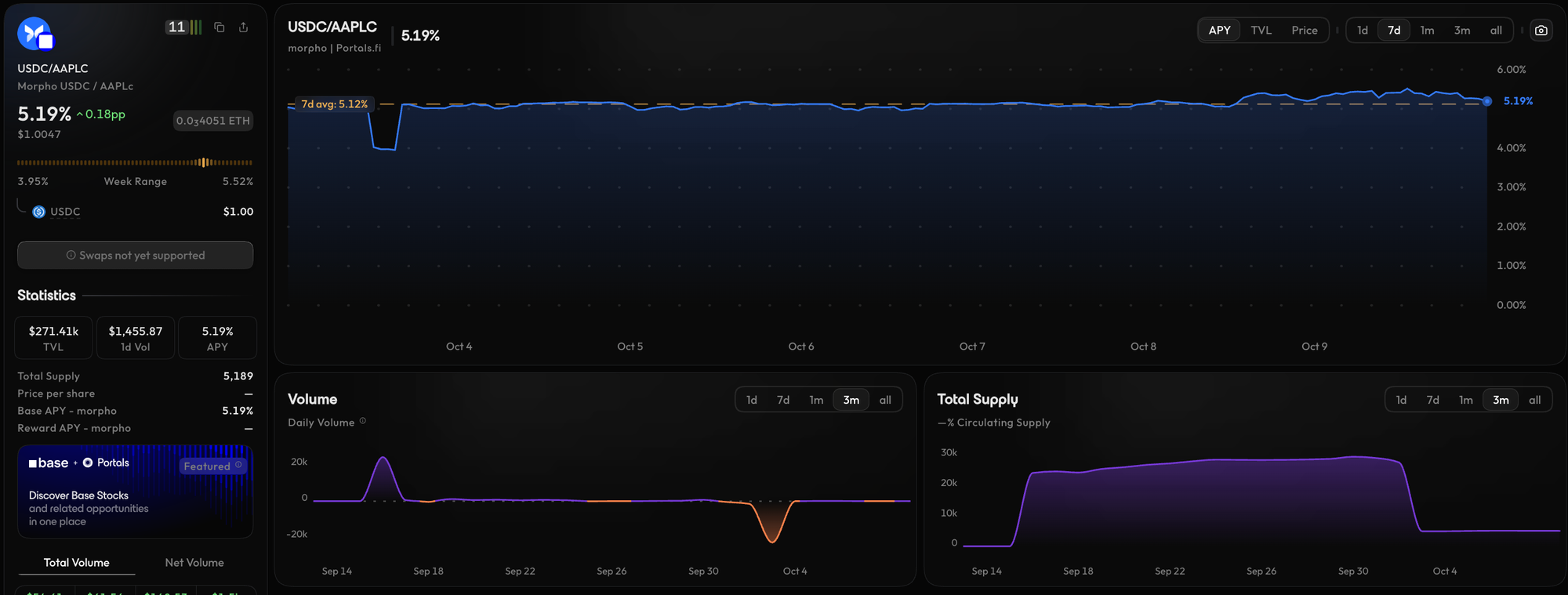
The live page showed a 5.12% seven-day average, slightly below the current rate. Lending markets backed by tokenized-stock collateral introduce tokenized-asset issuer, collateral-price, oracle, liquidity, liquidation, and smart-contract risk alongside the usual variable-rate risk.
2. Morpho USDC / SPCXc (Base)
Morpho USDC / SPCXc on Base is offering a 4.95% APY with $505.06k in TVL. Lenders supply USDC against SPCXc collateral in a separate isolated Morpho market from the same campaign.
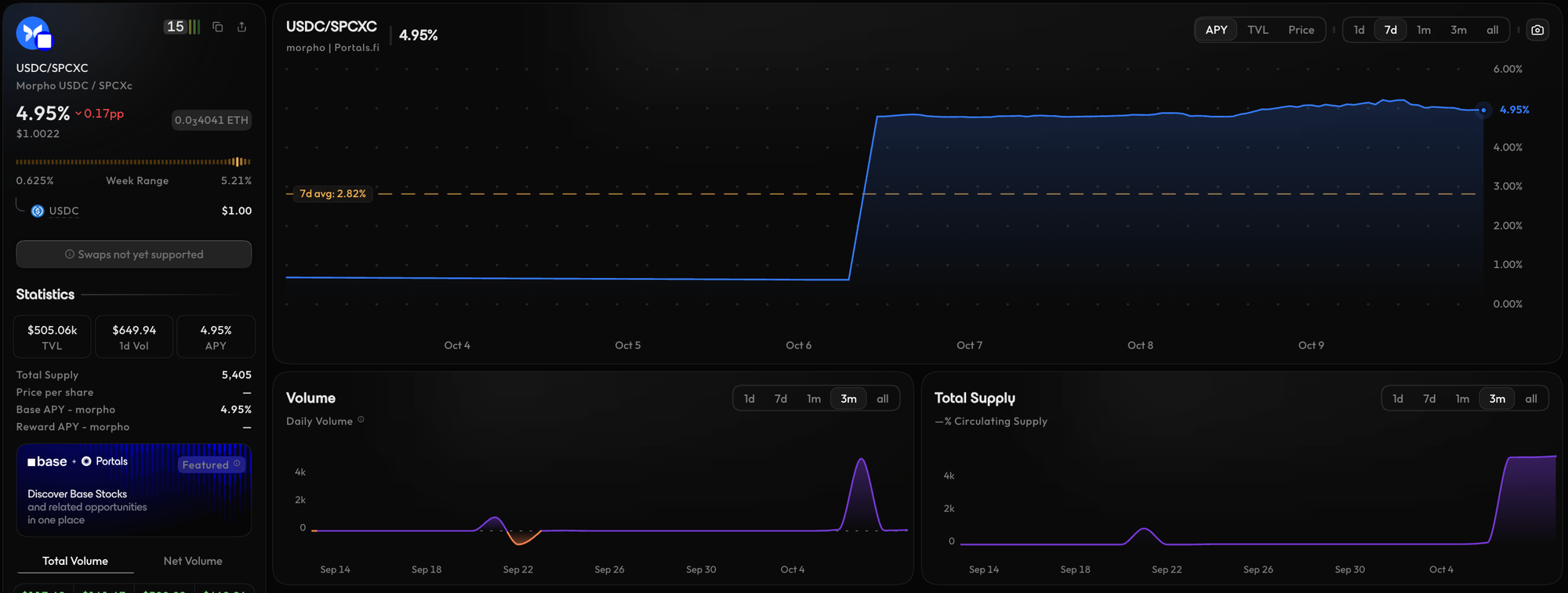
The 4.95% displayed rate was above the 2.79% seven-day average. The higher current rate is not a guarantee of future return; tokenized-stock collateral, liquidation parameters, oracle design, issuer and market liquidity, protocol contracts, and rate variability should all be assessed before supplying.
3. Morpho PYUSD / PRIME (Ethereum)
Morpho PYUSD / PRIME on Ethereum is offering a 4.77% APY with $209.57M in TVL. The isolated market lets lenders supply PYUSD against PRIME collateral at an 86% loan-to-value threshold.
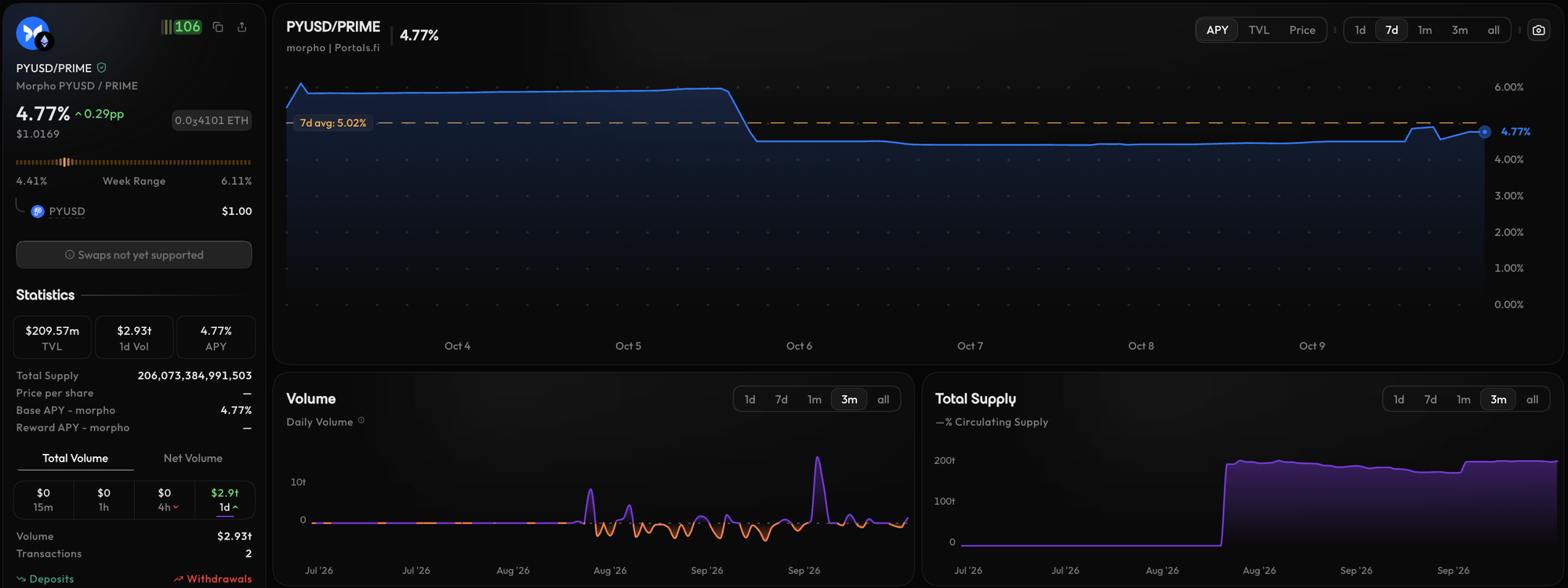
PRIME is Hastra’s staked wYLDS token, whose stated yield source is home-equity-line-of-credit lending rather than crypto markets. The live rate was below its 5.02% seven-day average.
PYUSD, collateral, oracle, borrower-credit, smart-contract, liquidity, liquidation, and variable-rate risks remain relevant.
4. Morpho USDC / USDe (Base)
Morpho USDC / USDe on Base is offering a 4.09% APY with $390.48M in TVL. In this isolated market, lenders supply USDC against USDe collateral at a 91.5% loan-to-value threshold.
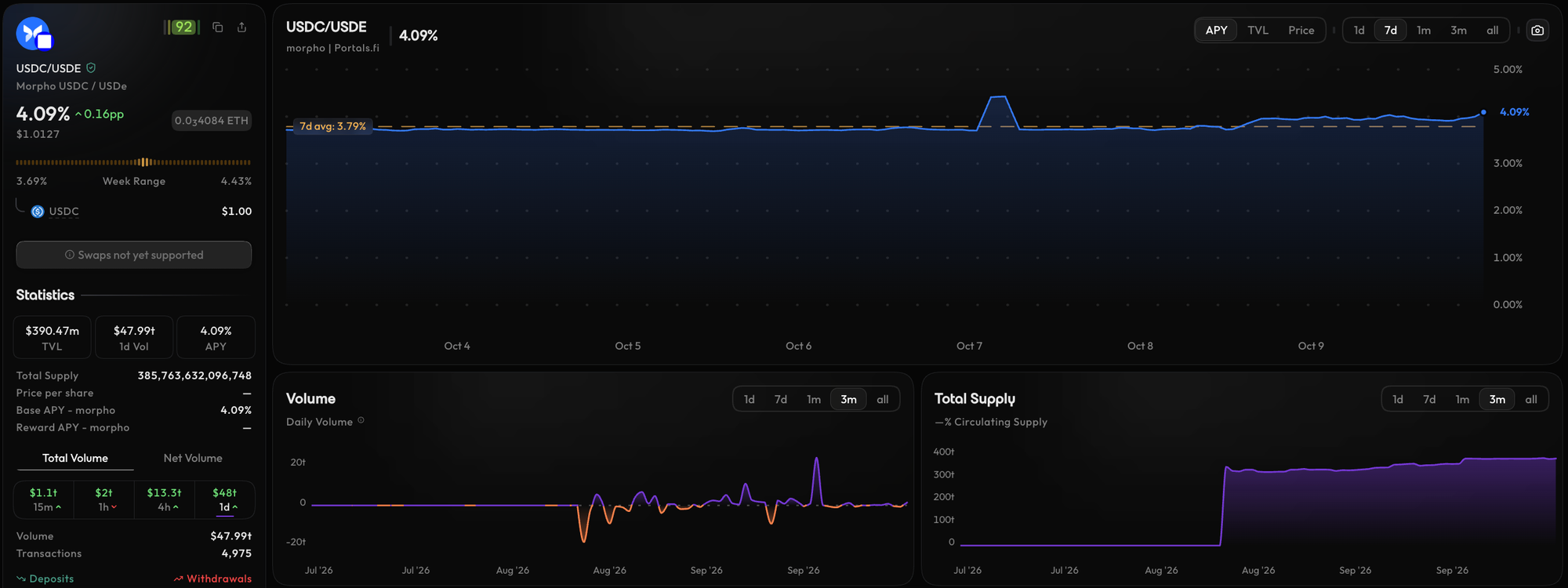
The 4.09% rate was close to its 3.79% seven-day average. USDe maintains its design through delta-hedged derivatives rather than bank-held fiat reserves, so users should factor its strategy and peg mechanics into the assessment alongside USDC, oracle, smart-contract, liquidity, liquidation, and variable-rate risk.
5. Aave Plasma USDT0 (Plasma)
Aave Plasma USDT0 is offering a 3.93% APY with $772.84M in TVL. The position is the interest-bearing receipt token Aave v3 mints when a user supplies USDT0 on Plasma; its balance accrues supply-side interest.
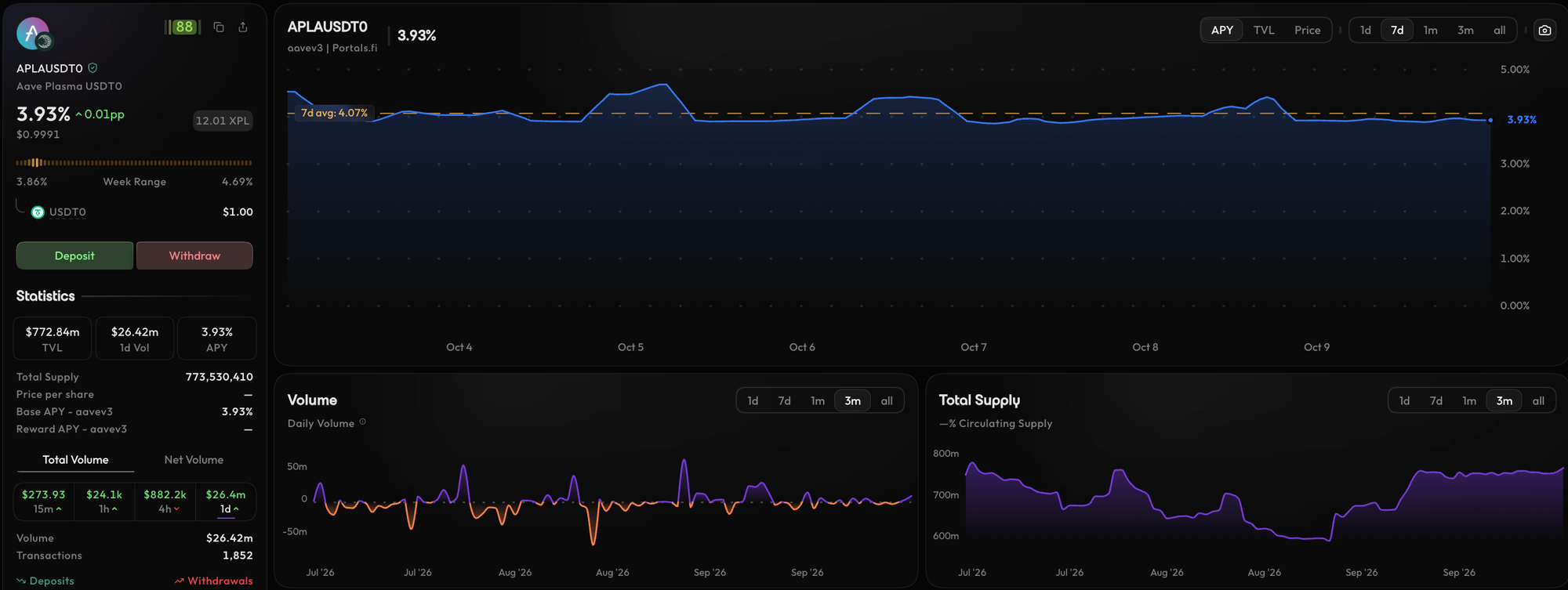
The current rate was below its 4.07% seven-day average. USDT0 is a LayerZero-powered omnichain version of USDT, so its issuer and bridge design, Plasma-network, Aave-market, smart-contract, liquidity, and variable-rate risks all matter. For the differences between Aave versions and market architecture, see the Aave V1–V4 guide.
Explore Tokenized Stocks on Base on Portals
The Portals and Base campaign brings tokenized stocks and the DeFi opportunities they power into one interface.
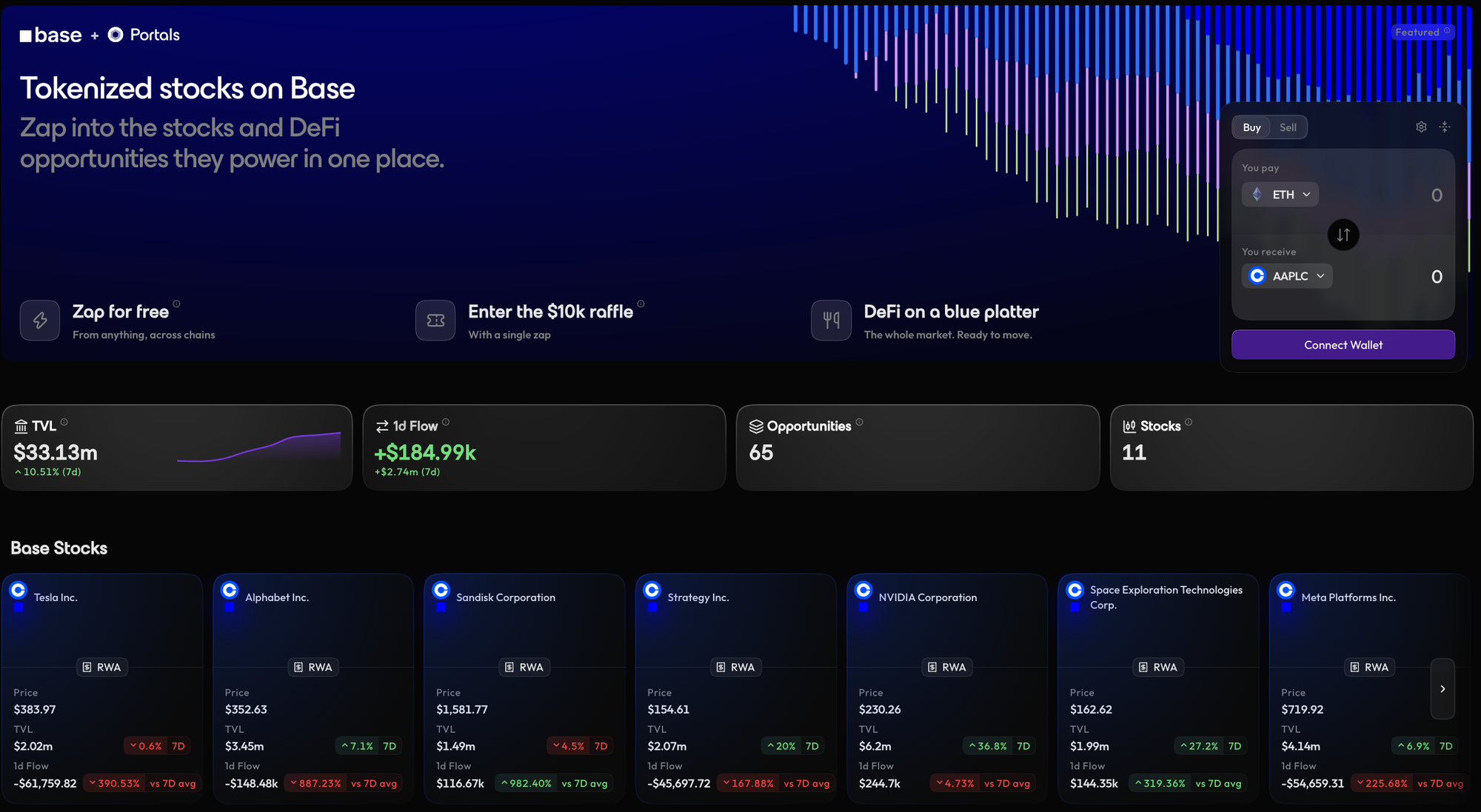
Users can explore stock-linked assets and related markets, zap from assets across chains, and review live opportunities.
A tokenized stock, its lending market, and any strategy wrapper are separate layers, each with their own issuer, liquidity, oracle, protocol, and access considerations. Read more about the campaign in Portals’ Base tokenized-stocks launch.
Discover Base Tokenized Stocks on Portals
DeFi News
Aave V4 Tokenized-Stock Deposits Reach Reported $4.7M on Base
Coinbase-issued tokenized-stock deposits in Aave V4’s Base Equities Hub reached $4.7M and doubled week over week, with Meta and Nvidia accounting for about half of the deposits.
Aave’s product announcement confirms the market mechanics: eligible non-U.S. users can post seven Coinbase tokenized stocks as collateral to borrow USDC in an isolated Base market.
The $4.7M figure is an independently reported adoption observation, not an audited balance or a guarantee of liquidity. Aave states that Chainlink prices the tokenized equities 24/5 while the lending market operates continuously, so collateral factors, oracle timing, borrowing costs, market caps, and liquidation mechanics remain central to any assessment.
FinCEN Withdraws Proposed Unhosted-Wallet and CVC-Mixing Rules
FinCEN announced that it would withdraw two proposed digital-asset rules: a 2020 proposal covering certain reportable transactions involving unhosted or otherwise covered wallets, and a 2023 proposal related to convertible virtual-currency mixing.
The unhosted-wallet proposal would have applied identity, recordkeeping, and reporting requirements to covered high-value transactions.
The separate mixing proposal followed FinCEN’s finding that international CVC mixing was a primary money-laundering concern. Their withdrawal removes the proposed measures; it does not exempt illicit-finance activity or make privacy tools free of legal, operational, or compliance risk.
Securitize Launches Regulated Onchain Trading of U.S. Stocks
Securitize announced that it had launched global onchain trading of U.S. stocks through security entitlements that are 1:1 backed by the referenced shares. The company says the product preserves stated investor rights and economic benefits. The initial deployment is on Solana for eligible investors.
Initial trading has extended hours. Securitize’s 24/7 and additional-venue plans were not live at the publication cutoff, so the development should be read as an early market-structure milestone rather than proof of continuous public-equity liquidity or DeFi collateral availability.
Ledger Wallet Adds Morpho-Powered BTC-Backed Borrowing
Morpho announced that eligible Ledger Wallet users can borrow USDC or USDT against WBTC or cbBTC through Morpho’s isolated lending markets without leaving the wallet interface. The integration connects a major self-custody distribution channel to an onchain credit use case rather than simply adding a token listing.
Borrowing against wrapped Bitcoin still carries variable-rate, collateral, liquidity, smart-contract, market-availability, and liquidation risk. Wallet integration does not remove the need to understand market parameters or to monitor a position’s health factor.
Base Vault Drained After Reported Malicious Safe Allowlist Change
GoPlus Security reported that an unclaimed Base vault lost approximately $6M after a malicious contract was added to its Safe borrow allowlist. The reported flow involved approximately 1,783 aBaswstETH, which was withdrawn and redeemed through Aave V3.
The reported incident is a privileged-permission failure, not a confirmed exploit of Aave core contracts or Base itself. It is a practical reminder that a lending protocol’s risk profile does not remove wrapper, operator, multisig, allowlist, or smart-contract risk around a strategy.
Chain Performance Analysis
Ethereum held $51.20B in DeFi TVL, equal to 56.0% of the cross-chain total, after a 4.06% weekly decline. Its scale continues to anchor lending, liquid staking, vault infrastructure, and stablecoin liquidity, even as the market moved lower over the comparison window.
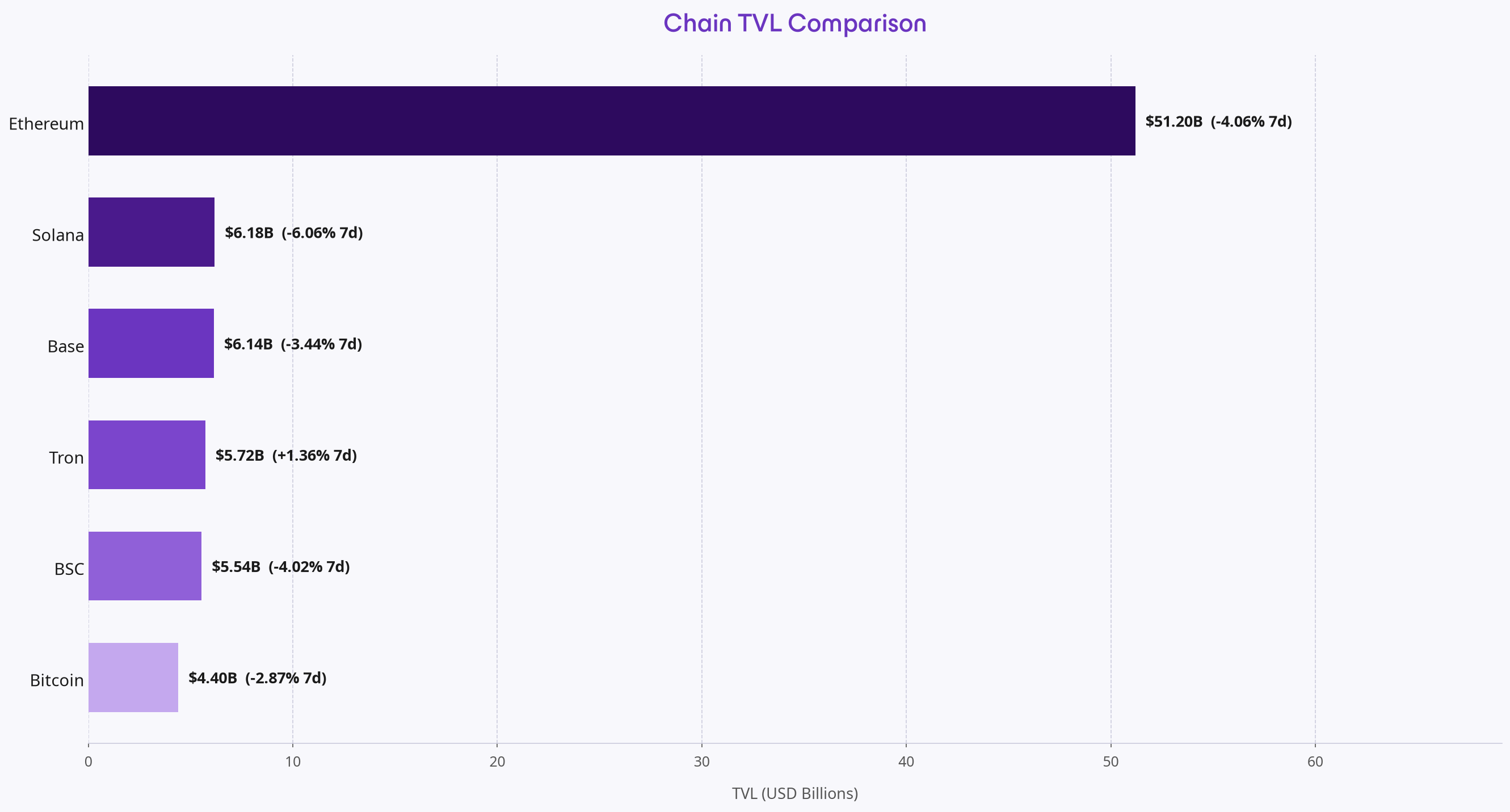
Solana remained the second-largest chain in this comparison at $6.18B after a 6.06% weekly decline. Base held $6.14B after a 3.44% decline, BSC held $5.54B after a 4.02% decline, and Bitcoin DeFi held $4.40B after a 2.87% decline. The Base measure reflects aggregate protocol TVL; it does not measure the trading value or activity of a specific tokenized-stock market.
Tron was the exception among the six charted chains, increasing 1.36% to $5.72B. The weekly comparison is an aggregate capital measure rather than a direct reading of executable position-level depth, exit capacity, or user activity.
Top DeFi Protocols
Lido remained the largest protocol family at $24.12B. It is followed by Aave V3 at $17.26B and Morpho Blue at $11.16B, showing the continued concentration of the largest protocol balances in liquid staking and lending.
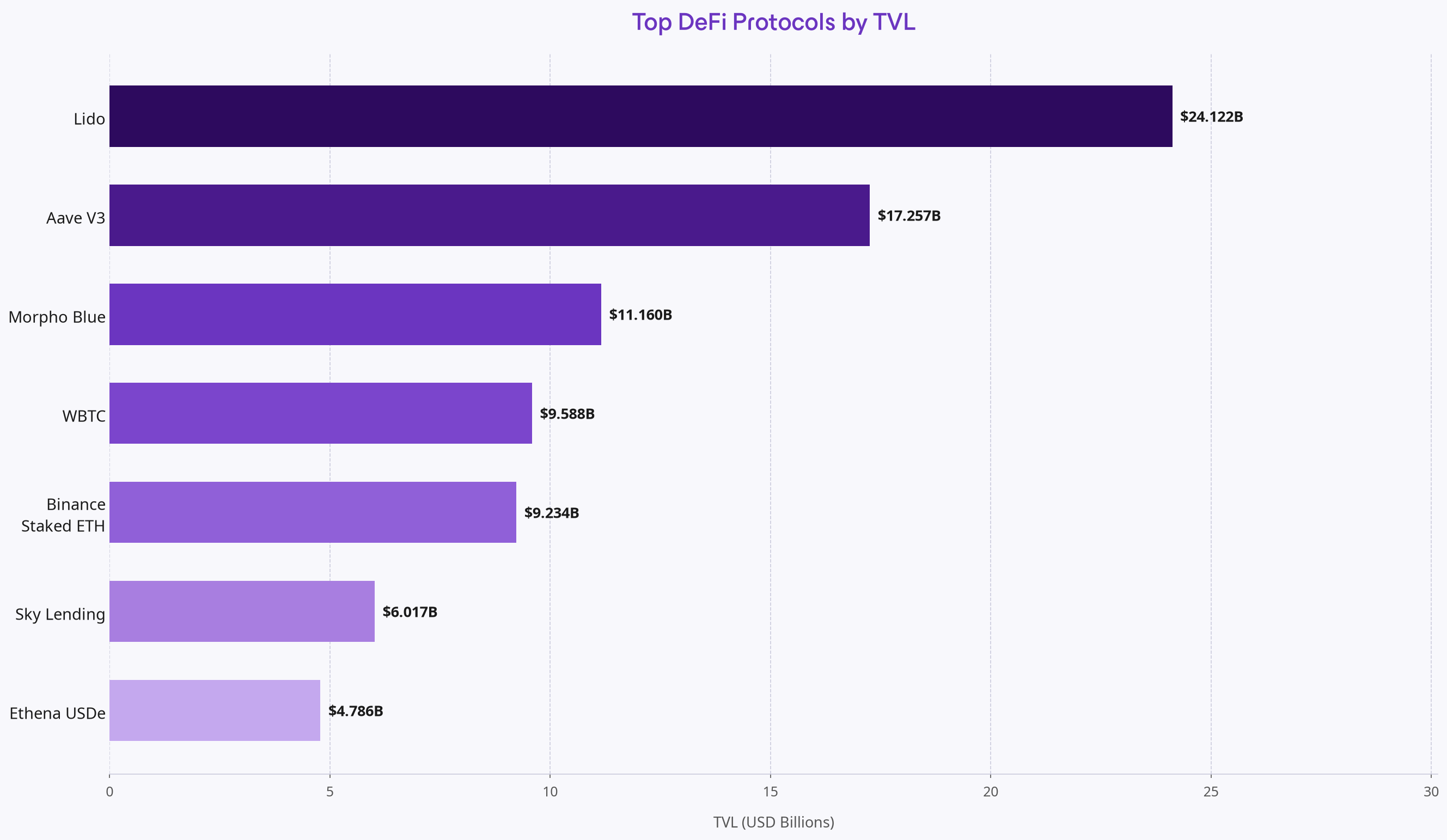
WBTC held $9.59B, Binance Staked ETH held $9.23B, Sky Lending held $6.02B, and Ethena USDe held $4.79B. These categories use different collateral, redemption, governance, counterparty, and operating models, so TVL compares scale rather than protocol risk, revenue, or liquidity quality.
Looking Ahead
Policy Follow-Through After FinCEN’s Withdrawals
The immediate policy event is complete, but the practical implications will depend on whether and how regulators pursue replacement rulemakings, guidance, or enforcement priorities. Self-custody users, application operators, and compliance teams should distinguish a withdrawn proposal from an exemption from existing obligations.
Tokenized-Stock Collateral, Pricing, and Risk Controls
The Aave V4 Base adoption figure and Securitize launch make tokenized stocks the main market-structure theme to monitor.
Readers should separate an underlying equity exposure, token issuer, eligibility terms, oracle schedule, lending market, strategy wrapper, and collateral-management process rather than treating them as one risk layer.
Self-Custody Credit and Permission Security
Ledger’s Morpho integration puts a familiar self-custody interface next to isolated lending markets, while the Base vault incident illustrates the governance and permission risk that can sit around those markets.
Monitor borrowing terms, collateral buffers, wallet and jurisdiction eligibility, and any future incident disclosure before treating either development as a broad safety signal.
Read last week’s edition: DeFi TVL October 2026 Week 1: Balancer Wind-Down
About Portals: Portals is the DeFi Super App. A one-click gateway to the entire onchain economy. Powered by real-time data and seamless execution, Portals connects traders to over 20 million assets, thousands of protocols, and every major blockchain.
Disclaimer: The content of this newsletter is for informational purposes only. It is not investment advice. Please do your own research and consult with a qualified financial advisor before making any investment decisions. DeFi investments carry significant risks, and past performance does not guarantee future results. More details here.
Portals.fi Blog Newsletter
Join the newsletter to receive the latest updates in your inbox.