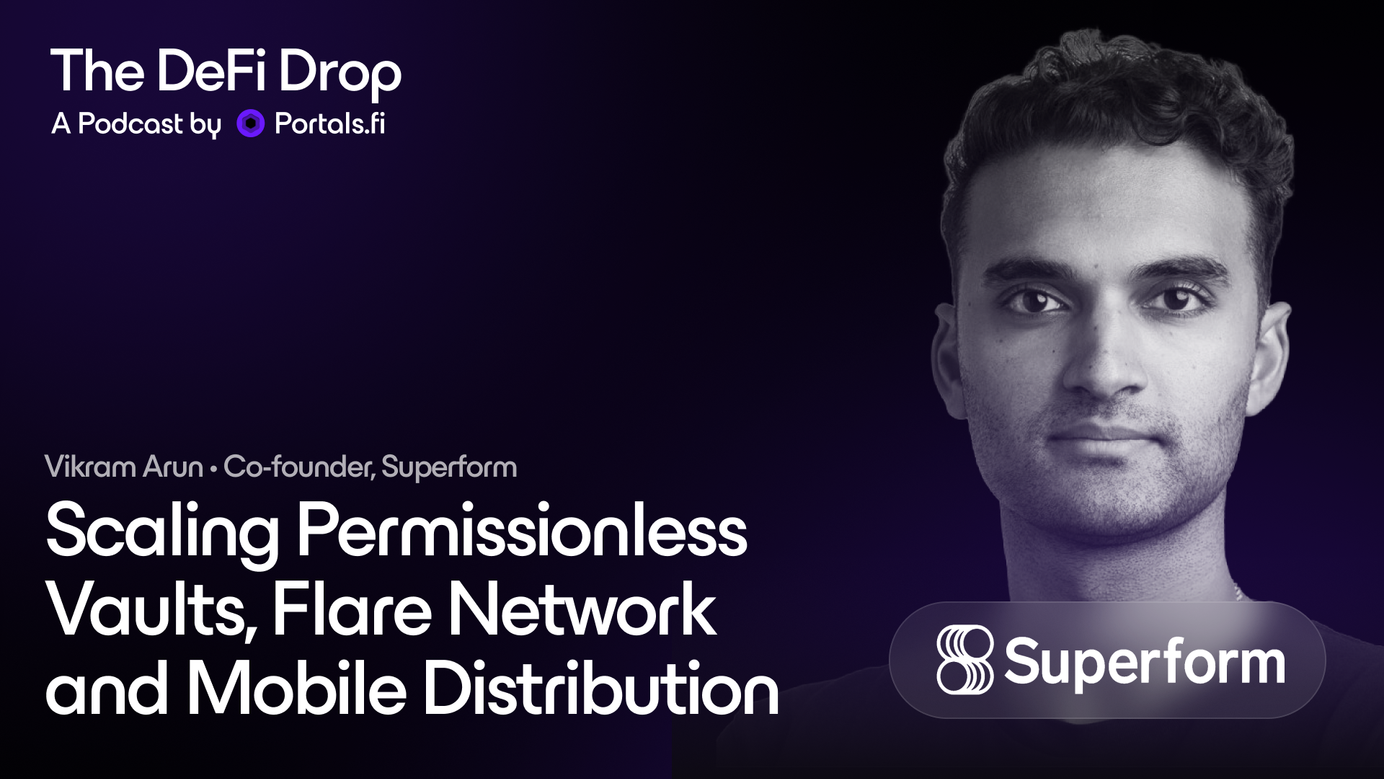
Superform on The DeFi Drop: Scaling Permissionless Vaults and Mobile Distribution
Guest: Vikram Arun, Co-founder and CEO, Superform
Host: Edward Ward, Portals.fi
Scaling Permissionless Vault Creation with Superform OS
In this episode of The DeFi Drop, Edward Ward speaks with Vikram Arun, co-founder and CEO of Superform. The discussion centers on the rollout of Superform OS, their mobile app expansion across the EU, bringing yield to XRP through Flare Network and the mechanics of permissionless vault curation.
Superform OS was built from the ground up to support permissionless scale in vault creation. The core idea is to move away from gating vaults behind expensive B2B contracts. Instead, the smart contracts are entirely on-chain and callable by anyone.
However, genuinely permissionless scale introduces challenges around curation and front-end distribution. To manage this, Superform introduced an upkeep mechanism.
Creators stake UP tokens to gain economic value and front-end visibility. This staked value can be slashed, serving as a measure of the creator's backing and reputation.
"The slashing bond isn't just discouraging bad actors, it's making curators' reputation economically legible on-chain."
The operations of a vault, such as setting rules for lending to Morpho markets or depositing into Euler vaults, are provided out of the box. The cost of running these automations is also activated by staking tokens, ensuring the entire process remains permissionless while maintaining operational integrity.
Bounded Execution and the Curator Landscape
The vault curator landscape has seen significant shifts, with some institutional-type curators bowing out. Superform OS addresses the operational risks by enforcing bounded execution.
Operators act only within disclosed, Merkle-verified rules, and validators attest to the price per share.
Vikram emphasized that Superform OS does not replace curation. Instead, it provides the "body and hands" for curators to execute their strategies securely. By making the strategy behind a vault public and encoding rules on-chain, Superform OS protects against improper execution by third parties.
The curator landscape is bifurcating into two distinct sides. On one hand, large institutions like Bitwise and Apollo are entering the space, focusing on broad distribution networks.
On the other hand, DeFi-native curators are seeking long-tail opportunities and evaluating risk in more complex environments.
Bringing Yield to XRP Through Flare
Superform has launched externally curated SuperVaults on the Flare network, specifically targeting stablecoin and XRP yields. Flare presents a unique opportunity because a massive amount of XRP currently sits off-chain.
By bringing XRP into the EVM ecosystem through fXRP, Flare unlocks new yield opportunities.
Currently, the USDT0 vault on Flare allocates into Mystic Morpho lending vaults, driven largely by network incentives. The fXRP vault also operates within Mystic, with plans to expand into async and cross-chain opportunities, as well as LPing with protocols like Firelight.
Vikram noted that while early yields are heavily incentivized, the long-term goal is for real economic borrow demand for stablecoins and fXRP to replace these incentives as more XRP comes on-chain.
Superform Swap and Intent-Based Bridging
Superform Swap allows users to fund trades with an arbitrary number of input tokens across multiple chains. This is powered by their own bundler and ERC-4337 account abstraction infrastructure.
A major technical challenge in cross-chain execution is handling reverts mid-execution. Superform addresses this by integrating intent-based bridges like Across and deBridge, which shift the atomicity risk.
If a transaction fails, the assets remain custodied in the user's smart account on the destination chain, ensuring security and reducing the monitoring burden.
UP Tokenomics and Community Governance
The Superform community recently voted down a flat 20% APY staking proposal in favor of SIP-8. This new proposal replaces the fixed rate with a revenue-backed base reward, uncapped upside, and a seven-day cooldown.
This vote demonstrated a highly engaged community prioritizing sustainable tokenomics over short-term gains. Over 250 users participated in the vote, showing that holders are paying close attention to the protocol's long-term health. The UP token emissions are now increasingly backed by real protocol revenue.
Mobile Distribution and the Retail User Base
Superform's Q3 focus is heavily on distribution, particularly through their iOS and Android apps. While crypto-native yield farmers remain anchored to the web interface, the mobile app is attracting a different demographic.
The mobile user base is more willing to explore new products like Superform Swap. The focus for mobile is on providing easy fiat on-ramps across various jurisdictions, allowing users to move from fiat directly into stablecoin yield opportunities.
Vikram compared this dynamic to the rise of neobanks like Revolut and Monzo, where smaller, initial deposits from curious retail users signal broader adoption.
Superform aims to provide this accessible entry point while maintaining the underlying crypto-native infrastructure.
TVL Prediction: $100 Billion by 2026
When asked for his prediction on total DeFi TVL by New Year's Eve 2026, Vikram offered an optimistic but measured forecast of $100 billion.
With TVL sitting at $73 billion at the time of recording, he noted that a recovery in major asset prices, such as ETH returning to $3,000, would likely bridge the gap.
Explore DeFi Protocols with Portals
Portals.fi is a DeFi aggregation platform that lets users swap tokens, discover yields, and manage positions across 20+ blockchains from a single interface.
Whether you are exploring new protocols or managing an existing portfolio, Portals searches across hundreds of liquidity sources to find the optimal route for every transaction.
Visit portals.fi to get started.
This article is for informational purposes only and does not constitute financial advice. DeFi protocols carry inherent risks including smart contract vulnerabilities, liquidation risk, and market volatility.
Always conduct your own research before interacting with any protocol. For our full disclaimer, please visit disclaimer.
Portals.fi Blog Newsletter
Join the newsletter to receive the latest updates in your inbox.