YieldBasis Gauge Now Live and Verified on Portals
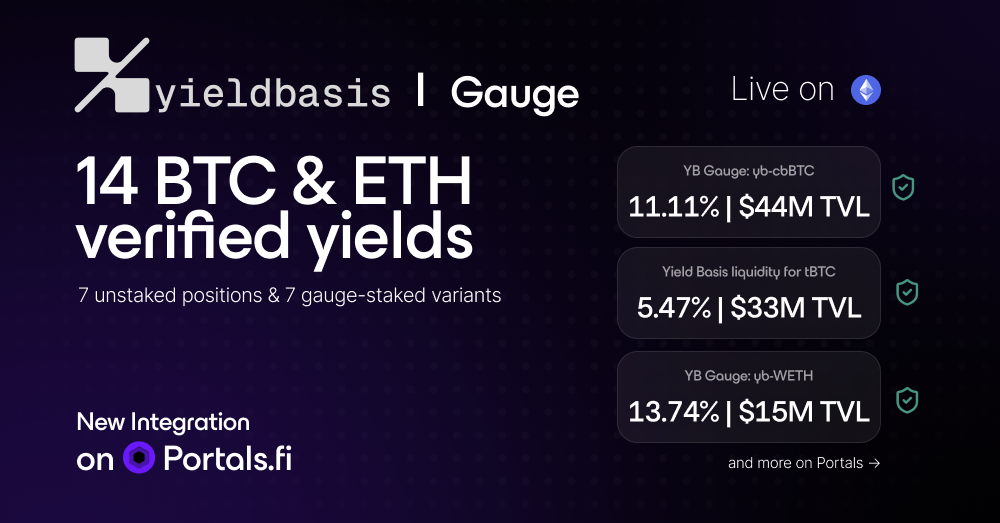
YieldBasis is now supported on Portals. Positions from the YieldBasis ecosystem, including the YieldBasis Gauge variant, are live and verified on the Portals Explorer, where users can browse them alongside opportunities from across DeFi.
This article reflects the status of the integration described as of the publication date. Supported positions and protocols can be removed from public access, deprecated, or otherwise changed at any time after this article is posted.
Portals does not undertake to update this article when that happens. The current status of any position can be checked on the Portals Explorer.
This article walks through what YieldBasis is, how it addresses one of the oldest problems in AMMs, and where it fits in the broader DeFi landscape.
What YieldBasis is
YieldBasis is a liquidity protocol that sits on top of Curve's infrastructure and aims to solve impermanent loss for liquidity providers.
It was created by Michael Egorov, the founder of Curve Finance, and represents one of the most significant pieces of mechanism design to come out of the Curve ecosystem in recent years.
The headline pitch is simple: provide liquidity to a YieldBasis pool, earn the trading fees of an AMM, and keep the price exposure of simply holding the underlying asset. The mechanism that makes this possible is more involved.
How YieldBasis addresses impermanent loss
Impermanent loss is the long-standing tax that liquidity providers pay in standard AMM designs. When the price of one asset in a pool moves relative to the other, the pool rebalances by selling the appreciating asset and buying the declining one.
The result is that an LP holding a 50/50 pool ends up with less of the asset that performed well than they would have had if they had just held it.
YieldBasis sidesteps this by maintaining constant 100 percent exposure to one asset (in the canonical example, BTC) using a combination of leverage and crvUSD borrowing.
The mechanism works as follows. A user deposits an asset like BTC into YieldBasis. The protocol borrows an equivalent dollar amount of Curve's crvUSD stablecoin and pairs the BTC and crvUSD into a Curve liquidity pool.
Because the protocol holds debt against the BTC position, the LP's net exposure stays at 100 percent of the underlying asset rather than the 50 percent it would be in a standard AMM pool. The pool earns trading fees as normal; the leverage offsets the rebalancing dynamics that produce impermanent loss.
The result resembles a constant-leverage carry trade: the LP gets the trading fees of an AMM position and the price exposure of holding the asset, while borrower interest on the crvUSD loan is recycled back into the LP position itself.
The Gauge variant
Following the Curve pattern, YieldBasis exposes two earning modes for the same underlying position. Holders of the LP token (ybBTC) can either hold it unstaked to receive trading fees in the underlying asset, or stake it in the protocol's gauge to forgo trading fees and receive YB token emissions instead.
The two modes are mutually exclusive: a dynamic admin fee adjusts based on staking participation, balancing rewards between fee-earners and emission-earners.
Users who prefer to receive trading fees in the underlying asset hold the un-gauged variant. Users who prefer exposure to YB emissions stake into the gauge. The un-gauged variant also remains available for users who want to use the position elsewhere in DeFi without the additional staking step.
What problems does YieldBasis solve?
Impermanent loss is the structural problem that has shaped AMM design for years. Most attempts to address it work by changing the curve, restricting which assets can be paired, or moving to concentrated liquidity.
YieldBasis takes a different angle: keep the standard AMM, change the position structure around it.
For LPs, this means a path to providing liquidity on volatile pairs without the directional drag that has historically made volatile-pair LPing unattractive.
For Curve, it adds a new product category to the ecosystem and creates structural demand for crvUSD, which is borrowed in size to back YieldBasis positions.
Notable features
A few things stand out about YieldBasis relative to other liquidity protocols:
- Built on Curve. The protocol uses Curve's existing AMM infrastructure rather than building a new one. This gives it immediate access to deep liquidity, established tooling, and the broader Curve incentive ecosystem.
- Constant-leverage design. The 2x leverage maintained against deposited assets is what produces the impermanent-loss-resistant property.
- crvUSD-native. The protocol uses crvUSD as the borrowed leg, which ties YieldBasis directly into Curve's stablecoin ecosystem.
- Gauge integration. Standard Curve-style emissions distribution means YieldBasis pools can be incentivised the same way Curve pools are.
Risks worth understanding
YieldBasis is a leveraged protocol, so the risk surface includes everything that comes with leverage in DeFi.
Smart contract risk applies at multiple layers: YieldBasis itself, the Curve AMM infrastructure underneath, and crvUSD as the borrowed asset.
Liquidation risk applies if the underlying asset price moves in a way that breaks the protocol's leverage assumptions. crvUSD peg risk applies indirectly, since crvUSD is held in the LP position and depegs would affect the position's value.
Variable yield is the standard caveat: AMM trading fees and emissions are both variable. None of this is unique to YieldBasis. It is the standard risk surface of a leveraged DeFi liquidity product.
Where YieldBasis fits in DeFi
YieldBasis sits at the intersection of two long-running themes in DeFi: the search for impermanent-loss-resistant liquidity provision, and the build-out of the Curve stablecoin ecosystem.
Both have been active areas of research and product development for years; YieldBasis combines them into a single, coherent product.
For a Portals user browsing the Explorer, YieldBasis adds a category of yield that has historically been difficult to access cleanly: trading-fee yield from volatile-pair liquidity provision, without the directional drag that usually comes with it.
The Gauge variant lets users opt for YB emissions in place of trading-fee yield.
YieldBasis via Portals.fi
Portals.fi is a DeFi aggregation platform that surfaces curated yield positions across major protocols through a unified interface.
Users exploring YieldBasis can find supported positions, including the Gauge variant, on the Portals Explorer alongside opportunities from other protocols, accessible from a single access point.
For more information about how Portals.fi works
This article is for informational purposes only and does not constitute financial advice. DeFi protocols carry inherent risks, including smart contract vulnerabilities, leverage and liquidation risk, stablecoin peg risk, AMM dynamics, and variable yield.
Information in this article is current as of the publication date and may not reflect later changes to the protocol or its products. Always conduct your own research before interacting with any protocol. For our full disclaimer, please visit here.
Portals.fi Blog Newsletter
Join the newsletter to receive the latest updates in your inbox.