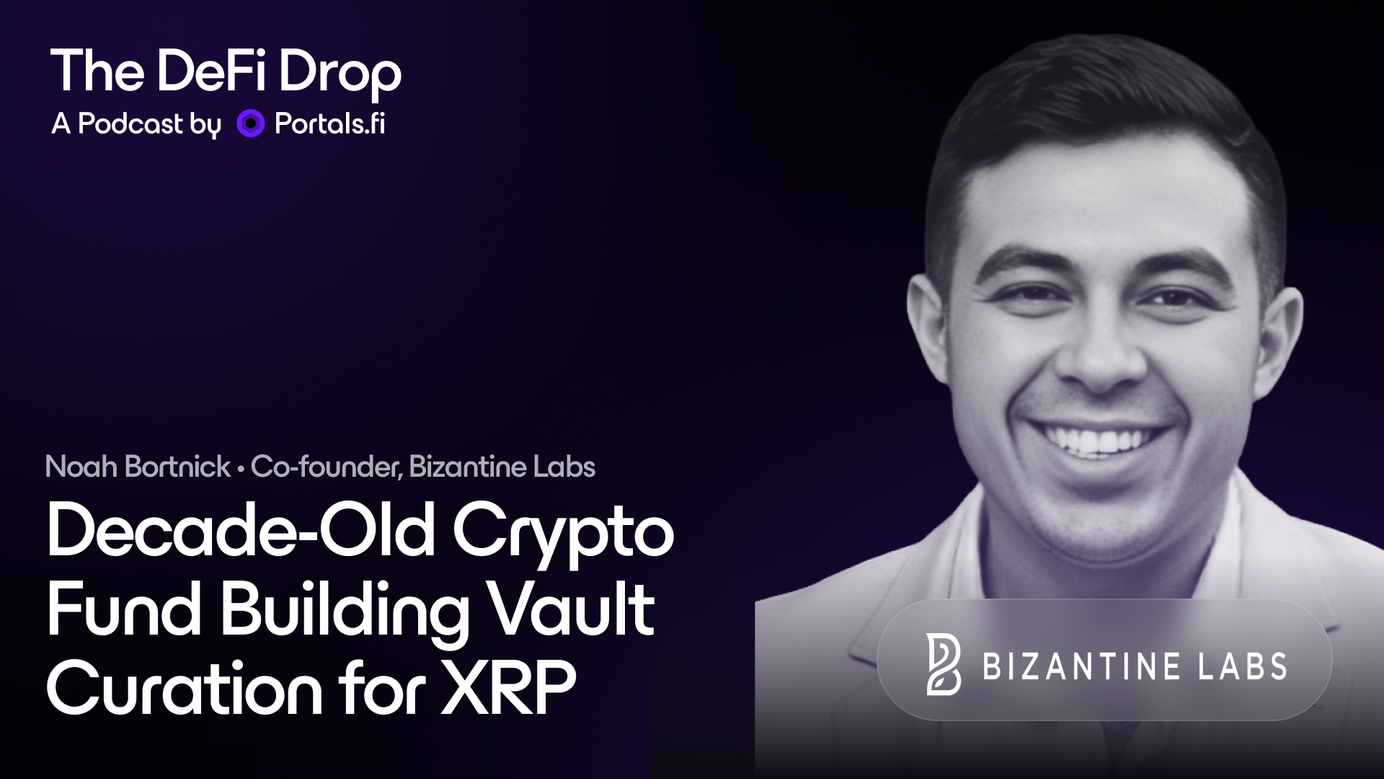
Bizantine on The DeFi Drop: A Decade-Old Crypto Fund Builds Vault Curation for XRP
Guest: Noah Bortnick, Partner, Bizantine Capital and Co-founder, Bizantine Labs Host: Edward Ward, Portals.fi
A Ten-Year Fund Brings Institutional Discipline to Vault Curation
In this episode of The DeFi Drop, Edward Ward speaks with Noah Bortnick, Partner at Bizantine Capital and co-founder of Bizantine Labs, the risk and vault curation arm of one of crypto's longest-running funds.
Bizantine Capital has been active since the 2016 to 2017 era, an Ethereum-focused fund operating across multiple chains. Bizantine Labs now brings that decade of fund management experience to DeFi vault curation, with its first live products built on the Flare network and distributed through Superform.
The conversation covers Noah's path from a university blockchain club to running crypto asset managers, why a fund chose to spin out a separate curation business, and how Bizantine is building yield infrastructure for XRP, an asset that has barely touched DeFi despite its size.
From a Kansas Blockchain Club to a Decade of Crypto Funds
Like most people in the space, Noah has a crypto origin story. His began in high school, listening to his future business partner talk about Bitcoin and Ethereum. The interest did not fully land until he reached the University of Kansas, where Ripple CEO Brad Garlinghouse, a KU alumnus, had helped start a blockchain institute on campus.
What began as a once-a-month meeting in his sophomore year turned into a career. Noah went on to help run a series of boutique crypto asset managers, including Black Box Digital and Carpathian Capital, typically managing between one and thirty million dollars. While completing an MBA at the same time, his focus settled not on speculative trading but on treasury management and sustainable cash flows.
He was candid about why directional bets never appealed to him.
"Buying and selling, those days were great when you could buy the liquid speculative funds and boom, you go up. I was never really that interested in that side of it. It felt like gambling."
DeFi offered something he had not seen before: yields that could be engineered into a repeatable treasury strategy rather than a wager on price.
Why a Fund Spun Out a Separate Curation Arm
Bizantine made the decision to build a dedicated curation business in late 2025. The logic was structural.
Standing up another traditional fund means repeating the same playbook every time: lawyers, legal structure, capital raise, fund administrator.
Meanwhile, Noah watched a wave of vault curators build large brands quickly, a difficult thing to do under US advertising and marketing rules for fund managers.
Bizantine wanted a way to operate publicly as a curator while keeping the discipline of a fund. Noah, who leads DeFi at the firm, had spent years close to vault providers and curators, and a set of network relationships, Flare in particular, turned that direction into live products.
He was direct about the risk in the curator landscape, noting that some institutional-type curators had recently gone away, a reminder that this is not a guaranteed business.
"All these vault curators are blowing up. Some of the curators are blowing up, some of the institutional type of curators are going away."
The broader lesson Noah draws from a decade across four different funds is to plan for downturns before they arrive.
"Don't even wonder if there's going to be bad times. Prepare for those bad times. Create the systems that you don't even have to make a decision on, that will be in place to ensure that when those bad times hit, not only do you survive, you can take advantage."
Security as the Base Layer
For Noah, the parts of a strategy a curator can actually control sit at the base level, and security comes first.
Bizantine's infrastructure uses Hypernative for on-chain monitoring, institutional MPC wallet infrastructure for custody, and a governance setup built around multi-signature safes with defined policies, including a move to three-of-five key structures on signing wallets.
He framed this as the difference between a polished front end and the substance underneath. Launching a vault is not as simple as deploying a Lagoon or Upshift contract.
The work that separates a serious curator, in his view, is the security model, the infrastructure risk, and the real liquidity available behind a strategy, rather than the headline yield.
Bringing Yield to XRP Through Flare
The Flare opportunity is what makes this episode timely. Flare is an EVM Layer 1 purpose-built to bring assets like XRP into DeFi, representing XRP on-chain as FXRP through its FAssets system.
XRP is one of the largest crypto assets by market capitalisation, yet very little of its supply is active in DeFi, and its community has historically sat outside it.
Noah's view is that this is a missed opportunity for holders sitting on idle assets.
"If I can create some amount of passive income each month, there it is. If you have all these assets sitting on a ledger or a hot wallet, why would you not try to put them to work?"
Bizantine already has a USDT0 vault live on Superform that has been running on Flare for several weeks. It lends primarily into the core FXRP money market on Flare, a market curated by Clearstar Labs, which Bizantine views as a low-risk venue for the rewards on offer.
Roughly 92 percent of the vault is deployed, with the remainder held in reserve for orderly redemptions.
The yield split matters. Noah explained that around four and a half to five and a half percent is native yield, with Flare incentives adding roughly eight to twelve percent on top, depending on the moment.
Bizantine harvests those emissions monthly, swaps the optimal portion back into USDT0, and continues to compound. Because Flare is incentivising the opportunity heavily, the governance committee actively reviews whether the vault should diversify into additional yield sources over time.
A week or two earlier, the firm also launched a stablecoin vault on Flare yielding in the region of twelve to seventeen percent including UP token rewards.
His incoming FXRP SuperVault on Superform is the next step, going live imminently, and will be among the first XRP yield products distributed through an aggregator.
Skin in the Game
A recurring theme was that Bizantine allocates its own capital alongside depositors in its products, whether funds or vaults.
Noah argued this is a discipline mechanism rather than a marketing line. When your own money sits in the vault, you double-check that signing wallets are configured correctly, that key structures are right, and that governance policies are in place.
He also pointed, carefully, to past vaults elsewhere that went badly while their managers carried serious exposure, evidence that skin in the game is necessary but not sufficient. The principle still holds.
"Nobody cares about your money more than you care about your own money."
Distribution and the Discoverability Gap
Edward noted that Portals has just added the Flare network to its platform, with Bizantine's and Superform's vaults set to be among the first Flare positions live on Portals.
Portals is deliberately cautious about which chains it adds, prioritising proven networks and engaged communities over a long list of names.
From a curator's seat, Noah sees distribution as a real bottleneck. Flare is not yet integrated with many aggregators, and getting strategies discoverable has been a genuine process, even as DeFi Llama picks up some chain data. He was direct that solving discoverability is where aggregators earn their place.
"You guys are the first, to my knowledge, to do that. That puts you ahead, and you guys are focused on vault distribution. That's a huge audience that I would hope the industry taps into."
Flare's total value locked has risen sharply as it has attracted XRP capital, which makes the gap between live capital and discoverable capital more consequential, not less.
Where Bizantine Fits Among the Big Names
With Apollo, Bitwise, Kraken and Coinbase all now involved in DeFi vaults in some form, Edward asked where a firm like Bizantine fits as larger names build their own infrastructure.
Noah's answer was that the model already runs through crypto-native curators. Coinbase routes deposits through a Morpho vault curated by Steakhouse, and the Apollo and Coinbase arrangement needed a crypto-native underwriter sitting in between on the protocol.
Bizantine is not trying to chase a one-to-five-billion-dollar traditional registered advisor sitting on 401ks. Noah was clear that the terminology gap with that world is too wide, and that side is better left to the BlackRocks of crypto.
Bizantine is set for crypto-native institutions, on-chain high-net-worth individuals and DAOs, building strategies and vault structures suited to capital that is already on-chain or ready to come on-chain.
On the institutional on-ramp, he highlighted insurance as a step in the right direction, pointing to the vault cover initiative through OpenCover and Nexus Mutual.
He has seen this firsthand with Asian family offices and LPs, where regulations in markets like Korea require that type of cover, and where customisable, affordable protection can be the difference that brings capital on-chain.
DeFi TVL Prediction
At the time of recording, total value locked across DeFi sat at roughly 73 billion dollars per DeFi Llama. The DeFi Drop asks every guest where they think that number lands on 31 December 2026.
Noah declined to put a hard figure on it, but framed it as a recovery story. Given the capital that has left DeFi through recent exploits, which he sees as learnable and fixable, he believes clawing back around 30 percent toward prior levels by year end is very doable. He would rather it happen sustainably than fast.
"Slow growth is sustainable growth. Every time we see quick growth in this industry, it's a trend that comes back down."
A measured, optimistic call to close one of the more operationally grounded conversations the show has had.
About Bizantine
Bizantine Capital is one of crypto's longest-running funds, active since the 2016 to 2017 era and originally focused on Ethereum across multiple chains.
Bizantine Labs is its risk and vault curation arm, bringing institutional fund management discipline to on-chain strategies, with its first live vaults built on the Flare network and distributed through Superform.
About Portals.fi
Portals.fi is the DeFi Super App, a one-click gateway to the entire on-chain economy. Powered by real-time data and seamless execution, Portals.fi connects traders to over 20 million assets, thousands of protocols, and every major blockchain.
Explore yields and strategies through the Portals Explorer.
This article is for informational purposes only and does not constitute financial advice. DeFi protocols carry inherent risks including smart contract vulnerabilities, liquidation risk and market volatility.
Always conduct your own research before interacting with any protocol. For our full disclaimer, please visit disclaimer.
Portals.fi Blog Newsletter
Join the newsletter to receive the latest updates in your inbox.