DeFi Drop: Midas and RWA Tokenization
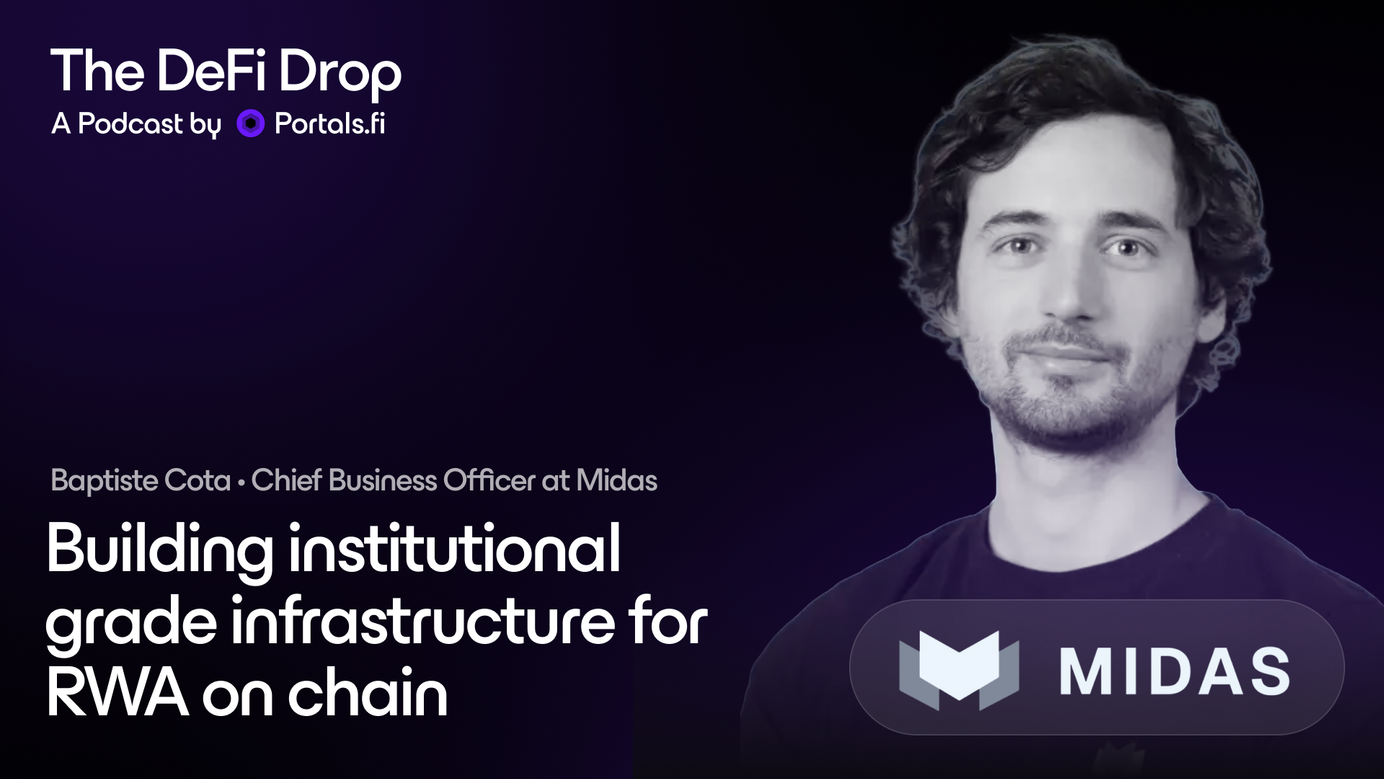
Guest: Baptiste Cota, Chief Business Officer, Midas
Host: Edward, Portals.fi
From Goldman Sachs to RWA Tokenization
Baptiste Cota, Chief Business Officer at Midas, joined the DeFi Drop to break down how the Berlin based asset tokenization protocol is building institutional grade infrastructure for real world assets on chain.
With $2.1 billion in assets issued, $43 million in yield distributed and a $50 million Series A led by Franklin Templeton and Coinbase Ventures, Midas has become one of the most important pieces of RWA infrastructure in DeFi.
Baptiste's path to Midas started at Goldman Sachs in equity research, where he worked alongside Dennis, the current CEO and co-founder.
After four years he left to launch a blockchain focused venture capital fund, raising $50 million and deploying into around 20 startups including Talos, Kiln, Token Terminal and BitPanda. When Dennis invited him to join Midas, the move from investor to operator felt natural.
Why Institutions Are Moving While Retail Retreats
Fear and greed indicators are near historic lows and retail sentiment has been shaky, yet 73% of institutional investors plan to increase crypto exposure this year.
Baptiste explained that institutions operate on fundamentally different timelines. Any announcement you see today has been in the works for six months or longer, and a market dip does not change the underlying commitment.
The deeper point is that crypto prices will matter increasingly less to what is actually being built on chain. BlackRock did not wake up one morning and decide to tokenize a money market fund because BTC went up. They understood the technology, mapped it out and executed.
Baptiste believes tokenized assets will eventually be worth more than the crypto market cap itself. The rails are proven, stablecoins are everywhere, and tokenization will follow.
Making RWAs Compatible with DeFi
The core challenge Midas works on every day is making tokenized real world assets behave like native on chain tokens. Entry into a leveraged RWA position can be atomic, but closing it is structurally broken.
The token lives on chain while the asset does not, so exit is expensive and slow.
Midas approaches this on two fronts. First, building products that add instant liquidity to the tokens they issue. Second, working with DeFi protocols to evolve their infrastructure to accommodate RWA characteristics.
The most important product on the first front is MSL, Midas Stake Liquidity.
How MSL Solves the Exit Problem
MSL is Midas's answer to the liquidity gap between on chain tokens and off chain assets. Currently funded from the $50 million raise, MSL will open to external depositors this summer.
External participants commit stablecoins and earn yield for absorbing the duration gap, with their loan sitting senior to token holders.
The system has two key mechanics. First, a loan mechanism: when someone redeems an mToken instantly, the mToken portfolio borrows from MSL, and those stablecoins are sent to the redeeming investor.
If MSL enables instant redemption for 10% of an mToken, the loan is backed by roughly 9x its value, making it an extremely safe position in LTV terms.
Second, a holdback mechanism that protects remaining token holders from stale pricing. Because on chain prices for off chain assets cannot update every block, there is always an arbitrage risk.
The holdback gives the redeemer 90 to 95 cents on the dollar immediately, with the remainder paid once a new NAV arrives, minus an instant redemption fee ranging from 10 to 100 basis points depending on the product.
Three Layers of Instant Liquidity
MSL is not the only line of defence. Baptiste described three distinct liquidity layers that Midas maintains for its products.
The first layer is internal liquidity. Certain products like mF1 and mGlobal hold around 10% of their portfolio in instantly redeemable assets, deployed into T-Bills or Aave.
If a redemption hits, the system automatically pulls funds and sends them through.
The second layer is MSL itself, which sits above the internal reserves and provides the loan and holdback mechanics described above.
The third layer is OTC partners and external liquidity providers. For mGlobal, these include Fasanara (the fund's own manager), Infinify and Symbiotic Liquid Lane. These are bilateral trades in which the redeemer transfers tokens to a counterparty and receives stablecoins in return.
Baptiste also noted that most Midas products settle T+1 to T+3, which means liquidators in practice simply redeem normally and collect the liquidation bonus. Atomic instant settlement is not always necessary for protocol solvency.
What Gets Tokenized Next
Midas has expanded from mTBILL, its flagship Treasury product, into credit, basis trading, MEV strategies and BTC exposure.
Baptiste said the current market is gravitating toward low risk, principal protected products with single to mid single digit yields and minimal drawdown risk.
Recent launches reflect this. mGlobal is an asset backed credit fund managed by Fasanara with $3 billion in AUM across their flagship fund.
Midas is also working on an investment grade and CLO combined product offering mid single digit returns with a premium over T-Bills. A Euro denominated product is coming soon as well.
On the other end, Baptiste flagged real estate tokenization as structurally unsuitable for now. It has been talked about for six or seven years since the STO era, but the distribution challenges on chain, the lack of DeFi composability use cases and the difficulty of making it palatable to on chain investors make it a poor fit in the current environment.
Regulatory Architecture as a Competitive Moat
Midas spent over a year getting authorized by Liechtenstein's FMA, with products structured under German law and issued as securities under European regulation.
Baptiste drew a clear line between genuine DeFi protocols, which often do not need licensing, and tokenization businesses like Midas that issue products pointing to actively managed strategies and transferable assets.
Those products are securities, and when you issue securities, laws apply. Baptiste was blunt: a lot of players in the space are issuing products that qualify as securities without appropriate authorizations, licenses, documentation or risk disclosures.
With MiCA's transitional period ending on July 1st, that dynamic is about to shift.
The regulatory work unlocks institutional distribution. Without defined legal frameworks, the large platforms that service retail populations will not move. Their legal and compliance teams need to understand what they are buying.
It is not fun, Baptiste acknowledged, but it is necessary to bring tokenized assets to a broader audience.
Failure Modes and the Off Chain Advantage
When asked to rank his biggest concerns, Baptiste put strategy underperformance first.
Smart contract exploits ranked lower because of a key architectural feature: funds invested through custodians into real world assets are simply unreachable by on chain attackers.
If someone hacks the mGlobal smart contract, they cannot access the underlying fund. The assets are not on chain.
This separation between the on chain issuance and redemption layer and the off chain custodial layer is the architectural distinction most people miss.
Every risk is disclosed in the legal documentation, and all products come with defined investor rights under a framework built to hold up under scrutiny.
TVL Prediction
Baptiste predicted total DeFi TVL (per DeFi Llama) would reach $110 billion by New Year's Eve 2026. Current TVL at the time of recording sat at $72 billion. A bullish call, but as he put it: if you work in this space, you have to believe.
Key Takeaways
Midas has built a comprehensive RWA tokenization stack that combines European securities regulation, institutional custody, three layers of instant liquidity and a growing product suite spanning Treasuries, credit and basis strategies.
The $50 million Series A with Franklin Templeton on the cap table validates the approach. MSL opening to external depositors this summer will be a significant milestone for on chain RWA liquidity.
The protocol currently has $2.1 billion in assets issued across multiple products, with integrations live on Morphoin which the redeemer transfers tokens to a counterparty and receives stablecoins in return, Pendle and over 20 other DeFi protocols.
As tokenized real world assets continue to grow, Midas's combination of regulatory compliance, structured liquidity and institutional grade risk management positions it as a key piece of infrastructure for the next phase of DeFi.
Explore DeFi Protocols with Portals
Portals.fi is a DeFi aggregation platform that lets users swap tokens, discover yields and manage positions across 20+ blockchains from a single interface.
Whether you are exploring new protocols or managing an existing portfolio, Portals searches across hundreds of liquidity sources to find the optimal route for every transaction.
Visit portals.fi to get started.
This article is for informational purposes only and does not constitute financial advice. DeFi protocols carry inherent risks including smart contract vulnerabilities, liquidation risk and market volatility.
Always conduct your own research before interacting with any protocol. For our full disclaimer, please visit disclaimer.
Portals.fi Blog Newsletter
Join the newsletter to receive the latest updates in your inbox.