DeFi TVL May 2026 Week 4: AI Security Threats & Hyperliquid ETF Inflows
The final week of May 2026 kicked off with a warning from OpenZeppelin regarding AI-driven smart contract exploits, alongside continued institutional momentum for Hyperliquid ETFs.
Total DeFi TVL has contracted to $79.17B amid a broader market pullback, with Bitcoin slipping to $73,882 and Ethereum testing the $2,035 level.
Despite the drawdown, stablecoin market cap remains robust at $320.81B, and hardware wallet provider Trezor has integrated Morpho to bring native stablecoin yields to its 2 million users.
Here is your weekly breakdown of the top protocols, biggest chain movers, and fresh yield opportunities verified on Portals Explorer.
Market Pulse
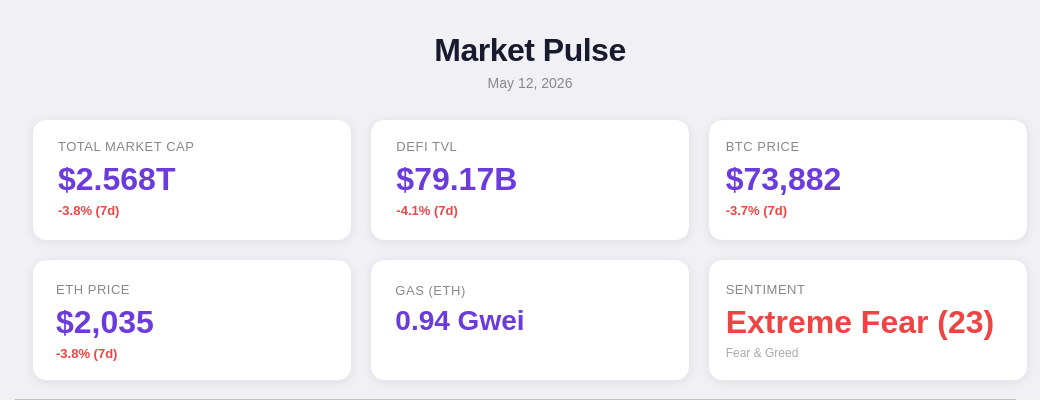
- Total Market Cap: $2.568T (-3.8% 7d)
- Total DeFi TVL: $79.17B
- Stablecoins Market Cap: $320.81B
- BTC Price: $73,882 (-3.7% 7d)
- ETH Price: $2,035 (-3.8% 7d)
- Gas (ETH): 0.94 Gwei
- Sentiment: Extreme Fear (23)
The market experienced a remarkable contraction this week, with the total market cap falling 3.8% to $2.568 trillion. Bitcoin (BTC) retreated 3.7% to $73,882, while Ethereum (ETH) saw a similar 3.8% decline to $2,035. This price action directly impacted TVL across DeFi, which dropped 4.1% to $79.17 billion.
Market sentiment has plummeted into "Extreme Fear" territory, registering a score of 23 on the Fear & Greed Index. Ethereum gas fees remain exceptionally low at 0.94 Gwei despite the volatility, and the stablecoin market cap held steady at $320.81 billion, showing that capital is rotating into stable assets rather than exiting the ecosystem entirely. Let's jump into what's new with yields.
The Yield Market Pulse
The yield scenario this week clearly demonstrates the market's rotation toward stablecoin and delta-neutral strategies. As directional volatility increases, liquidity providers are seeking shelter in fixed-rate products and established lending markets.
Pendle's principal tokens (PT) continue to offer attractive fixed yields, while HyperEVM and Arbitrum are emerging as competitive environments for stablecoin deployment.
Top Opportunities This Week
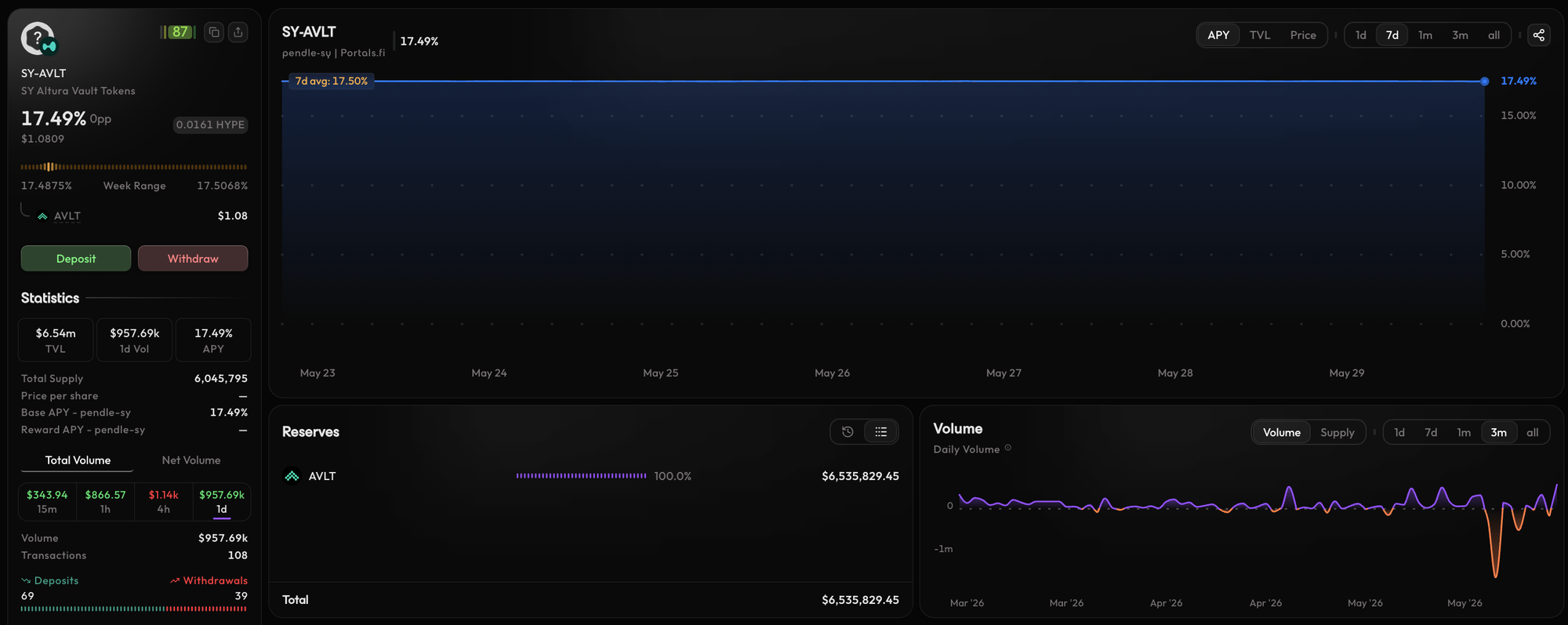
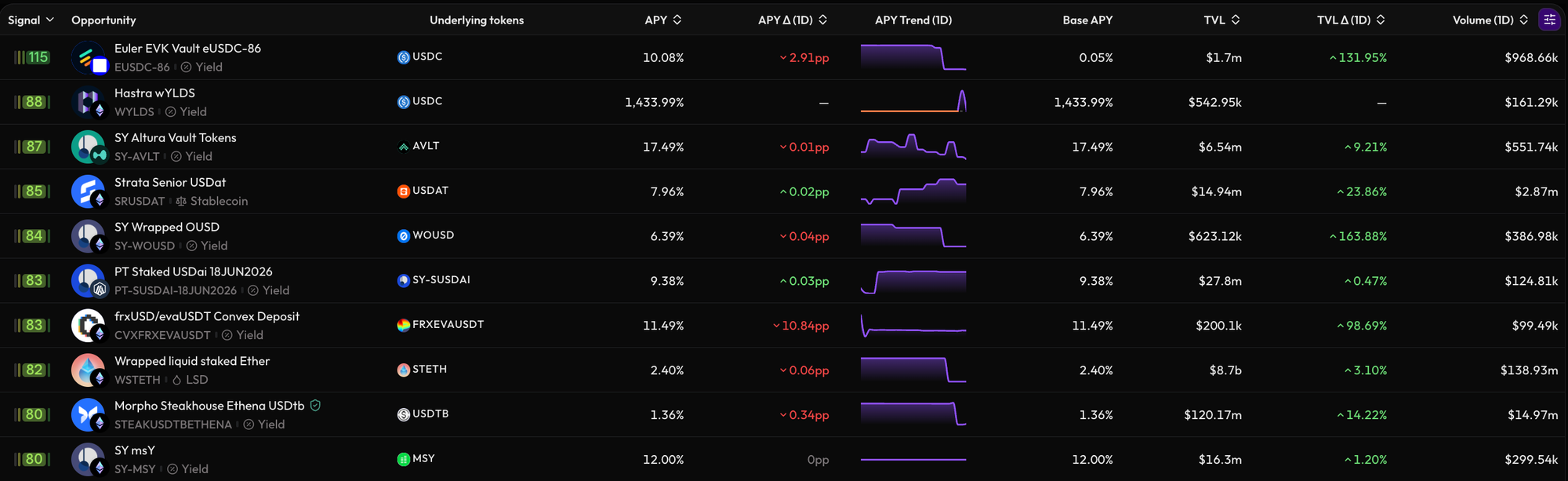
Operating on the HyperEVM, this Pendle-integrated vault is currently generating a 17.49% APY. With $6.54M in TVL.
A high-yield opportunity for users comfortable with the emerging Hyperliquid ecosystem. The vault leverages Altura's infrastructure to optimize returns on deposited assets.
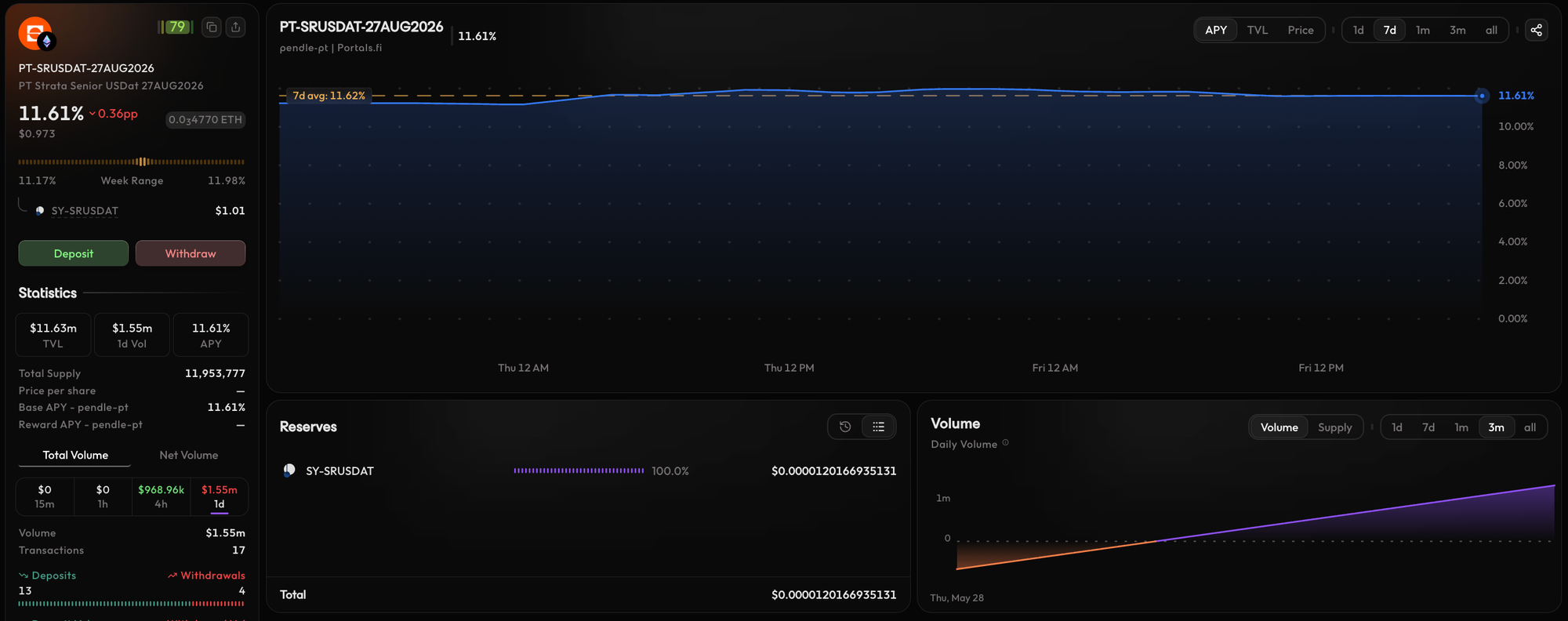
This Principal Token on Pendle offers a fixed 11.61% APY, maturing on August 27, 2026. Operating on Ethereum, the pool has attracted $11.63M in TVL.
By utilizing Strata's senior tranche architecture, it provides a predictable, fixed-rate return for USDat depositors seeking to lock in double-digit yields through the summer.
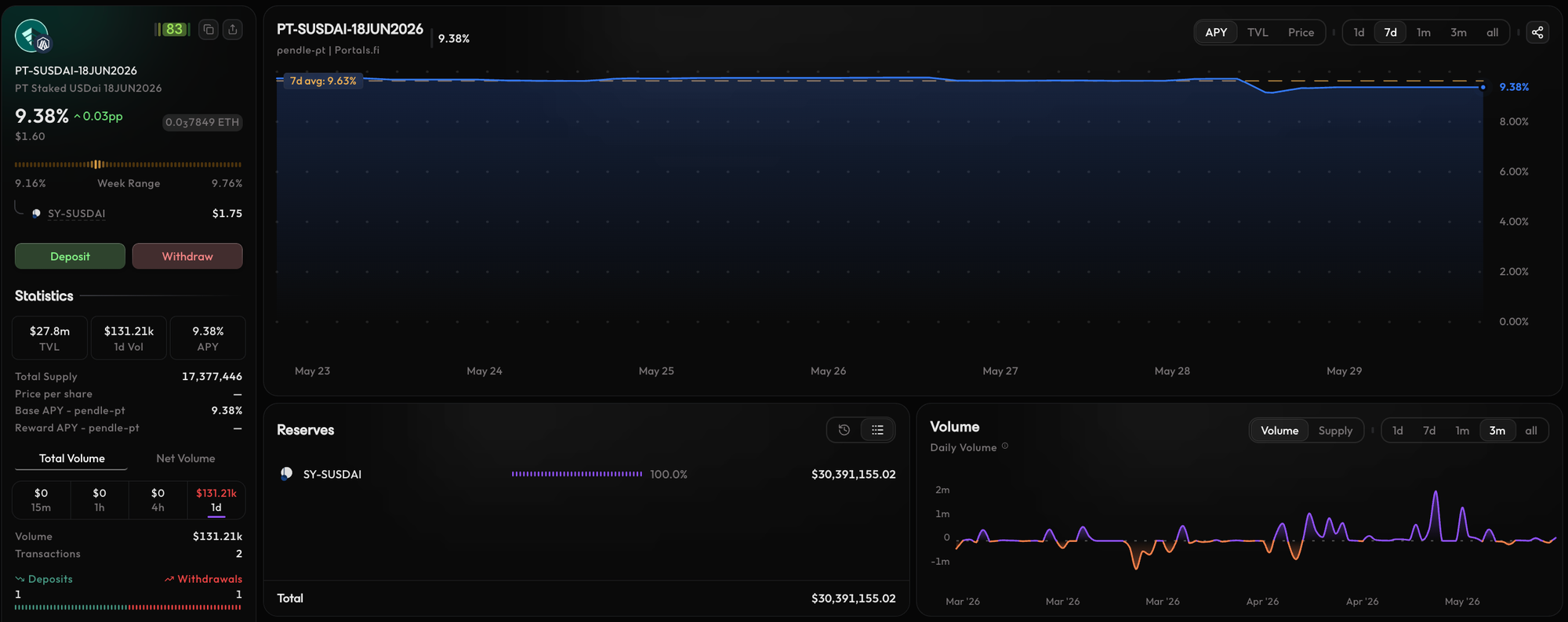
This Pendle Principal Token on the Arbitrum network delivers a fixed 9.38% APY with a near-term maturity of June 18, 2026.
The pool's substantial $27.80M in TVL, makes it a highly liquid option for users looking to secure a fixed yield on USDai while benefiting from Arbitrum's lower transaction costs.
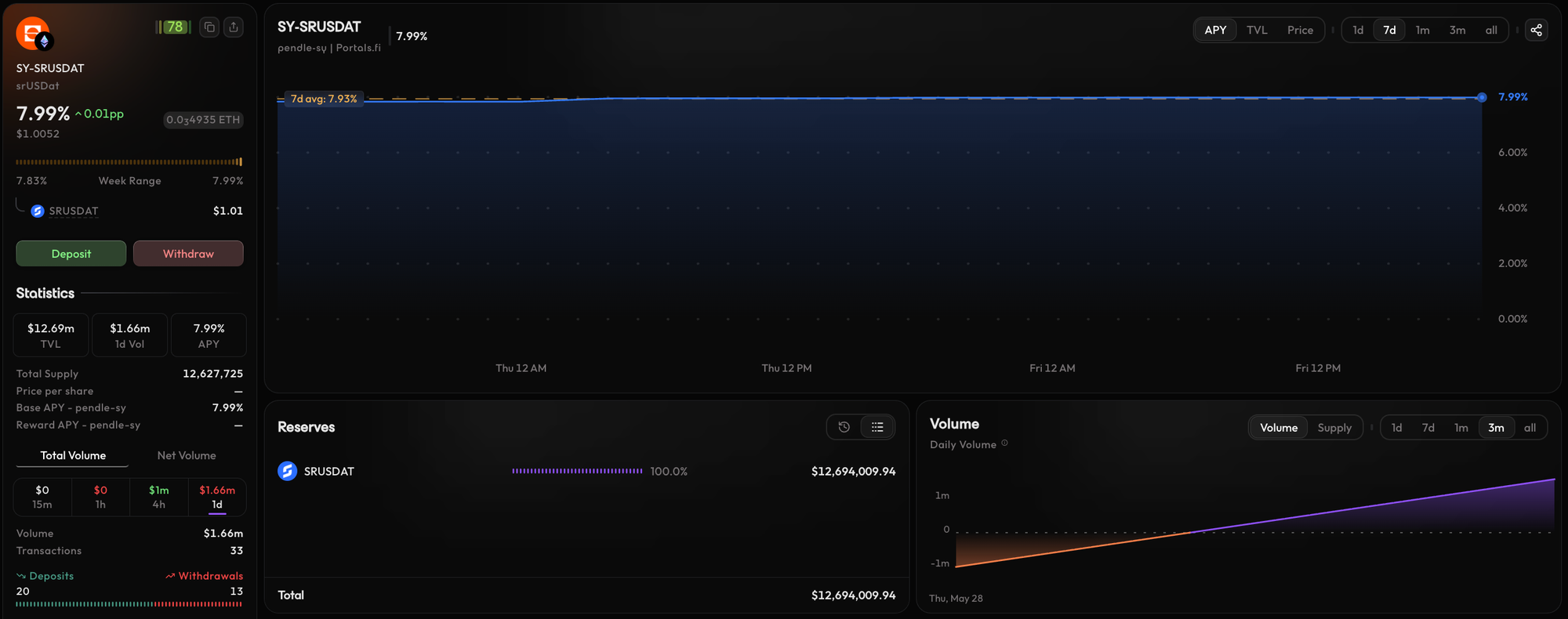
This Standardized Yield (SY) token on Ethereum is currently yielding 7.98% APY with $12.69M in TVL.
As the underlying yield-bearing asset for Pendle's USDat markets, it offers variable exposure to the Strata protocol's yield generation strategies, providing a solid single-digit return for stablecoin depositors.
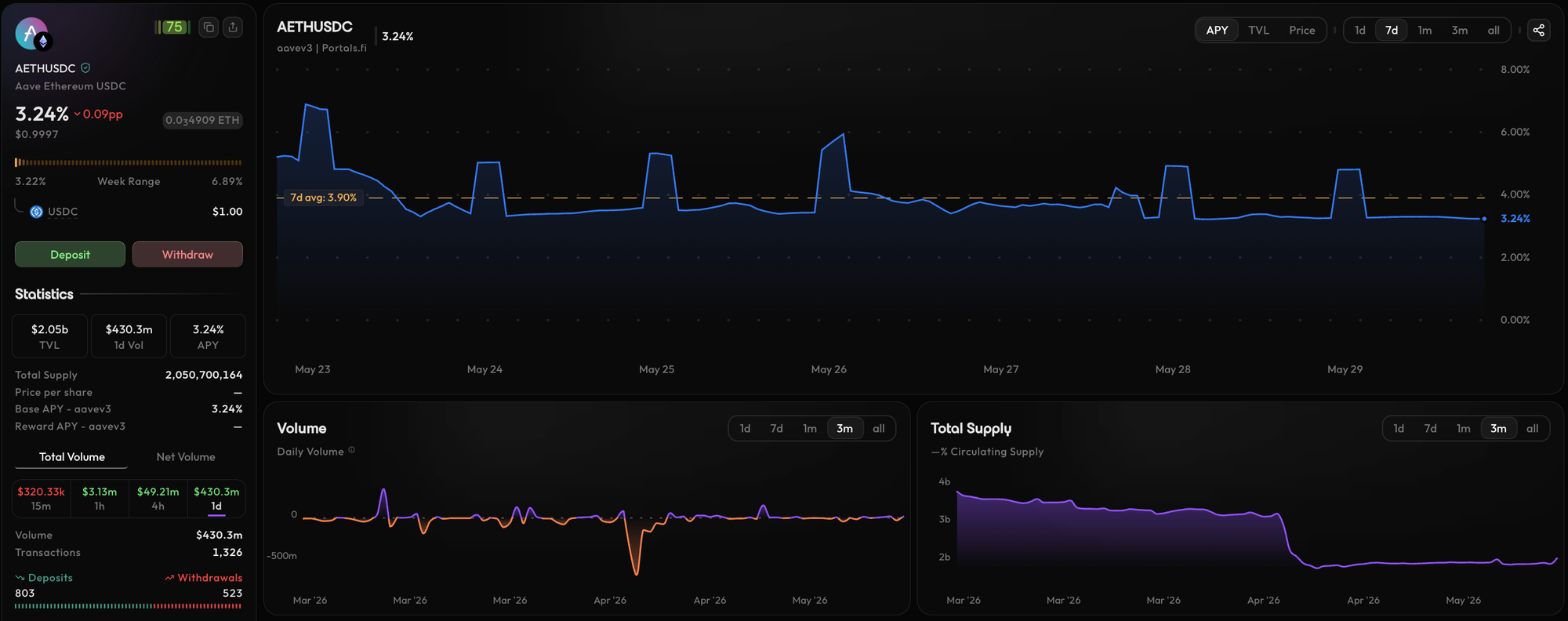
As the anchor of the DeFi lending ecosystem, Aave V3's USDC market on Ethereum is currently offering a 3.24% APY.
With a massive $2.05B in TVL, this pool is low-risk, highly liquid stablecoin yield. The rate shows current borrowing demand and serves as a reliable baseline for institutional and retail capital alike.
Note: All APY and TVL figures are accurate as of May 29, 2026, and are subject to market fluctuations. Always conduct your own research before deploying capital.
Track, manage, and optimize your DeFi portfolio across 11+ networks with the Portals Explorer. Discover the best yields, monitor your positions, and execute complex transactions with a single click.
Now lets move onto what's new in DeFi.
DeFi News
OpenZeppelin Warns of AI-Driven Smart Contract Exploits
Following a year that saw over $1 billion drained from DeFi protocols, OpenZeppelin's CEO issued a warning that AI is making the ecosystem fundamentally unsafe.
The security firm noted that AI agents are becoming "superhuman" at identifying complex vulnerabilities in smart contracts. This is dramatically reducing the time between deployment and exploitation. Protocols are forced to adopt AI-assisted auditing tools and real-time threat monitoring to counter automated attack vectors.
We covered this topic in great length during our DeFi Drop Episode with Arcadia, watch the conversation unfold here.
Trezor Integrates Morpho for Native Stablecoin Yields
Trezor has integrated Morpho to offer native USDC and USDT yield generation directly within the Trezor Suite.
The integration targets Trezor's 2 million users, allowing them to deploy stablecoins into Morpho's lending markets without leaving the security of their hardware devices.
Hyperliquid ETFs Extend Inflow Streak as HYPE Hits ATH
While spot Bitcoin and Ethereum ETFs experienced $112 million in outflows this week, the newly launched Hyperliquid ETFs (BHYP and THYP) extended their positive inflow streak to eight consecutive days.
The sustained institutional demand pushed the native HYPE token to a new all-time high above $62. The traditional finance interest is growing in high-performance Layer 1 networks tailored for decentralized perpetual exchanges.
DeFi Hacks Highlight Operational Security Failures
A comprehensive review of the $98 million lost across THORChain, Verus Bridge, and Echo Protocol earlier this month revealed that operational security failures, rather than pure smart contract bugs, were the primary attack vectors.
The Echo Protocol incident, which resulted in a $76.7 million loss, was traced directly to compromised administrator private keys, underscoring the critical need for robust multi-signature setups and hardware-secured key management in protocol administration.
DeFi United Rescue and RWAs
The "DeFi United" coalition, led by Aave, Lido, and Consensys has secured over $300M in ETH commitments to recapitalize the rsETH shortfall.
BNB Chain has seen its RWA TVL hit $4 billion, caused by Circle's tokenized money market fund, signaling a successful move toward institutional-grade DeFi utility.
State of Chains
Chain Performance Analysis
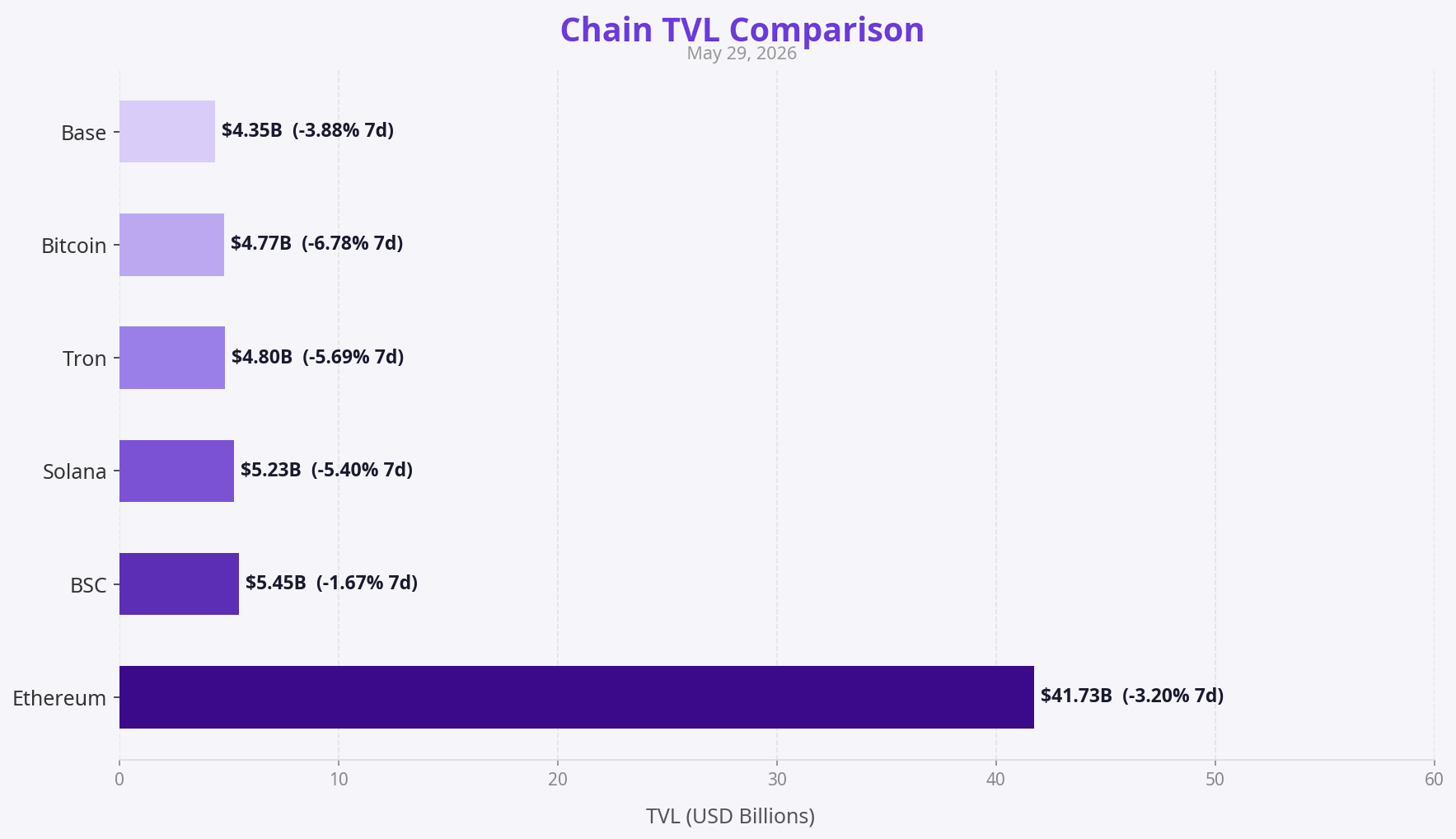
The top six networks all experienced TVL contractions this week, reflecting the market drawdown.
Ethereum remains the dominant force with $41.73B in TVL, though it saw a 3.20% decline over the past seven days.
Binance Smart Chain (BSC) showed the most resilience among the majors, dropping only 1.67% to maintain $5.45B in TVL.
Solana and Tron experienced steeper declines of 5.40% and 5.69% respectively, bringing their TVLs to $5.23B and $4.80B.
The Bitcoin DeFi ecosystem, which had been growing rapidly, saw the sharpest contraction among the top chains, falling 6.78% to $4.77B.
Base, Coinbase's Layer 2 network, demonstrated relative strength compared to other L2s, declining 3.88% to hold $4.35B in TVL.
Top DeFi Protocols by TVL
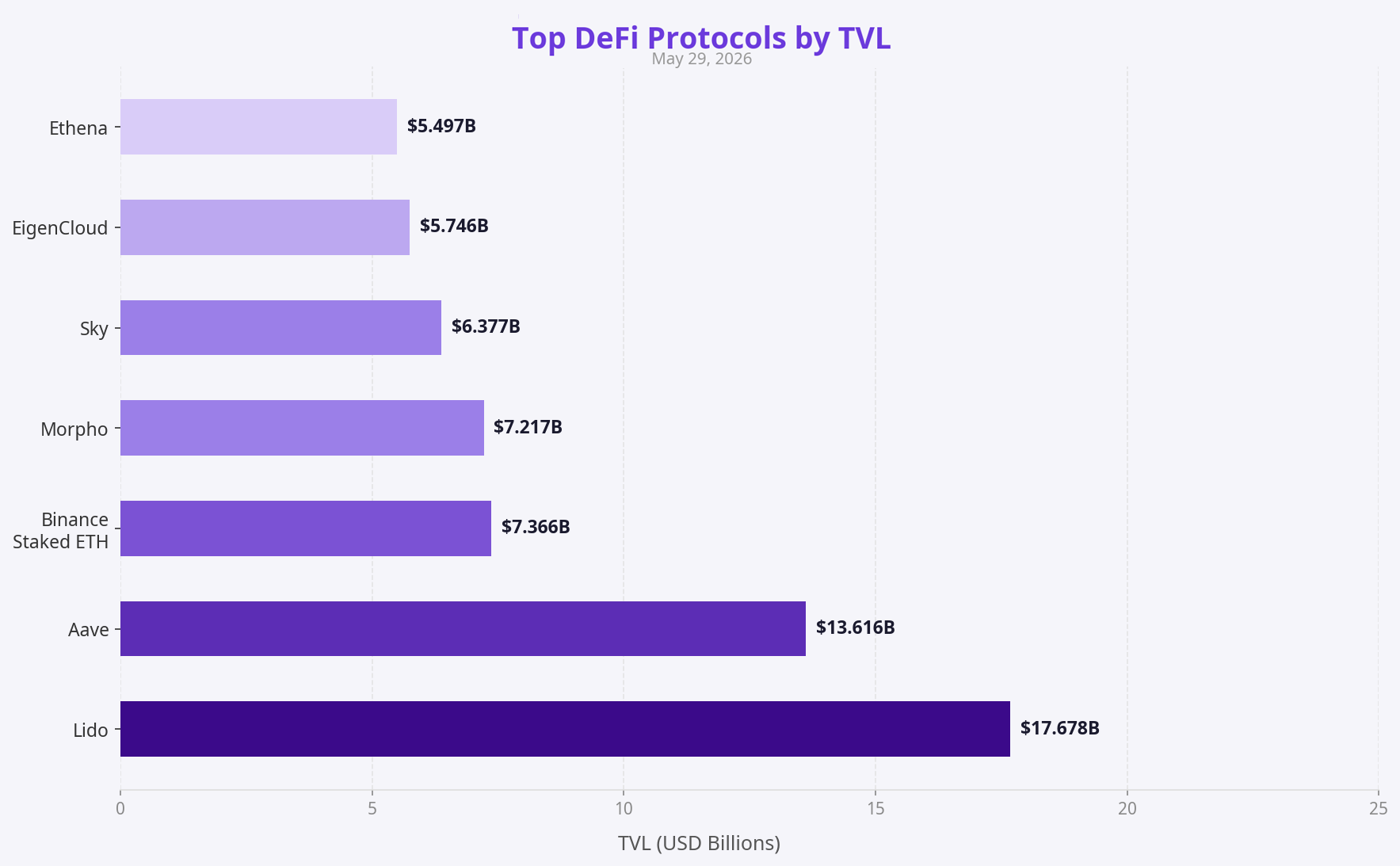
Lido continues to lead the protocol rankings by a wide margin with $17.68B in TVL, despite a 6.27% weekly decline in its liquid staking deposits.
Aave maintains its position as the premier lending protocol with $13.62B in TVL, showing relative stability with only a 3.95% drop.
Binance Staked ETH ($7.37B) and Morpho ($7.22B) are locked in a tight race for the third and fourth positions.
Morpho demonstrated notable resilience, dropping only 2.60% for the week.
Sky ($6.38B) was the standout performer among the top protocols, posting an impressive 8.05% gain against the broader market trend.
EigenCloud ($5.75B) and Ethena ($5.50B) round out the top seven, with EigenCloud experiencing a significant 14.44% contraction as restaking dynamics continue to evolve.
Portals Platform Updates
DeFi Exploit Post-Mortem: This Week's $100M Security Lessons
We have published comprehensive post-mortem analyzing the recent wave of DeFi exploits. The article breaks down the attack vectors used in the THORChain, Verus Bridge, and Echo Protocol incidents, providing actionable security lessons for both protocol developers and liquidity providers.
Read the full analysis on the Portals Blog.
Royco Dawn on DeFi Drop: Exploring Risk Tranching
The latest episode of the DeFi Drop podcast features the team from Royco Dawn discussing the evolution of risk tranching in DeFi is out. Catch the full segmant here.
Looking Ahead
Key Catalysts
AI Security Tooling Adoption
Following OpenZeppelin's warning regarding AI-driven exploits, expect a rapid acceleration in the deployment of AI-assisted auditing and real-time threat monitoring tools across major DeFi protocols. This is the most concerning topic in DeFi at the moment.
Hardware Wallet DeFi Integration
Trezor's integration of Morpho establishes a new standard for secure yield generation. Watch for competing hardware wallet providers to announce similar native DeFi integrations to capture the growing demand for secure, non-custodial yield.
Hyperliquid Ecosystem Expansion
The sustained inflows into Hyperliquid ETFs (BHYP and THYP) provide significant institutional validation. This capital influx is likely to spur further development and liquidity provision within the HyperEVM ecosystem.
Market Outlook
The final week of May 2026 has been defined by a broad market contraction and heightened security concerns. The capital is prioritizing preservation over aggressive yield seeking.
However, the stability of the $320.81B stablecoin market cap indicates that liquidity remains within the ecosystem, waiting for clearer directional signals.
The warnings regarding AI-driven smart contract exploits emphasise a critical inflection point for DeFi security. As attack vectors become more sophisticated, the premium on established, battle-tested protocols like Aave and Morpho will likely increase.
Users should exercise heightened diligence when interacting with newer protocols, particularly those with publicly accessible administrative functions or complex proxy architectures.
The growing adoption of transaction simulation tools like Portals Foresight provides a practical layer of defence against these security risks.
The integration of native yields into hardware wallets like Trezor represents a vital step forward, offering users the ability to generate returns without compromising on operational security, a crucial development in the wake of recent administrative key compromises.
For last week's data and analysis, see the DeFi TVL Weekly, 22nd May 2026
About portals.fi: portals.fi is the DeFi Super App. A one-click gateway to the entire on-chain economy.
Powered by real-time data and seamless execution, portals.fi connects traders to over 20 million assets, thousands of protocols, and every major blockchain.
Disclaimer: The content of this newsletter is for informational purposes only. It is not investment advice. Please do your own research and consult with a qualified financial advisor before making any investment decisions.
DeFi investments carry significant risks, and past performance does not guarantee future results. More details here.
Portals.fi Blog Newsletter
Join the newsletter to receive the latest updates in your inbox.