DeFi TVL July 2026 Week 4: Uniswap Permissioned Pools & Hyperliquid RWA Surge
The DeFi market demonstrated resilience this week, with TVL reaching $75.94B, marking a steady recovery despite broader market volatility. Bitcoin maintained its position above $64,000, while Ethereum showed strength approaching $1,865, pushing renewed activity across major lending and yield protocols.
This week's edition covers Hyperliquid's historic milestone as RWA trading volume overtakes crypto for the first time. As well as Uniswap's launch of Permissioned Pools for tokenized assets, Zama's confidential RFQ swap protocol going live on Ethereum, and Morpho Midnight's official deployment on Base. We also examine the latest TVL movements across top chains and protocols.
On the yield front, we have identified five high-performing positions on Portals Explorer, spanning Base, Ethereum, and Plasma. These positions offer attractive risk-adjusted returns for stablecoin and yield-bearing assets across multiple risk profiles.
Let's dive into the data for Week 4 of July 2026.
Market Pulse
- Total Market Cap: $2.28T (-1.2% 24h)
- DeFi TVL: $75.94B (-1.41% 24h)
- BTC Price: $64,129 (+1.4% 7d)
- ETH Price: $1,865 (+2.0% 7d)
- Gas (ETH): 0.158 Gwei
- Sentiment: Fear (28)
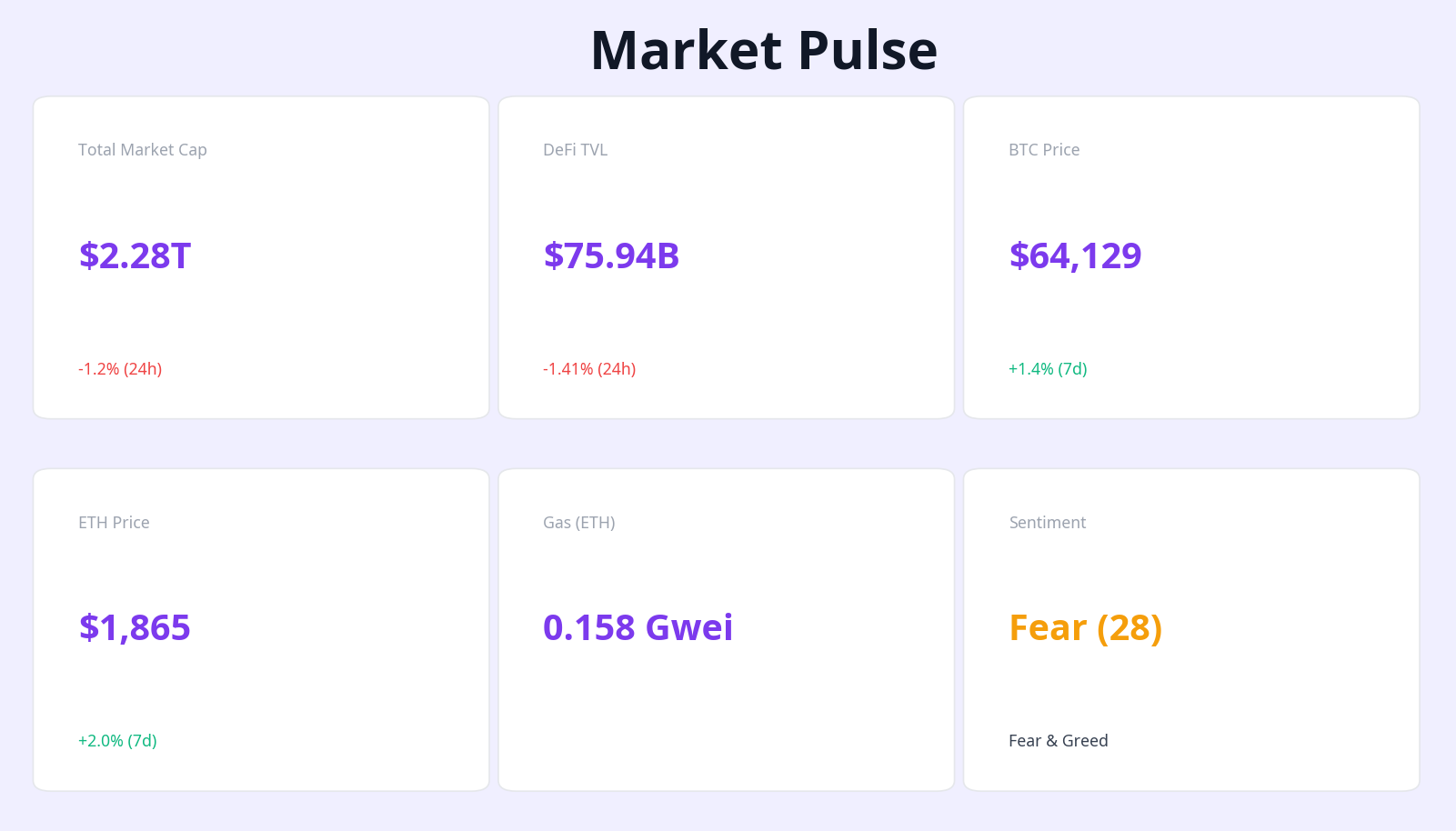
The market is showing signs of steady consolidation this week. BTC posted a slight 7-day gain of 1.4%, while ETH managed a modest 2.0% gain, keeping the Fear & Greed Index stable at 28, firmly in standard Fear territory.
Gas fees remain exceptionally low at 0.158 Gwei, offering a highly cost-efficient window for yield farmers to reposition across Ethereum mainnet and execute complex vault strategies.
Stablecoin market cap held steady at $309.67B, showing sustained liquidity within the ecosystem. DEX volume reached $5.84B over the past 24 hours, reflecting healthy on-chain trading activity despite the cautious sentiment.
The Yield Market Pulse
This week, we highlight five verified yield opportunities currently tracked on Portals Explorer. These positions span multiple networks and asset classes, offering diverse strategies for yield generation.
1. Morpho King Elepan USDC Vault (Base)
The Morpho King Elepan USDC Vault on Base is currently generating a 13.96% APY with $13M in TVL. This vault utilizes Morpho's efficient lending infrastructure to optimize yields for USDC depositors.
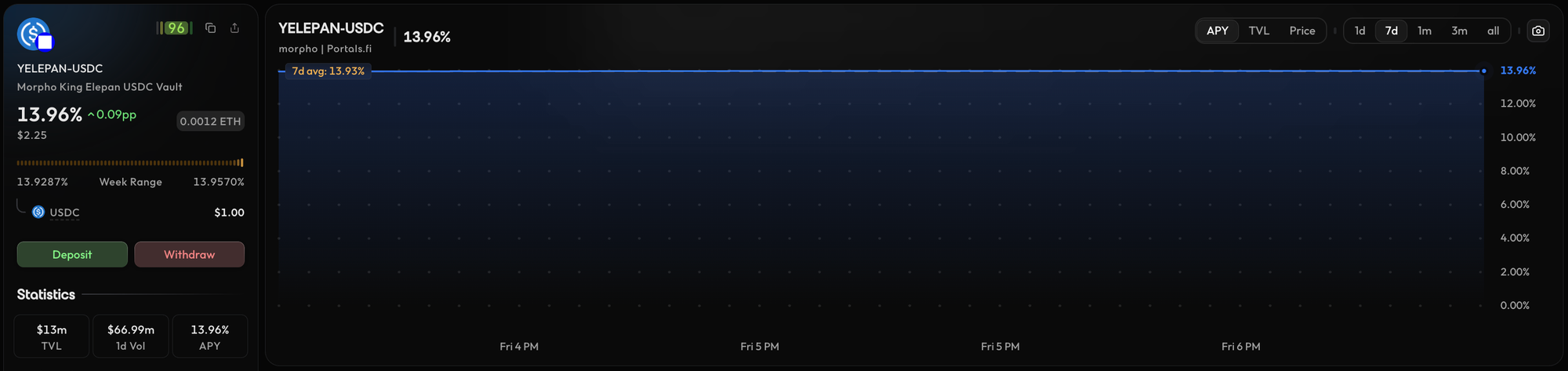
The strategy benefits from the growing liquidity and activity on the Base network, providing a competitive return for stablecoin assets. The 7-day average APY sits at a consistent 13.91%, indicating stable performance.
Investors should note that yields on lending protocols can fluctuate based on borrowing demand. However, the current rate offers a compelling opportunity for those seeking stablecoin exposure on Layer 2 networks.
2. Upshift Sentora USD Earn (Ethereum)
The Upshift Sentora USD Earn position on Ethereum is offering a 7.70% APY with $31.4M in TVL. This strategy focuses on generating yield through optimized stablecoin deployment.
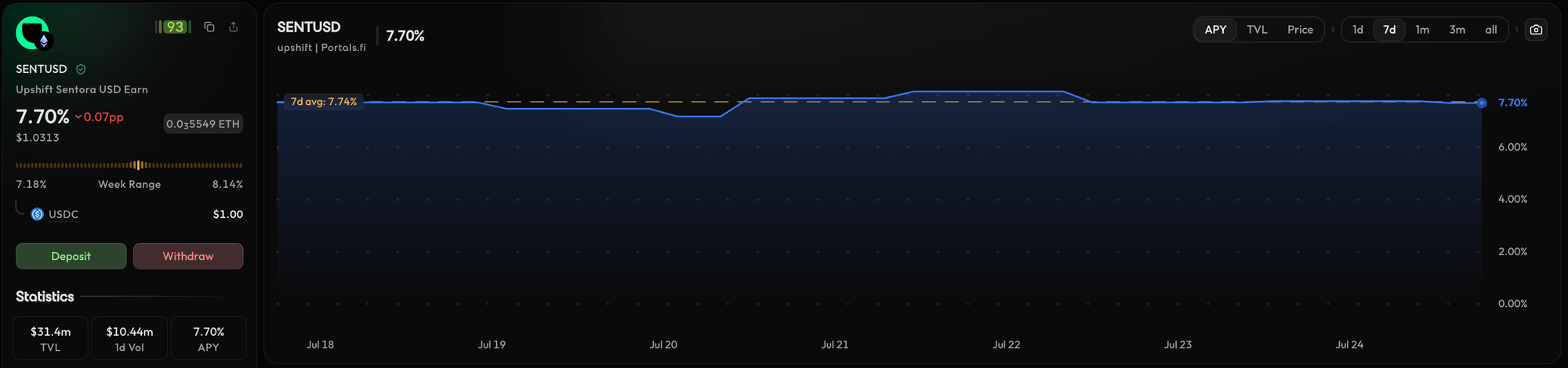
The vault has maintained a steady 7-day average APY of 7.74%, demonstrating reliable returns in the current market environment. The strategy leverages Upshift's architecture to maximize capital efficiency.
This position is suitable for investors looking for consistent, single-digit returns on Ethereum, benefiting from the protocol's established security and liquidity.
3. SY reUSD (Ethereum)
The SY reUSD position on Ethereum is currently yielding 6.39% APY with $89.46M in TVL. This is Pendle's Standardized Yield (SY) wrapper for reUSD, the principal-protected deposit token from Re Protocol.
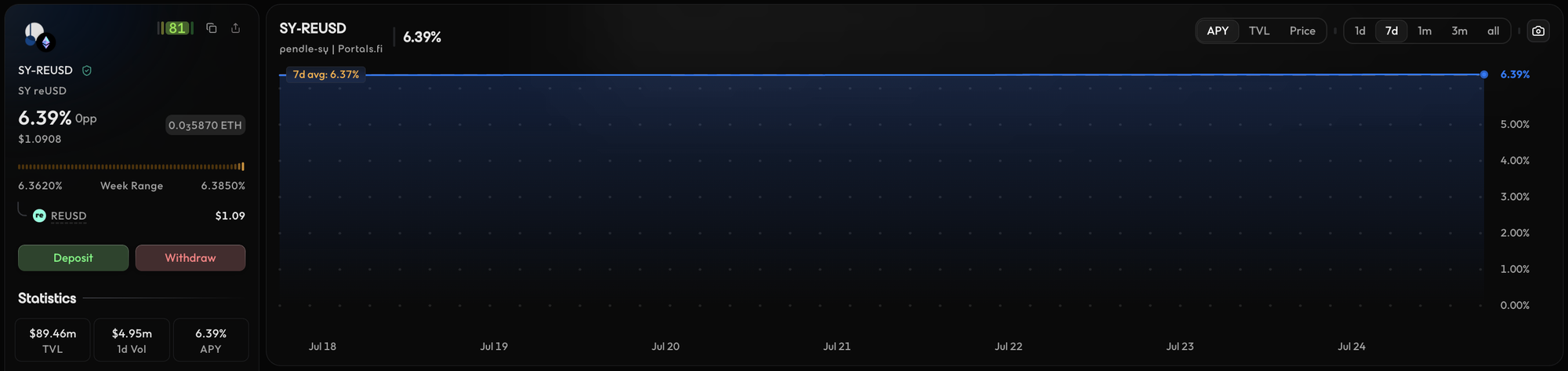
The reUSD token represents a senior-tranche position in Re Protocol's on-chain reinsurance marketplace. This provides dollar-denominated exposure to insurance premium yields with capital preservation as a structural priority.
The SY wrapper standardizes reUSD's yield accrual for integration into Pendle's fixed-rate and yield-trading infrastructure, allowing users to either lock in a fixed rate or trade the yield component independently.
4. SY reUSDe (Ethereum)
Similar to the reUSD position, the SY reUSDe vault on Ethereum offers a higher APY of 12.99% with $79.32M in TVL. This strategy leverages Ethena's synthetic dollar (USDe) to generate substantial returns.
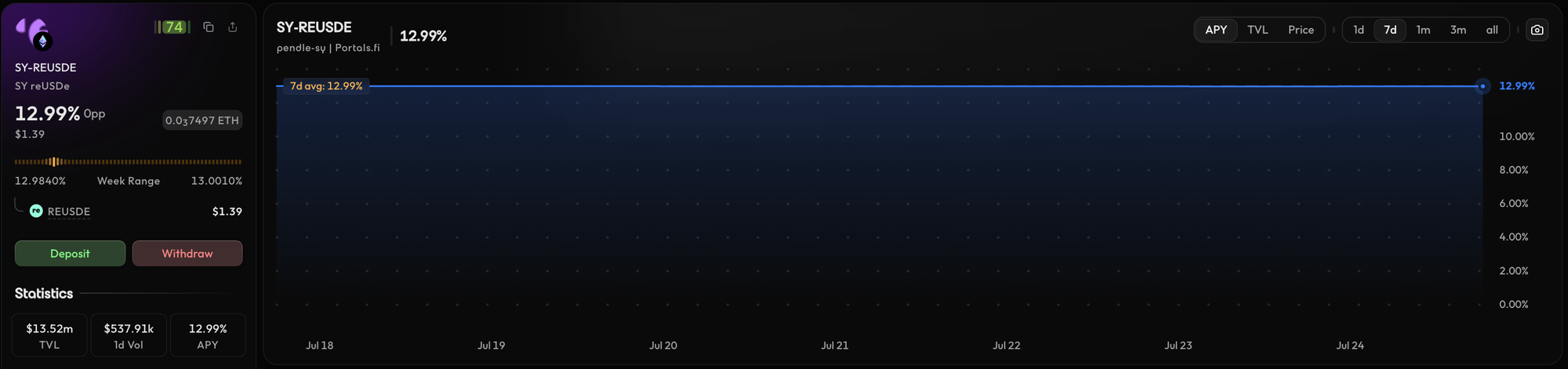
The dual-layer yield structure, USDe funding rates plus reinsurance premiums, provides a differentiated source of return compared to standard lending or staking strategies.
It is important to consider the specific risks associated with synthetic assets and the underlying mechanisms generating these elevated returns.
5. Staked Yuzu USD (Plasma)
The Staked Yuzu USD position on the Plasma network is generating a 7.84% APY with $44.43M in TVL. This opportunity provides exposure to the emerging Plasma ecosystem and its native yield strategies.
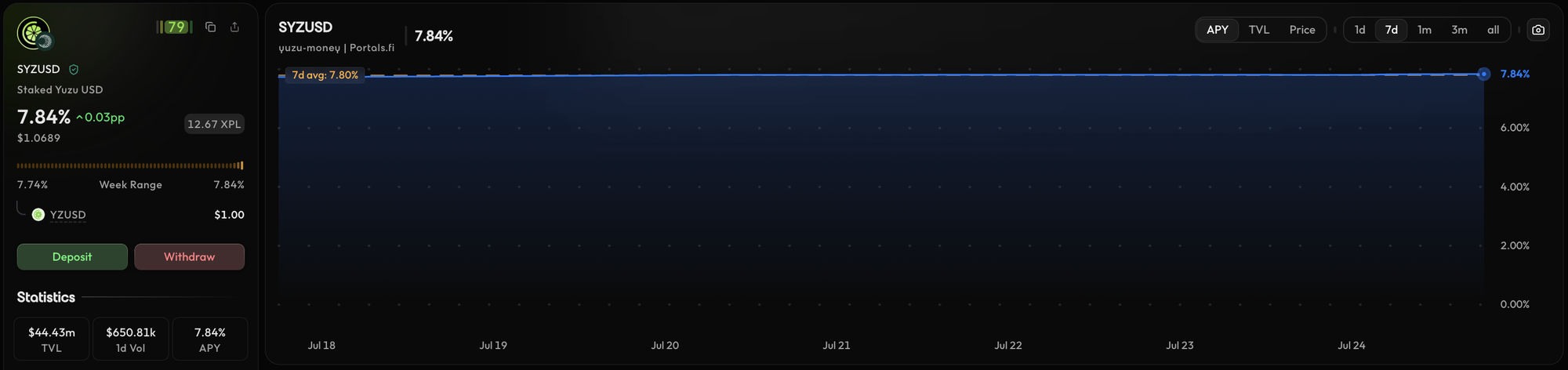
With a 7-day average APY of 7.80%, the vault offers stable returns for YZUSD depositors. The strategy benefits from the specific incentives and liquidity dynamics on the Plasma network.
Investors looking to diversify their yield sources across different networks may find this position an attractive addition to their portfolio.
TRENDING NOW on Portals Explorer
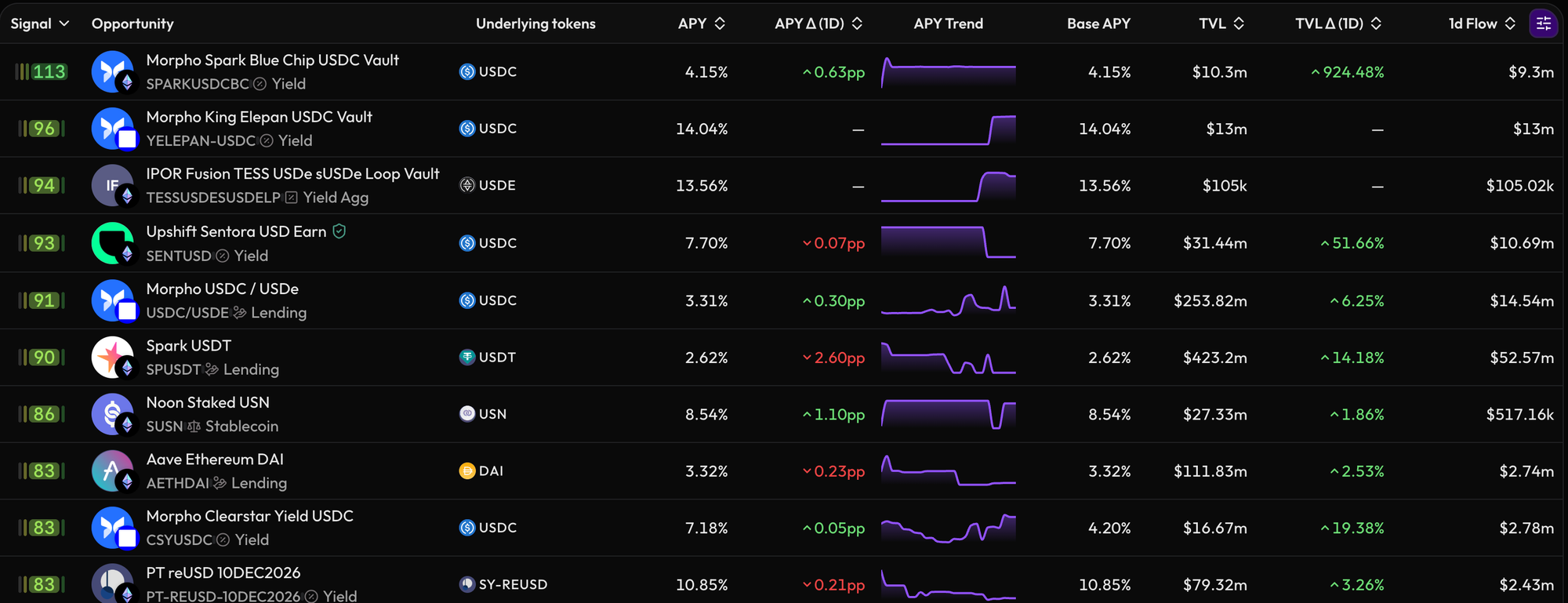
Track, manage, and optimise your DeFi portfolio across major networks with Portals Explorer. Discover the best yields, monitor your positions, and execute complex transactions with a single click.
Discover all the trending opportunities on Portals Explorer
DeFi News
Hyperliquid RWA Volume Overtakes Crypto Trading
The RWA trading volume on Hyperliquid has surpassed traditional crypto asset trading for the first time.
According to data shared by ARK Invest's Director of Research Lorenzo Valente, RWAs accounted for 54% of Hyperliquid's total trading volume during the week of July 13-19. The platform processed $50 billion of the broader market's $79 billion in weekly DEX perpetual volume, with $26 billion coming specifically from its HIP-3 RWA markets.
Since June, single equities have overtaken indices and commodities, now representing 61% of all RWA trading on the platform. This surge in tokenized stock trading pushed Hyperliquid's total open interest to an all-time high of $11.07 billion in mid-July.
This milestone indicates that specialized category leaders may emerge within the RWA sector, challenging the assumption that RWA trading will simply consolidate on existing major crypto platforms.
Uniswap Launches Permissioned Pools for Tokenized Assets
Uniswap has unveiled "Permissioned Pools," a new infrastructure standard built on Uniswap v4 hooks designed to enable regulated financial assets to trade compliantly on-chain.
Developed in collaboration with major tokenization firms including Securitize, Superstate, and Dowgo, the standard allows tokenized securities, funds, and equities to access AMM liquidity without relying on off-chain verification or centralized intermediaries.
Unlike traditional permissioned platforms that rely on frontend restrictions, Permissioned Pools perform compliance checks directly within the protocol. Before any swap or liquidity provision occurs, the v4 hook verifies whether the interacting wallet appears on an issuer-managed allowlist.
This protocol-level verification ensures that only approved investors can interact with designated pools, while issuers retain full control over eligibility.
Zama Deploys Confidential RFQ Swap Protocol on Ethereum
Privacy-focused infrastructure provider Zama has launched its Confidential RFQ (Request for Quote) swap protocol on the Ethereum Mainnet, aiming to eliminate Maximal Extractable Value (MEV) and front-running for large on-chain trades.
The protocol allows users to execute swaps without publicly revealing sensitive transaction details such as trade size, slippage limits, or trade direction.
The system utilizes encrypted trade requests submitted to an RFQ smart contract. Market makers receive these encrypted requests and submit their own encrypted quotes, competing in a sealed-bid auction without knowing whether the user is buying or selling.
Only the winning market maker learns the trade direction to complete the on-chain transaction. Following the announcement, the ZAMA token surged 32%, with trading volume spiking 129% to approximately $129 million.
Currently in private beta, the protocol supports three initial trading pairs (cUSDT/cUSDC, cZAMA/cUSDC, and cSteakcUSDC/cUSDC) and is built on the ERC-7984 confidential token standard.
Uniswap Governance Votes on V4 Fee Switch to Accelerate UNI Burn
Uniswap has submitted three governance proposals to activate protocol fees across multiple chains and DEX versions, aiming to direct new revenue into the existing UNI token burn mechanism.
The proposals target V2 and V3 pools on the newly launched Robinhood Chain, as well as V4 pools across Ethereum, Base, Arbitrum, BNB Chain, Polygon, and Optimism.
According to Uniswap CEO Hayden Adams, the activation of fees, particularly on high-volume networks like the Robinhood Chain, which crossed $1 billion in volume shortly after launch, is expected to have a "substantial" impact on the UNI burn rate.
The protocol has already burned over 107.49 million UNI tokens, with the burn rate surging 3x to over $160,000 in the past week.
The proposals have sparked debate among liquidity providers (LPs). Entities like Gamma Strategies have voiced opposition, arguing that V4 still lags behind V3 in volume and faces intense competition from alternative DEX models like Hyperliquid.
Since 2018, LPs have accrued over $5 billion in cumulative fees, while the protocol itself has generated only $25 million in revenue, highlighting the tension between LP profitability and protocol value capture.
Morpho Midnight Brings Fixed-Rate Lending to Base
Morpho has officially launched "Midnight," its highly anticipated fixed-rate, fixed-maturity lending protocol, on the Base network. Exiting its months-long beta, Midnight introduces predictable interest rates and predetermined maturity dates to the on-chain credit market, mirroring traditional fixed-income financial instruments.
The protocol utilizes a peer-to-peer matching architecture designed to reduce slippage and improve capital efficiency compared to standard pooled lending models.
By deploying on Base, Morpho leverages Ethereum's security while benefiting from lower transaction costs, faster settlement times, and integration with Coinbase's extensive liquidity ecosystem.
This launch provides both retail and institutional users with new tools to hedge against rate volatility and execute fixed-income yield farming strategies.
However, users must navigate the specific mechanics of fixed-maturity loans, including potential early withdrawal penalties and liquidity constraints if attempting to exit positions before the predetermined maturity date.
Portals Updates
Portals at ETHGlobal, Lisbon
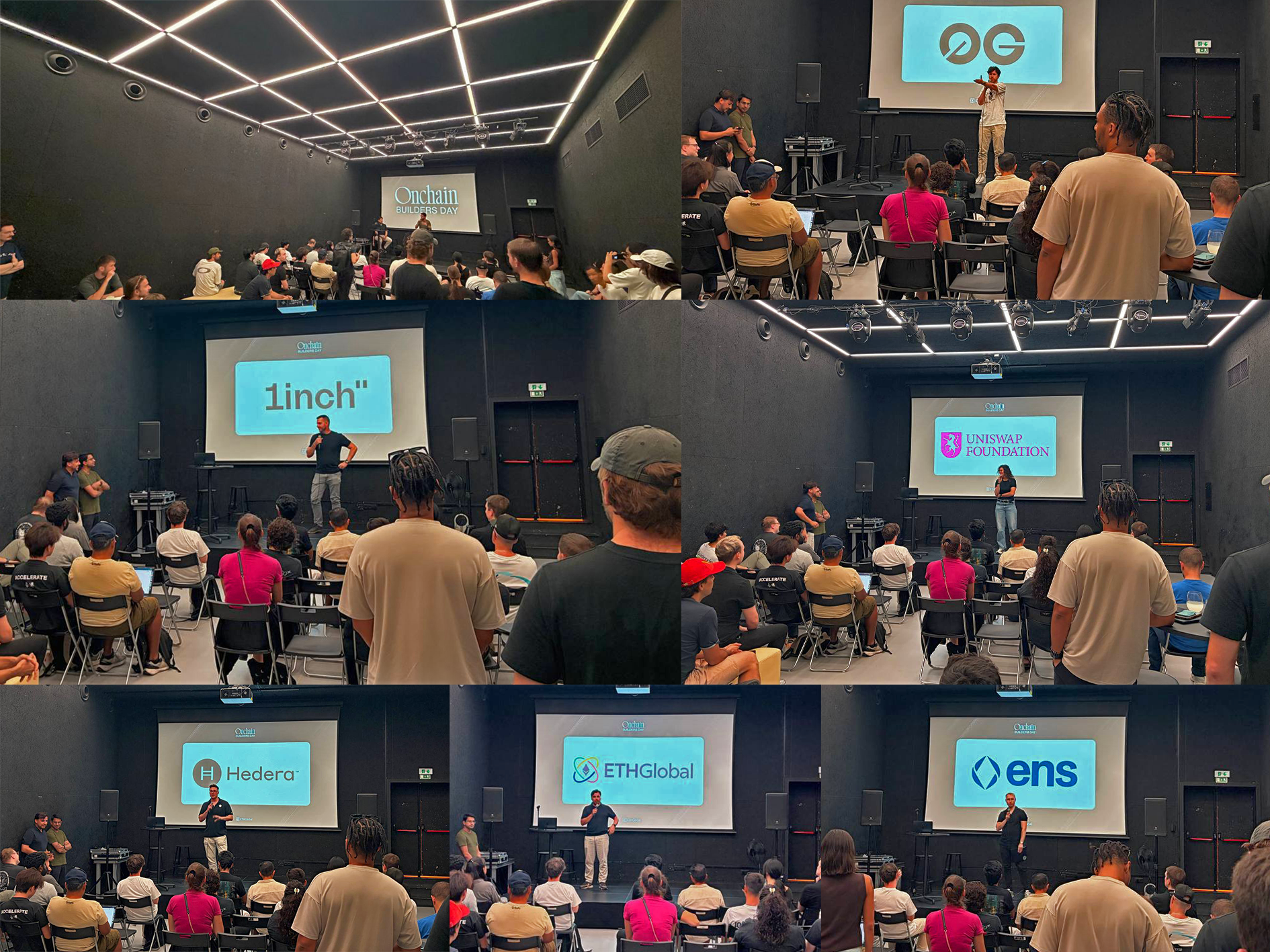
Our team was present at ETHGlobal in Lisbon, and here are some highlights from insightful sessions with 1Inch, Uniswap Foundation, ENS , Hedera and more.
State of Chains
Chain Performance Analysis
Ethereum continues to dominate the landscape with $41.3B in TVL, posting a solid 1.69% gain over the past 7 days. This growth emphasises Ethereum's enduring position as the primary hub for high-value DeFi activity and institutional capital.
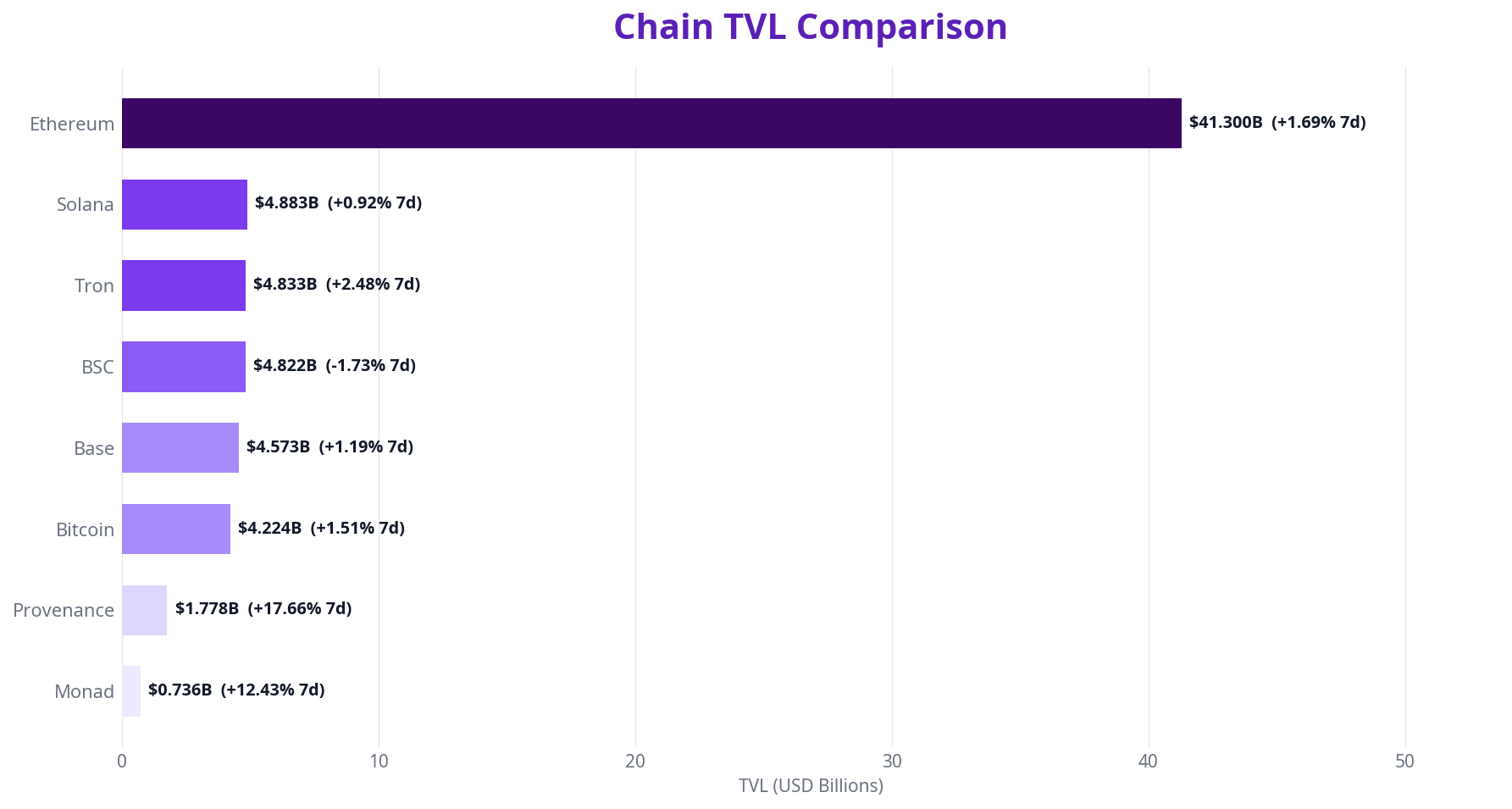
Solana and Tron maintain their positions as the leading alternative Layer 1s, with $4.88B and $4.83B in TVL, respectively. Tron saw a notable 2.48% increase this week, driven by sustained stablecoin activity.
Among the emerging networks, Provenance and Monad demonstrated exceptional growth. Provenance surged 17.66% to reach $1.77B, while Monad climbed 12.43% to $736M, highlighting the rapid expansion of these specialized ecosystems.
Top DeFi Protocols
Lido remains the undisputed leader in the protocol rankings with $17.53B in TVL, despite a minor 1.00% daily dip. Aave follows closely at $14.31B, maintaining its status as the premier decentralized lending market.
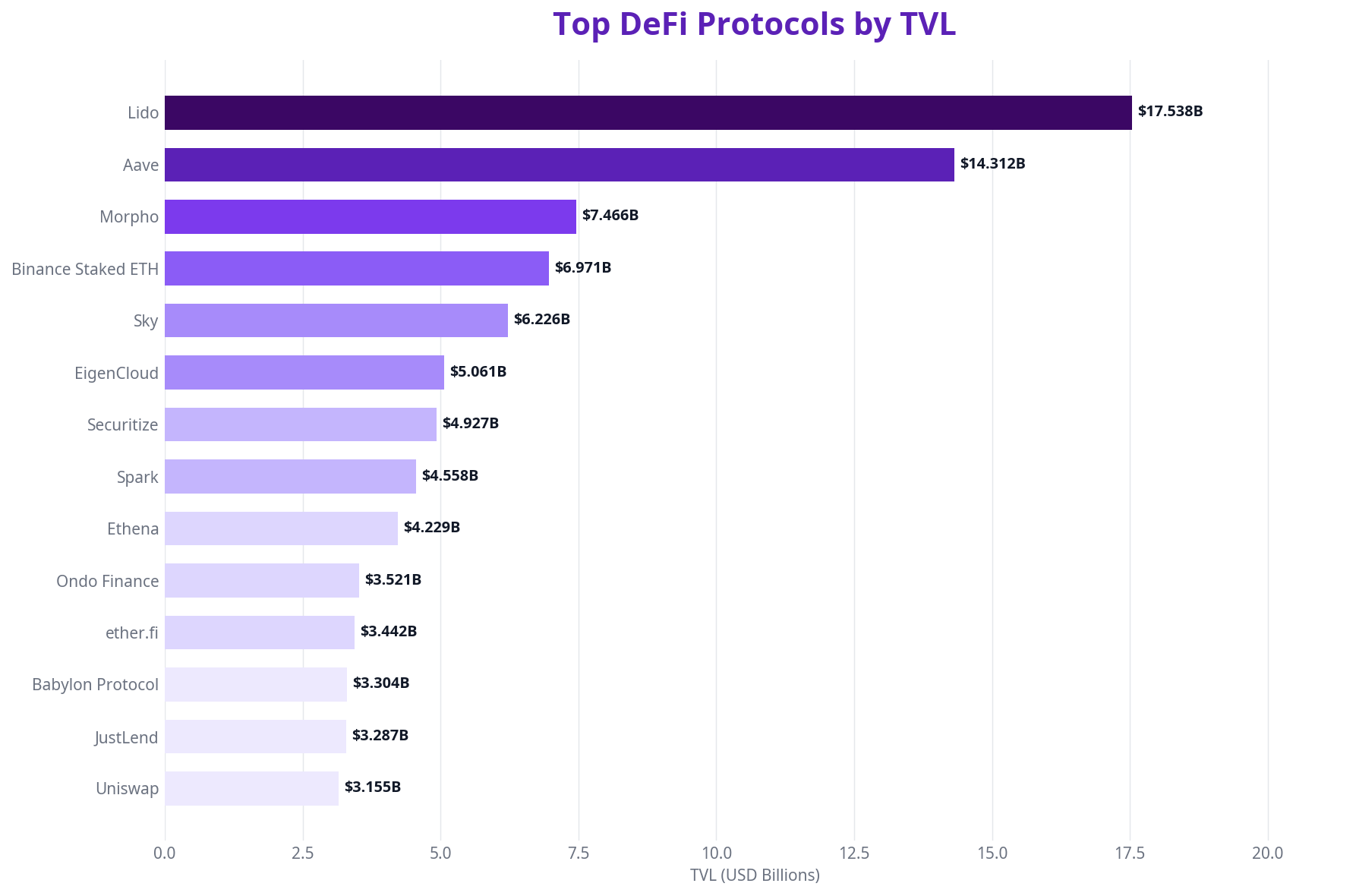
Morpho continues to solidify its position in the top three with $7.46B in TVL. The protocol's efficient matching engine and expanding vault ecosystem have driven consistent growth and user adoption.
Further down the list, Securitize saw a positive 1.65% daily increase, bringing its TVL to $4.92B. This growth reflects the increasing traction of tokenized RWAs within the broader DeFi landscape.
Looking Ahead
Permissioned DeFi Becomes Infrastructure
Uniswap's Permissioned Pools launch signals a structural shift in how DeFi is being built. Rather than a separate "compliant DeFi" track, compliance is now being embedded directly into core protocol infrastructure via v4 hooks.
Expect more protocols to adopt similar patterns as tokenized RWA volumes continue to grow and institutional capital demands on-chain compliance without sacrificing decentralized liquidity.
The Rise of App-Chains
The rapid growth of networks like Robinhood Chain and Hyperliquid highlights the increasing viability of application-specific blockchains.
As these platforms mature, they may capture a larger share of retail and institutional volume, challenging the dominance of general-purpose Layer 1s.
Yield Optimization Strategies
With gas fees remaining low, we anticipate continued innovation in yield optimization strategies. Users will likely leverage complex, multi-step vault interactions to maximize returns, driving further adoption of aggregators and automated yield managers.
Read the previous DeFi TVL Weekly edition: DeFi TVL July 2026 Week 3: Morpho Midnight & Bitcoin DeFi Surge
About portals.fi: portals.fi is the DeFi Super App. A one-click gateway to the entire on-chain economy.
Powered by real-time data and seamless execution, portals.fi connects traders to over 20 million assets, thousands of protocols, and every major blockchain.
Disclaimer: The content of this newsletter is for informational purposes only. It is not investment advice. Please do your own research and consult with a qualified financial advisor before making any investment decisions.
DeFi investments carry significant risks, and past performance does not guarantee future results. More details here.
Portals.fi Blog Newsletter
Join the newsletter to receive the latest updates in your inbox.