DeFi Weekly October 2026 Week 4: Aero Launch
The DeFi Weekly October 2026 Week 4 snapshot closes with TVL at $90.19B, down 0.63% over seven days. Bitcoin fell 0.16%, Ethereum fell 0.41%, and the Fear & Greed Index registered 50, or Neutral.
This week’s lead DeFi story is the Aero launch following the Aerodrome and Velodrome merger. The edition also covers the OCC’s final GENIUS Act rule for payment-stablecoin issuers, J.P. Morgan Asset Management bringing tokenized money-market funds to Solana for qualified U.S. investors, Initia’s network halt after a security incident, and OpenZeppelin’s Chainlink tooling integration.
On the yield front, this edition highlights five live positions on Portals Explorer. The selection pairs two Base tokenized-stock carry vaults with three larger Ethereum markets, covering USDC lending, a USDC claim token, and RLUSD lending against WBTC collateral.
Market Pulse
- Total Market Cap: $2.75T (-2.32% 24h)
- DeFi TVL: $90.19B (-0.63% 7d)
- BTC Price: $81,371 (-0.16% 7d)
- ETH Price: $2,401 (-0.41% 7d)
- Gas (ETH): 0.051 Gwei
- Sentiment: Neutral (50)
The DeFi Weekly October 2026 week 4 data reflects a narrow seven-day reduction in deposited capital and a nearly flat weekly move in BTC and ETH. The matched daily comparison shows a decline of roughly $571.43M in DeFi TVL.
Ethereum gas was 0.051 Gwei at the publication cutoff, keeping the direct transaction-cost hurdle low for mainnet deposits, withdrawals, and rebalancing. Low gas does not remove asset, smart-contract, liquidity, market, or redemption risk.
Neutral sentiment at 50 fits a market where the total market cap fell 2.32% over 24 hours while the seven-day moves in the two largest assets were comparatively contained.
Top Yields on Portals Explorer
This week, we highlight five live opportunities on Portals Explorer. The selection includes two Base tokenized-stock carry vaults from the current campaign and three Ethereum markets with materially different lending and rate mechanics.
1. TAU GOOGLc Carry Vault (Base)
TAU GOOGLc Carry Vault on Base is offering a 15.38% APY with $65.48K in TVL. It is an evergreen carry strategy for GOOGLc, a tokenized-stock asset, within the Base tokenized-stocks campaign.
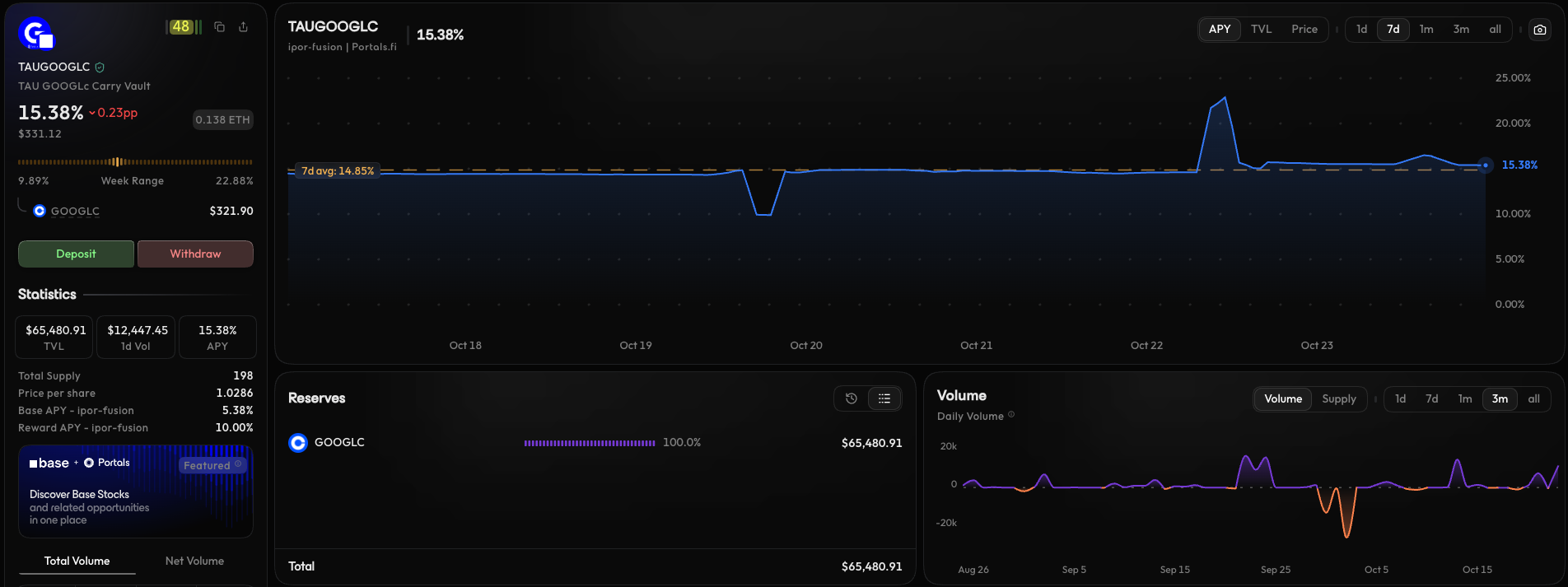
The live rate was above the 14.85% seven-day average and consists of 5.38% base APY plus 10.00% reward APY. Reward terms can change, and users should assess the tokenized-asset issuer and access terms, GOOGLc pricing and liquidity, the vault and strategy contracts, redemption capacity, and Base network execution before depositing.
2. TAU AAPLc Carry Vault (Base)
TAU AAPLc Carry Vault on Base is offering a 14.93% APY with $61.96K in TVL. The vault is an evergreen carry strategy for AAPLc, which gives the position both strategy-layer and tokenized-stock considerations.
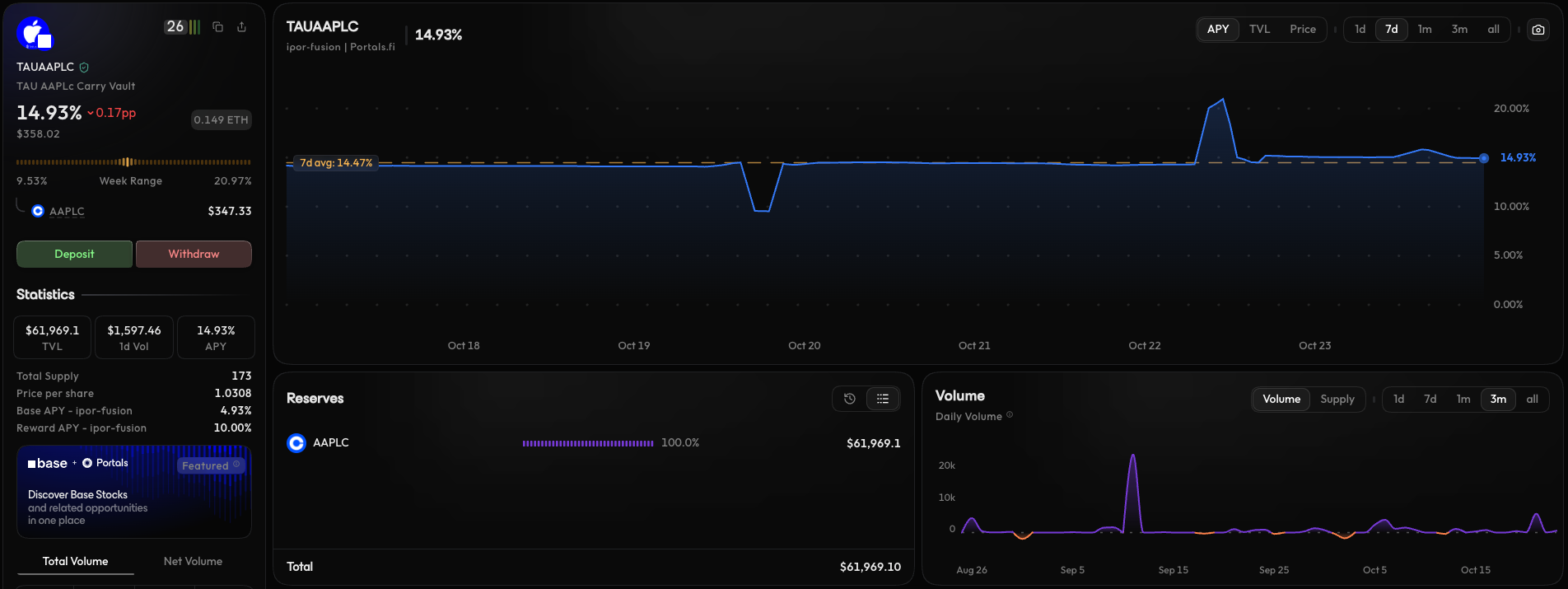
The observed rate was above the 14.47% seven-day average and includes 4.93% base APY plus 10.00% reward APY. The reward component is not a fixed return. Users should review the AAPLc issuer and eligibility terms, asset pricing and liquidity, wrapper contracts, reward schedule, withdrawal conditions, and the risk that tokenized-stock and strategy layers can behave differently.
3. Fluid USD Coin (Ethereum)
Fluid USD Coin on Ethereum is offering a 5.89% APY with $133.88M in TVL. FUSDC represents a claim on USDC deposited into Fluid, and the live page shows a 100% USDC reserve allocation.
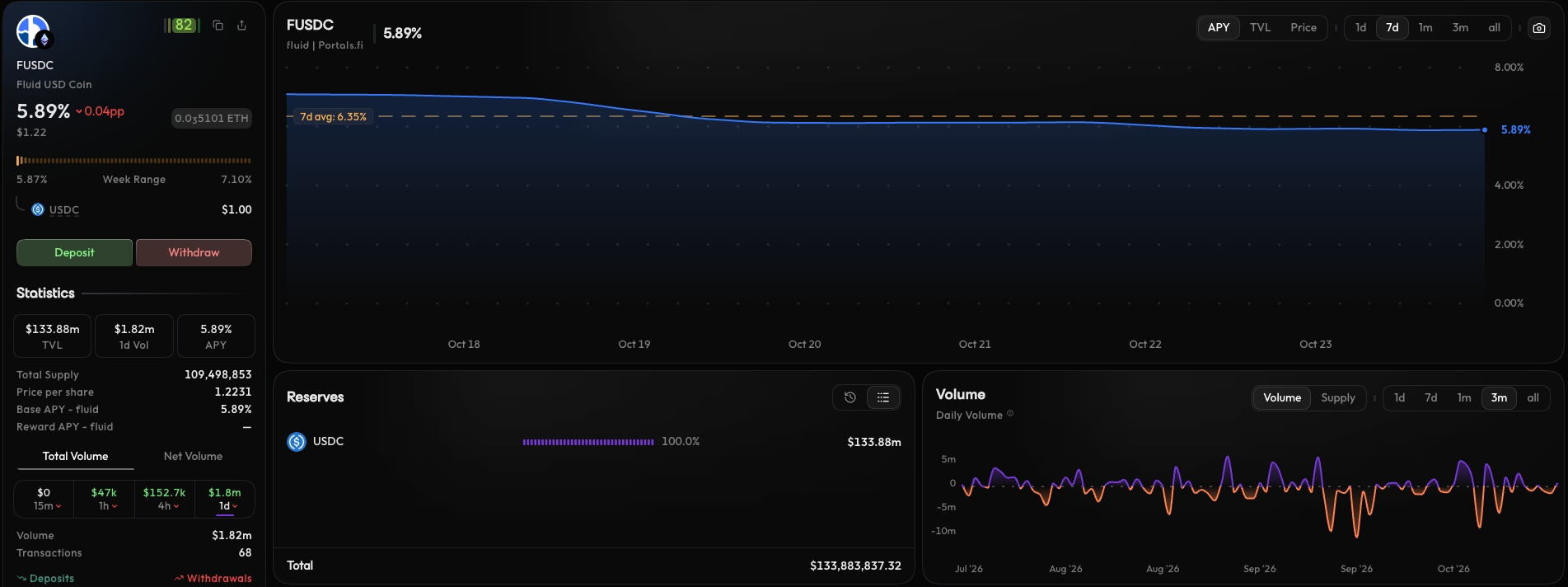
The live rate was below the 6.35% seven-day average and was shown as base APY rather than a separate reward component. This remains variable-rate lending exposure: assess the USDC issuer, Fluid smart contracts and rate mechanics, borrower and collateral conditions, available withdrawal liquidity, and the possibility that supply rates fall as utilization changes.
4. Aave Ethereum USDC (Ethereum)
Aave Ethereum USDC is offering a 3.80% APY with $2.38B in TVL. The aEthUSDC token represents USDC supplied to the Aave V3 Ethereum lending pool, where lender yield is generated from borrower interest.
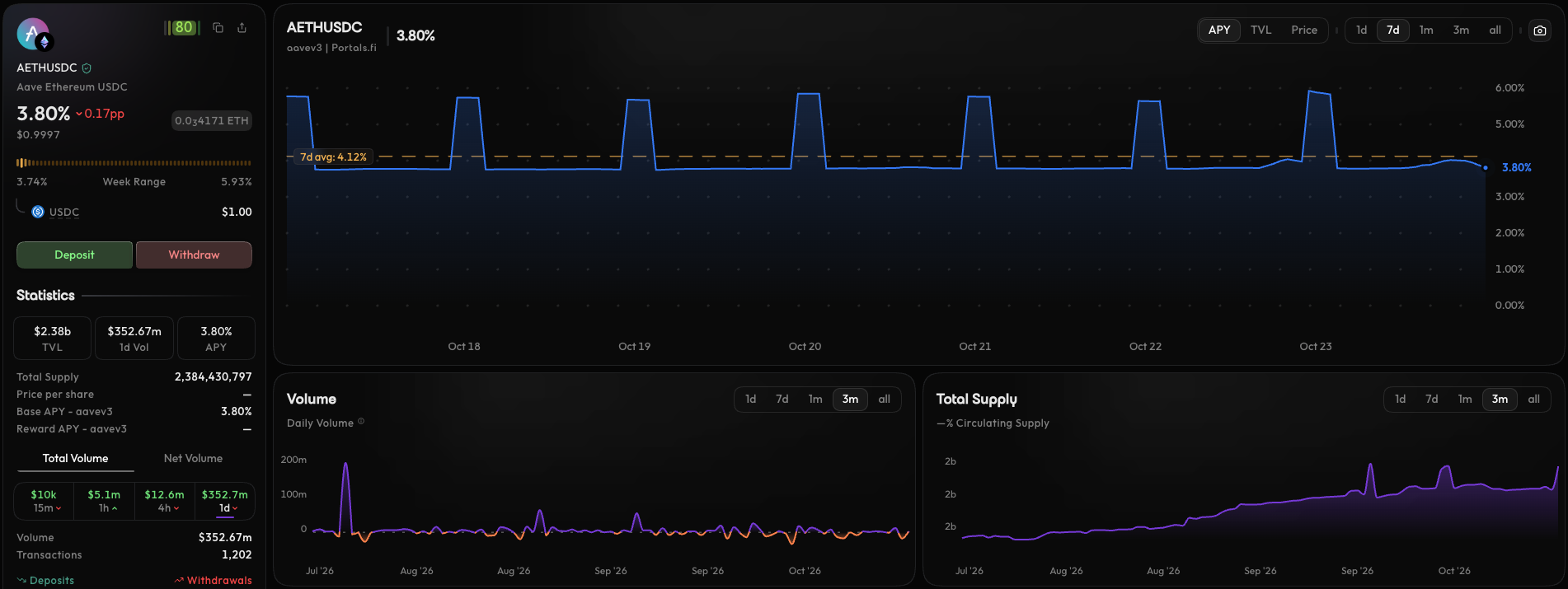
The observed rate was below the 4.12% seven-day average and is a variable base rate. Aave V3 uses overcollateralization, oracle pricing, health factors, and liquidations, so relevant considerations include USDC, protocol and smart-contract risk, governance-managed risk parameters, borrower demand, and the available pool liquidity at withdrawal time.
5. Morpho RLUSD / WBTC (Ethereum)
Morpho RLUSD / WBTC on Ethereum is offering a 3.63% APY with $26.38M in TVL. It is an isolated market in which lenders supply RLUSD against WBTC collateral.
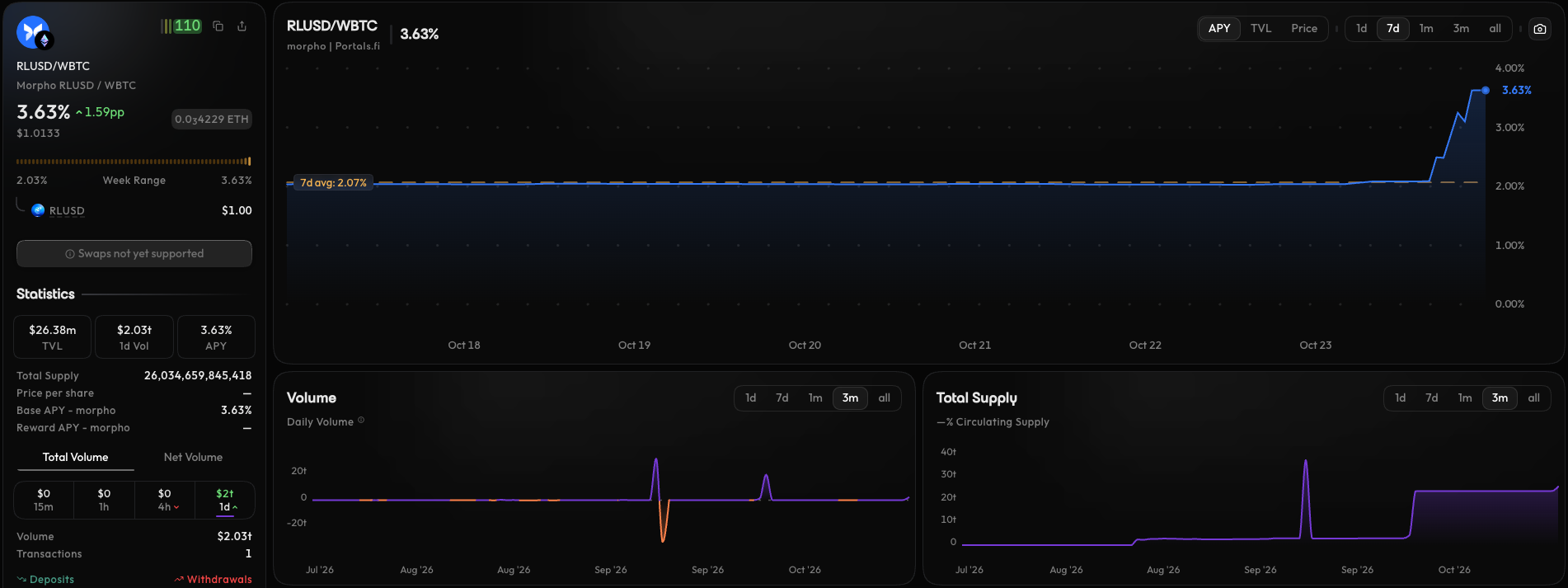
The live rate was above the 2.07% seven-day average and reflects a variable Morpho base APY. Lenders should consider RLUSD issuer exposure, WBTC custodian and bridge exposure, BTC price moves, oracle and liquidation design, Morpho contracts, isolated-market parameters, and available liquidity rather than treating the displayed rate as a promise.
Explore Tokenized Stocks on Base on Portals
The Portals and Base campaign brings tokenized stocks and the DeFi opportunities they power into one interface.
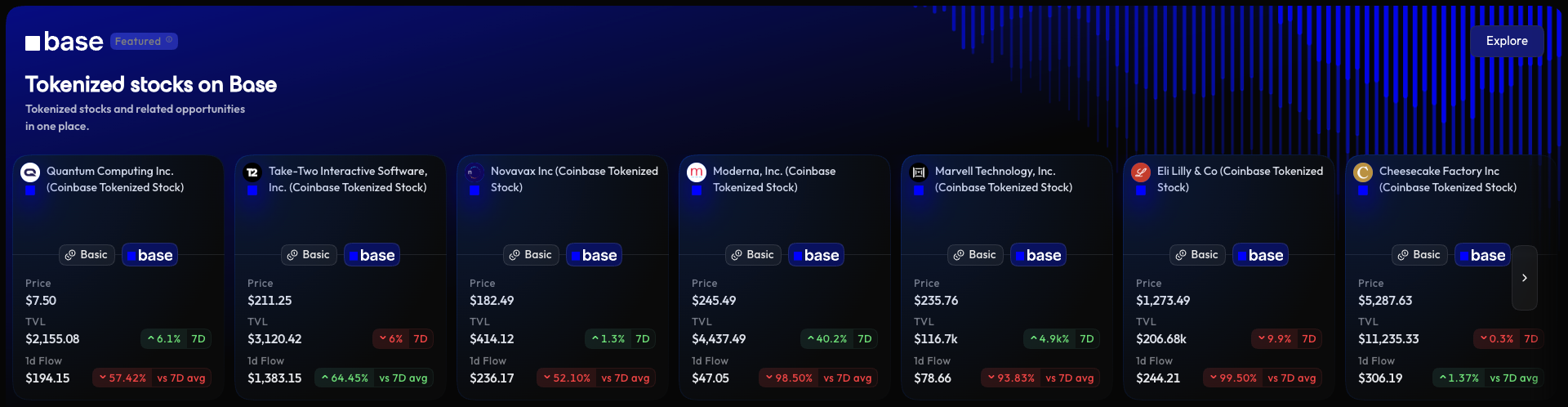
A tokenized asset, its strategy wrapper, and a lending market are separate layers. Each can introduce issuer, eligibility, liquidity, pricing, oracle, contract, and redemption considerations.
Discover Base Tokenized Stocks on Portals
DeFi News
Aero Goes Live After Aerodrome and Velodrome Combination
Aero’s migration guide says the Aerodrome and Velodrome combination opened at 00:00 UTC on 22 October. The new onchain spot exchange spans Ethereum, Base, Robinhood Chain, Ink, OP Mainnet, Arc, and Arbitrum, while existing AERO and VELO migrate to AERO and veAERO and veVELO convert to sAERO.
The launch is live, though holders and liquidity participants need to review the migration mechanics and any applicable chain-specific conditions. This is an operational transition rather than an assurance about token value, rewards, liquidity, or execution quality.
OCC Finalizes GENIUS Act Rule for Payment-Stablecoin Issuers
The Office of the Comptroller of the Currency issued its final implementing rule for permitted payment-stablecoin issuers and foreign issuers under OCC jurisdiction. It addresses issuance and redemption, reserve assets, risk management, custody, licensing, capital, reporting, and supervision.
The rule is final but does not take effect until 18 January 2027. BSA, AML, and OFAC provisions remain subject to separate rulemaking, so this is a meaningful regulatory milestone rather than a complete operational rulebook for every stablecoin arrangement.
J.P. Morgan Asset Management Expands Tokenized Funds to Solana
J.P. Morgan Asset Management announced that its MONY and JLTXX tokenized money-market funds became available through Morgan Money on Solana for qualified U.S. investors. MONY is a 506(c) private-placement fund, while JLTXX is a U.S.-registered government money-market fund.
The announcement describes access for a defined investor group, not a general DeFi lending integration or open retail availability. Eligibility, distribution terms, transfer restrictions, and the fund documents still define the usable product boundary.
Initia Halts L1 and Rollups Following a Security Incident
Initia said it halted its Layer 1 and rollups on 23 October because of a security incident. Reports described an apparent unlimited-mint exploit and an estimated $2.6M to $2.7M outflow, though the project had not confirmed a final loss or released a completed post-mortem at the publication cutoff.
The correct current status is an incident disclosure with the network halted and an investigation underway.
OpenZeppelin Adds Chainlink Components to Developer Tooling
OpenZeppelin announced a strategic partnership with Chainlink. CCIP and ACE configuration are available in OpenZeppelin Wizards, AI tooling, Skills, and documentation, with UI Builder support and institutional reference solutions listed as upcoming.
The integration gives developers a clearer route to configure cross-chain token compatibility and programmable controls such as sanctions screening, KYC checks, volume limits, and Secure Mint.
Chain Performance Analysis
Ethereum held $49.64B in DeFi TVL, equal to 55.0% of the aggregate DeFi total, after a 0.98% weekly decline. Its scale remains the largest foundation for lending, liquid staking, stablecoin liquidity, and vault infrastructure.
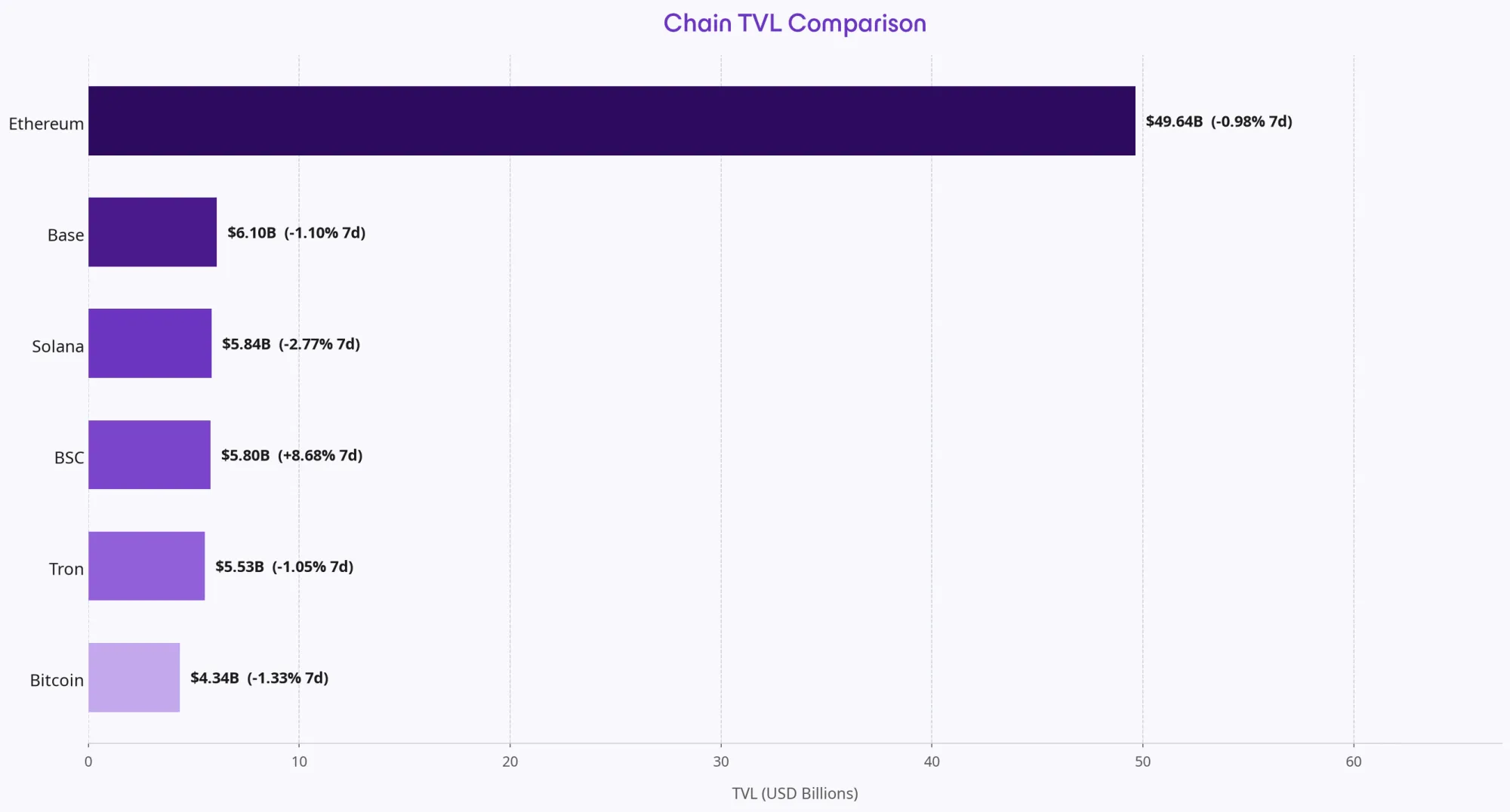
Base held $6.10B after a 1.10% weekly decrease, ahead of Solana at $5.84B, BSC at $5.80B, Tron at $5.53B, and Bitcoin at $4.34B. BSC was the only positive mover in the six-chain comparison, rising 8.68%, while Solana had the largest weekly decrease at 2.77%.
These figures are aggregate capital observations, not direct measures of executable depth, price impact, withdrawal capacity, or user activity.
The Base tokenized-stocks campaign is a specific category within Base and should not be treated as a standalone explanation for the chain’s aggregate weekly movement.
Top DeFi Protocols
Lido remained the largest protocol family at $23.17B, followed by Aave V3 at $16.89B and Morpho Blue at $11.20B. The distribution keeps liquid staking and lending at the center of the leading tracked protocol balances.
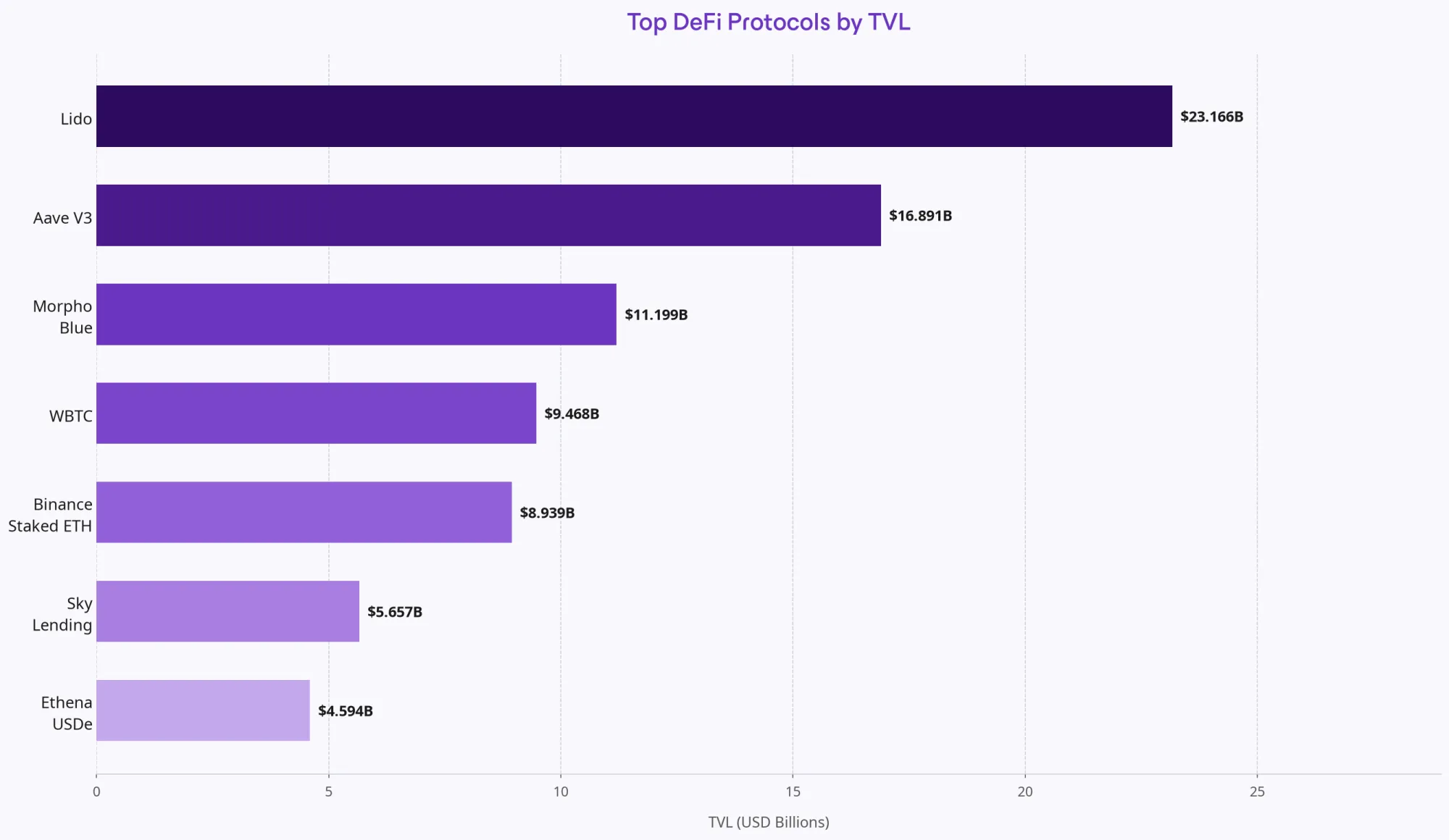
WBTC held $9.47B, Binance Staked ETH held $8.94B, Sky Lending held $5.66B, and Ethena USDe held $4.59B.
These protocol families have different collateral, redemption, governance, counterparty, and operating models, so TVL compares scale rather than risk, revenue, liquidity quality, or suitability for a particular user.
Looking Ahead
Aero Migration Execution
The first post-launch checkpoint for Aero is the migration experience for existing AERO, VELO, veAERO, and veVELO holders and liquidity participants.
Users should verify the applicable upgrade path before acting and monitor official product communication for chain-specific changes.
Stablecoin Rule Implementation
The OCC rule’s 18 January 2027 effective date creates a defined implementation window for affected payment-stablecoin issuers under OCC jurisdiction.
Future clarity will depend on the remaining separate BSA, AML, and OFAC rulemakings as well as issuer-specific execution.
Initia Remediation and Onchain-Finance Tooling
Initia’s post-mortem, remediation plan, and restart details are the next facts to watch after the network halt.
In parallel, developers can evaluate which currently live OpenZeppelin and Chainlink tooling components fit their own access-control, cross-chain, and compliance design requirements.
Read last week’s edition: DeFi Weekly October 2026 Week 3: Interactive Brokers Staking
About portals.fi: Portals is the DeFi Super App. A one-click gateway to the entire onchain economy. Powered by real-time data and seamless execution, Portals connects traders to over 20 million assets, thousands of protocols, and every major blockchain.
Disclaimer: The content of this newsletter is for informational purposes only. It is not investment advice. Please do your own research and consult with a qualified financial advisor before making any investment decisions. DeFi investments carry significant risks, and past performance does not guarantee future results. More details here.
Portals.fi Blog Newsletter
Join the newsletter to receive the latest updates in your inbox.